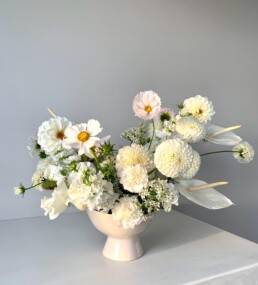
More than just Daisies - Vidette's Little Flower Shop
Did you know that we have a real life, actual floral boutique hiding in the nether streets of Cape St Francis? Having heard about the Little Flower Shop from its satisfied customers and been blown away (‘scuse the pun) by its stunning creations we decided to track down the owner, Vidette Jorge. She was only too happy to share her thoughts on blooms, business savvy and beautiful bouquets with Dune Daisies.
DD: Hi Vidette, it’s so lovely to have you with us, sitting in the Dune Daisies HQ today. How did the Little Flower Shop start, what was your motivation?
VIDETTE: Well, the Little Flower Shop launched a couple of years ago, on Spring Day (1st September 2021). It is a bespoke florist located in Cape St Francis that specialises in whimsical, sustainable creations for a range of events, weddings, celebrations, as well as private clients. The seed of the Little Flower Shop was planted whilst I was living in Ballito. There was this empty, dead space in our local mall which I thought would be the perfect place for a small flower shop. It would brighten up the area and offer beautiful, ecologically sustainable flowers to its customers.
However, real life took over this idea and the mall space remained empty. Then post Covid, I was chatting with a friend on how to do something more for myself and to explore hobbies that could become a profitable business. It had to be something creative. And my friend mentioned flowers, which reminded me of my ‘flower shop dream’ – and the flower idea took shape. The fully developed business as it is today took a lot of hard work, late nights and determination.

DD: Where do you get your flowers from?
VIDETTE: My flowers used to be sourced from the W Cape, but now, with a firm eye on carbon footprint and sustainability, I prefer to keep it local and seasonal. I do get the odd request for an event display that requires overseas sourcing, but local is definitely preferable. The Little Flower Shop offers unstructured styles of seasonal, local flowers – with the final bouquets mimicking the movement and diversity of wildflower groves. Dyed, artificial flowers are not that welcome in my shop.
DD: Who buys your creations?
VIDETTE: Lots of my clients are from overseas. They contact me to buy for local St Francis Bayers – for baby showers, work events, birthday and anniversary celebrations and of course weddings. My local client base is also growing every day.
DD: How can your clients make the most of your flowers?
VIDETTE: Flowers have different life expectancies depending on where they are grown, what their growing conditions were, how they were harvested and how well they are looked after. So I would say the life expectancy is anywhere from 4 days to 3 weeks. Dahlias last only 4-7 days.
I would keep your flowers in a cool, not too bright area, change their water every 2nd day to stop bacteria growing, have no leaves in the water and every time you change the water, cut off the bottom stems in an angle.
DD: What makes you want to spring out of bed in the morning and start flower arranging?
VIDETTE: My absolute best-thing is the deliveries! Watching people’s reactions is just amazing. It is the whole feeling that goes with someone receiving a bouquet of flowers – even if it is for a sad occasion. It is really such a boost for me. Some people hug me, some cry – it is the best part and totally makes my day.
DD: When do you have to breathe deeply and dig even deeply-er?
VIDETTE: The hardest part for me is people not being educated on flowers, and on how much they actually cost. People don’t realise the time and effort in creating the final product. It’s not mass produced; the growing, cutting, it is all hand done. Some bulbs planted into the ground now will only be ready in a year’s time! And when dealing with local suppliers, they put in such a lot of effort and it is really hard to decide what value to put on that. And of course the final cost is also dependent on what type of flower my clients choose. I offer luxurious and premium blooms, that are fragile and not hardy.

DD: What is the most important thing you have learnt since starting your business?
VIDETTE: One of the biggest take home messages I can share with you is the need to be flexible. The flower business is one beset by many environmental challenges, from rot to flooding, to drought and pests. Many hoops need to be jumped through before the flowers arrive at my workshop – I often have to work from plan ‘A’ right through to ‘F’! I have learnt not to promise too many specific flowers to my customers, to avoid disappointment.
These flowers don’t just grow, harvest, transport, wrap and deliver themselves.
DD: Any tips for those wishing to start their own small business?
VIDETTE: This journey has been a HUGE learning curve for me. I have had to learn more about business and self-development than the actual flowers. Mind-set is the key. You have to work on your mindset, believe in that you are doing, don’t worry about what everyone else is doing, don’t compete and really, just believe in yourself. That, and business skills. Network and take courses to learn as much as you can. I have also learnt such a lot from the wider, international, floral community and have met such cool people online, from places as far away as Australia and the USA.
It is important to remember that you are supplying not only product, but you are also providing a service to the community.

DD: Can you share your flower of the month?
VIDETTE: It is difficult as the seasons are changing and we are now moving into autumn. I would choose Scabiosa or cosmos – but they are also coming to the end of their season.
DD: If you could name your favourite flower and colour, what would they be?
VIDETTE: I have no favourite flower or colour! I definitely like more ‘airy’ flowers, peonies or speciality garden roses. If I had to choose a bouquet for myself, it would look like a wild field. Some flowers blowing in the wind, heavier ones down below – just how nature intended. I would love my perfect bouquet to showcase the whole life cycle of the flower – from it being in bud, to full bloom, and then also including the browner, drier elements. Bouquets should include flowers not only in their full bloom.
I love all the seasons of a flower.
DD: What should our readers consider when choosing a florist?

Find your Daisy:
- Cell: +27 (82) 695-4421
- Insta: the.little.flower.shop.za
- Email: hello@thelittleflowershop.co.za
- https://www.thelittleflowershop.co.za
“Happiness is to hold flowers in both hands”
Japanese proverb
Dig Deeper
- Tulips were once more valuable than gold! In 17th century Holland, a single bulb could cost $2000 – “Tulip Mania”
- Floriography is the use of flowers to communicate. This language of flowers dates thousands of year across diverse culture.
- Flowers have been part of wedding ceremonies dating back to Greek and Roman civilizations, but the bouquet toss originates from England in the 1800.
- The Rhizanthella orchid that grows in Australia blooms underground. It is pollinated not by bees, but by beetles.
- The white lotus is the only plant to fruit and flower simultaneously.
See Lucy’s Flowers & Sow Small Garden to dig even deeper


Know your Daisy
- Born in Joburg
- Moved to St Francis in 2015
- Has two children
- Owns a Basset Hound and a Green Cheek Conure
- Favourite places are the Cape St Francis beach and the Wildside
“To me, flowers are happiness.”
Stephano Gabbana
VIDETTE: Find someone you trust, who’s product you love. Remember that you are dealing with a creator; make sure you have seen their previous work. The vision you have in mind for your final product must align with that creation. So choose wisely.
DD: Lastly, what do you love about living and working in this area?
VIDETTE: It is a truly amazing community. I love that people stick together and help each other. Everyone is there for each other. You don’t get that in cities and bigger villages.


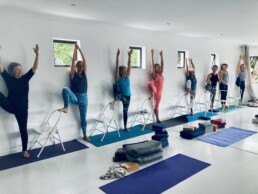
Blissful Daisies - Sharon and Iyengar Yoga
Not too long ago, I was looking for an original birthday present for a friend. Inspired by the impressive number of yoga teachers in our community and the whole peaceful, earthy vibe in St Francis, I bought a bunch of yoga classes for us to do together. Explaining that we were both beginners, I was directed towards Sharon van Niekerk’s classes as she describes the poses in detail and uses props to help coax your body into position. This sounded perfect as I doubted that I could even touch my toes at that point. I am not sure when it went from being painful to something I couldn’t do without, but Sharon’s class has been life-changing for me.
DD: Have you got any advice to anybody that would like to start yoga?
SHARON: Be consistent. If you’ve never done it before and you are not naturally a flexible person, it’s not going to be easy. It’s not a quick fix. The discipline is what comes.
Discipline your body, discipline your mind, and you will have the results that you are looking for.
My yoga teacher, David, used to joke and say that when new people want to come to class, he asks them to get down on the floor, and then get up. If you can’t get up off the floor, you should find a class that does chair yoga.
DD: Do you think your class would be suitable for a beginner?
SHARON: Yes, but only if you’re in good shape. Obviously, if you are somebody who has been sedentary for a long time, an older person, or are not naturally flexible, you will struggle.
DD: What motivates people to start doing yoga?
SHARON: Usually because they feel old age starting to creep up on them. Maybe they feel stiff and parts of their body are in pain; it is very rarely for spiritual reasons. However, people also want to start yoga because their mental state is a little bit out of whack, and they want to feel calm.

Iyengar Yoga with Sharon
Monday: 8.15-9.45 (186 St Francis Drive)
Wednesday: 8.15-9.45 (186 St Francis Drive)
Thursday: 8-9.30 (The Pound)
Saturday: 8.15-9.45 (The Dance Studio – Village)

DD: Why Iyengar Yoga and how is it different to other styles of yoga?
SHARON: When I started yoga in the 90’s in Cape Town, it wasn’t as big as it is now, but everybody raved about this guy, David Jacobs, and he was an Iyengar teacher. When I started with him, I realised that it was quite scientific and that appealed to me.
There has to be a reason and a benefit in doing something.
For example, why must I stand on my head? Because it is putting pressure on the crown of the head which creates activation of the pituitary and pineal gland, two important hormonal glands. Pineal is also connected to the third eye – there’s a lot of info one can go into. Generally, beginners aren’t really interested in all of that, but the more advanced you become, the more you understand.
From a physical perspective, why do you do head balance? Because turning upside down flushes fresh blood into all the organs, it works your shoulders, it works the spinal extension and gives you a good stretch. There are also spiritual and mental benefits. So, that’s what appeals to me about Iyengar.
DD: I read that he was very close to Yehudi Menuhin who said that Iyengar was his best violin teacher.
SHARON: Yes, he did yoga with Iyengar for many years and their association probably helped make Iyengar Yoga so popular in the West. Sivananda and Pattabhi Jois (Ashtanga) Yoga also had many followers. I like to call these yogis the Classicists.
Classical Yoga appeals to me because they have thousands of years of knowledge, they’ve got the text. Iyengar translated many books, wrote books himself and taught around the world. He was a seriously intelligent man. I watched a lot of his videos and there was something about him that really clicked with me. If you have the option, you should find a teacher that you click with because that will make you more consistent.
DD: And what about the props? Was that his idea too?
SHARON: Yes, that’s one of the things that makes Iyengar Yoga different. He was a very sickly child from a very poor background. He had tuberculosis and was a skinny little guy. On one of his school holidays he was sent to his sister who was married to Krishnamacharya who was the godfather of their lineage. He said, if you want to do yoga, just do it. So, he wasn’t given much instruction and just started. He soon realised how good it made him feel and as he improved, he was asked to demonstrate his skills. This was often before royalty or other dignitaries as a form of entertainment or spectacle to show what the incredible things his body could do. Eventually he started helping others get the poses. This made him think that there are others who might be weak or sick and suggested they use a wall or a block to make the posture easier.
Having said this, if you have a look at his book, Light on Yoga, you will see he didn’t use any props. I don’t force anyone who doesn’t need a prop to use one. Of course, everything is always changing and is not static. Over the years they found that if you do shoulder balance flat on the floor all the time, depending on the shape of your neck, you can hurt your neck. That’s why I insist on using props for this pose. Using props also involves humility, realising your own limitations and what your body is able to do and isn’t.

Facts about Sharon
Lives in Cape St Francis
Has two dogs
Owns a landscaping business
Studied Fine Art and Horticulture
Completed 3 years of Iyengar Teacher Training

DD: Do you have a favorite pose?
SHARON: Shoulder balance. It didn’t come easily to me when I started, but now it’s so valuable. When I had my cataract surgery and couldn’t do inversions for two weeks, I really felt the difference. It’s actually called Sarvangasana, meaning ‘all limbs’. When you are upside down your muscles are working against gravity, your organs are getting a rest, especially the heart. When you finish the inversion the organs get fresh blood. Also, the pressure of the chin into the thyroid gland stabilises your metabolism – these are some of the physiological benefits. From a mental point of view, it quietens your mind. It is given for respiratory problems, because when you are upside down the diaphragm has to push up against the gut and the intestines, so it tones the diaphragm and makes it strong. It also reaches different parts of your lungs when you are upside down. That’s why consistency is so important. At first it is hard and then with time it becomes easier. Then you start to see the other benefits.
DD: I like how you correct us in the classes. You are constantly manipulating our bodies to nudge them into the right position.
SHARON: That is called adjusting and another trait of Iyengar Yoga. There is always someone in the class doing this, not necessarily the teacher. One of the reasons I think Mr. Iyengar was such a guru was because when he adjusted someone in his class, you could see the whole body just fall into place. Almost like an electric shock. That was his gift – the ability to use the finest touch to put you in position and be sensitive.
DD: If you couldn’t do yoga, what else would you do?
SHARON: I would like to swim beautifully and do capoeira or parkour.


