
Grandpa's Daily Dozen
Grandpa’s Daily Dozen
The other day, I was going through an old suitcase my mom had given me and in amongst all my grandfather’s legal documents, I found an article entitled “Grandpa’s Daily Dozen.” It was such a treat to find these instructions, painstakingly typed on an old typewriter, on his personal routine for staying fit and active. To think he took the time to write it all down, seemingly for us, his grandchildren, makes them even more special. The exercises are really simple and I can see how they would keep you mobile and flexible. I love that a face massage is included halfway through the workout!
I’m sure he wouldn’t mind me sharing his thoughts…
Introduction
These exercises aren’t designed to develop muscle, but rather to keep the muscles you already might already possess in gentle use for a brief period daily. Do them after your normal ablutions (which should be as cool as you can bear them (whether shower or bath) – and they’ll lift your aches, stir your enthusiasm, and give you that sense of satisfaction and well-being that makes you agree, “This is the day which the Lord has made.”
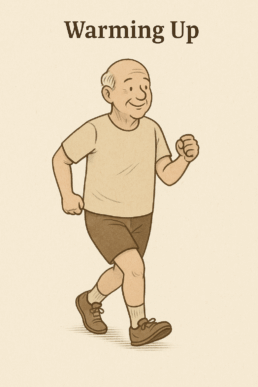
1. Warming Up
Suitably clad – shorts, with or without a vest in summer, or a tracksuit in winter – run lightly around the available space, or on the spot, for several minutes.
2. Knees
- Squats: From an upright position, sink down to your haunches and rise again, repeating the movement for ten full, deep breaths. If you feel unsteady, rest your hands lightly on a chair or some other firm support.
- Kicks: Stand upright and kick your legs loosely from the knees down, as though you were kicking a football. Kick each leg alternately for ten breaths in total. This loosens the leg muscles.
3. Shoulders
Shoulder rolls: Stand upright and circle your arms from the shoulders, reaching as high as possible. Rotate forward for ten revolutions, taking ten full breaths. Repeat the exercise in reverse.
4. Waist
Stand with legs apart and torso bent forward, with straight arms, swing your body from left to right, touching your left toe with your right hand and your right toe with your left hand. Take ten slow breaths as you repeat this movement slowly.
5. Body Swings
- ACROSS: Stand erect with your arms extended above your head, fingers interlocked. Rotate your extended arms in a circular manner, moving your waist. Do ten breaths in one direction and ten in the other.
- UP & DOWN: Now, still with your fingers interlocked and arms straight, swing forward from upright to touch your toes, keeping your legs straight and together. Lift your body back to vertical and repeat for ten full breaths.
- THROUGH: Repeat with your legs apart, swinging your arms through between your legs – again for ten breaths. Conclude with five rapid up-and-down movements, breathing naturally.
5. Neck and Upper-Body Exercises
- Stand erect with your feet braced and arms at your sides. Rotate your upper body sideways by moving your bent arms in a wide arc over your head. When moving to the left, your right arm – bent at the elbow – extends over your head so the fingers of your right hand touch your left shoulder. Repeat in the opposite direction and continue for ten breaths.
- Then, clench your fists and repeat the movement, bringing your right clenched fist into contact with your right armpit, and alternate sides. Finally, with arms bent at shoulder height and fists in front of your chest, rotate your body from the waist left and right in ten quick movements, breathing evenly.
- Punching bag: While standing erect move the arms forward and backwards as if punching a punching bag. The movements should be rapid and the breathing steady for ten breaths.
- Swimming: Move arms in a circular motion in an overarm swimming stroke rapidly for ten breaths.
8. Neck Muscles
- NO: Stand upright with your hands on your hips. Turn your head slowly to the right as far as you can, then to the left, keeping the motion steady.
- NOD: Next, lift your head upwards towards the ceiling, then lower it towards the floor – again to your fullest comfortable extent. Perform each movement firmly and breathe deeply for ten breaths.
- ROTATE: Rotate your head in a slow circular motion – first clockwise, then anti-clockwise – for ten breaths.
- NO NO NO: Repeat the side-to-side motion more briskly, as rapidly as feels comfortable. If you experience dizziness or strain, slow down or discontinue, especially if you are of advancing years.
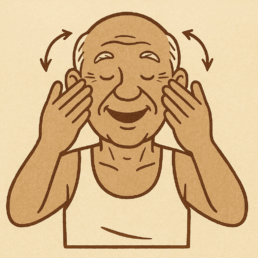
NOW FOR A MASSAGE….
Follow these exercises with a strong hand massage of the neck and some facial muscle work – grimacing, widening the mouth, and flexing the cheeks. Massage the skin from underneath the chin to the top of the head. Massage the temples and eye sockets gently. Rub the back of the head to the top of the spine. Move the head backwards against the pressure of a finger places against each segment of the spine between the shoulders and the back of the head.
“The rubbing movements conclude the standing exercises and should be done without fail. Your complexion will respond favorably.”
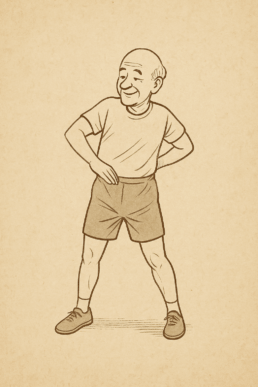
FLOOR Exercises
9. Legs and Lower Back Work
- Lie on your stomach on the floor with your toes dug into the floormat. Tense the toes and lift the weight of your legs on your toes. Move the weight of your toes backwards and forwards, so stretching all the joints of the all the toes, and exercising the ankles. Repeat during ten breaths.
- Lie on your back with legs extended and weight on your heels. Lift your lumbar region off the floor and extend as high as possible. “Initially this might give a degree of discomfort, but should be persisted with until you are able to do ten breaths.”
- Now do the same, but with your legs bent and heels upon the mat. Lift your lumbar as far as possible, placing strain on both your hips and lower back. “Initial discomfort may occur but will ultimately give relief to a most important region of your body.” Hold for ten breaths.
10. Hip Rotations
Lie on back with legs extended and heels on the carpet. Rotate both legs in a wide circular motion about the hips. Do the motions slowly to accommodate ten full breaths. Reverse the direction.
11. Stomach Work
- Still lying down, lift legs one by one from the floor to 90 degrees above it, repeat for ten breaths on each leg.
- In the same position, relax knee joints and cycle for ten breaths.
- Now, while lying down lift both legs straight up simultaneously and attempt to touch your chin with your knees. Kick back to the original position. Repeat for ten breaths – use the final movement to sit upright.
12. Flexibility
Widen legs and swing arms to touch your toes with alternate hands involving vigorous swinging of the upper body. Repeat for ten breaths.
The Importance of Breathing
The repetition ad-nauseum of the phrase “ten breaths” is not arbitrary. It serves to emphasise the importance of breathing itself rather than the number of movements. Breathing is, indeed, the one exercise without which life would be impossible; it has no peer. In conjunction with body movements in the forms indicated, “breathing” will ensure freedom from the majority of physical malfunctions for which medical intervention is often unavoidable.
The secret: Breathe fully – and add to your lifespan.

Bach & 4th hosts Take Four in Cape St Francis
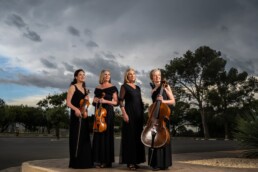
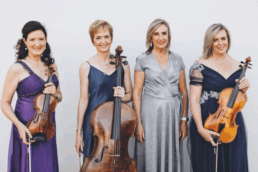
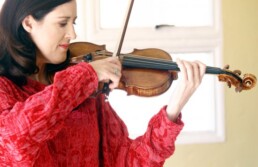
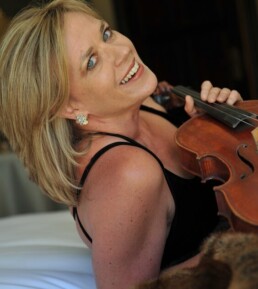
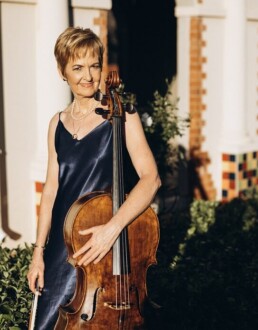
This Saturday, St. Francis will be graced by the enchanting sounds of the piano quartet, Take Four, as they perform in an intimate house concert, part of the Bach & 4th Concert Series. This exceptional ensemble features four world-class musicians: Zanta Hofmeyr (violin), Jeanne-Louise Moolman (viola), Susan Mouton (cello), and Elna van der Merwe (piano). They will present a captivating program that includes masterpieces by Mozart and Fauré.
It is a rare privilege to witness such talented musicians in our town, especially in such a cosy setting. To make the most of this unique opportunity, we seized the chance to delve deeper into the lives of these remarkable artists and explore the secrets behind their success in the music world.
Inspiration and Beginnings
“Music was never just a choice; it was a calling,”
reflects Zanta, the talented violinist from the Take Four Piano Quartet.
Each member of this dynamic ensemble has a unique journey that led them to a life of music, yet they all share a common thread of passion and dedication.
Growing up in a household where music was as essential as air, Zanta’s path seemed predestined. With parents who are both accomplished musicians still practising two to three hours a day at ages 87 and 90, her love for music blossomed early. At fifteen, a scholarship to the Interlochen Music Festival in Michigan marked her “aha” moment, where she realised that a life immersed in music was her true happiness. “It was there that I felt the joy of being part of something bigger than myself,” she shares.
For Elna, music was woven into the fabric of her childhood in Ladysmith, KwaZulu-Natal. Introduced to the piano by her grandmother at just three years old, she was nurtured by her mother, a piano teacher. “In a small town, there wasn’t much else to do, so I played the piano instead of helping in the kitchen,” Elna laughs. Her natural affinity for music led her to accompany the Natal Youth Choir and eventually study at Stellenbosch University.
Susan’s love for the cello has been a constant in her life. “Choosing to study music was an obvious choice for me,” she says, her dedication evident in her daily practice and joy in collaborating with fellow musicians. “Every note I play feels like a conversation with the audience.”
Jeanne-Louise’s musical journey began with a family violin, a cherished gift from her uncle and aunt. “My first orchestral course at eight ignited a lifelong passion for music,” she recalls, her eyes sparkling with nostalgia. “I’ve been captivated ever since.”
Daily Life and Practice
“Playing an instrument is much like any other sport – you can’t run a marathon or even a 100m sprint if you don’t practice every day.” Zanta
The life of a musician is a blend of discipline, creativity, and a touch of humour. Each member of the Take Four Quartet has a unique approach to their daily practice.
Zanta likens her practice to athletic training, emphasising the importance of warming up to prevent injury. “If you can play one of Bach’s solo violin sonatas well, you know you’re fit,” she asserts, dedicating three to five hours daily to perfect her technique.
As a mother and grandmother, Elna juggles family life with her role as a part-time accompanist at Stellenbosch University. “I focus on mental preparation for performances,” she explains, her quick learning ability allowing her to maintain a vast repertoire.
\Susan starts her day with scale practice, honing her sound and intonation. “It sets the foundation for everything else,” she notes, making her practice more fluid and enjoyable.
Jeanne-Louise balances daily teaching and practice with preparing for various performances, ensuring she’s always ready to shine with Take Four or her other ensembles.
Collaboration and Creativity
As old friends who love and respect each other, the Take Four Quartet is always “on the same page.” Surprisingly, they can’t remember ever disagreeing on anything.
Zanta describes performing in a chamber music setting as a wonderful experience where every member has a voice. “It’s a beautiful blend of individual expression and collective harmony,” she says.
Elna appreciates the quartet’s close friendship and lack of egos, fostering a conflict-free environment. “We’re unified in our goal of touching people’s hearts through our performances,” she shares.
“Working with the quartet is a dream come true,” says Susan, highlighting their shared musical interpretations and personal connections that make every performance special.
Jeanne-Louise values musical expression over verbal discussion, adapting her playing to harmonise within the group. “Listening and blending seamlessly is key,” she adds.
Memorable Performances
Every performance is an opportunity for magic, and the Take Four Quartet has had its share of unforgettable moments, the most recent being their performance in Malta, where the stunning cathedral and its acoustics created a magical atmosphere.
For Zanta, the pinnacle of her career was her debut recital at Carnegie Hall where she played for an amazing audience in a magnificent setting.
Some performances, however, are memorable for different reasons.
Zanta recalls a particularly chaotic orchestral concert. “The conductor was late, and by the time he arrived, the concert was already running twenty minutes behind schedule,” she chuckles. “He rushed on stage, buttoning his coat, and started the first movement of my concerto at half the normal tempo! I tried to speed it up, but he was determined to maintain his pace. It was a nightmare, but I survived!” Her laughter echoes the resilience and adaptability that musicians often need.
Audience Connection
“I love it when the audience feels what we feel.” Jeanne-Louise
The Take Four Quartet thrives on sharing their music with the audience, and feeling their reactions is the ultimate reward.
Zanta hopes her performances can change the audience’s energy and mood. “Music is a transcendental art; it lifts us out of our physical experience to a different sphere,” she explains. “I believe it channels emotions that we often can’t put into words.”
Elna finds immense satisfaction in knowing their music touches people’s hearts. “Every performance is meaningful when you see the impact it has on the audience,” she says, her eyes shining with purpose.
Susan appreciates the shared experience with the audience, feeling fortunate to make music with people who matter both personally and musically. “You can feel the electricity in the room when the audience is engaged,” she notes.
Jeanne-Louise adds, “When the audience senses the trust and communication within our group, it enhances their experience. It’s a beautiful cycle of connection.”
Balancing Act: Life Beyond Music
“I have learned to take good care of myself” Zanta shares, “there were times when I was younger when I suffered from not maintaining balance in my life.” Her routine includes consistent sleep patterns, morning exercises, and a disciplined diet. Tai chi, which she has practised for 31 years, is a cornerstone of her self-care, providing energy and tranquillity. “It changes my energy,” she says, highlighting its transformative power.
Elna emphasises the importance of balance, a lesson she has imparted to her daughters. She is not only a musician but also a cook, an avid gardener and manages to walk about ten kilometres a day. “You have to really be able to be organised,” she advises, underscoring the need for focus and preparation in her musical endeavours.
Susan acknowledges the challenges of being away from family but feels fortunate to have a supportive partner. “We are all extremely fortunate in having partners who understand,” she notes, highlighting the importance of a strong support system.
For Jeanne-Louise, being married to a fellow musician aids in maintaining self-care. “It is demanding, but I enjoy making music,” she reflects, appreciating the shared understanding and passion for music in her relationship.
The quartet members candidly discuss the hurdles they face, from the daily discipline of practice, the logistics of travel with expensive and large instruments, to financial constraints.
“The biggest challenge as a musician is to do the basic work every day,” they agree, emphasising the need for self-discipline and perseverance.
The financial implications of being a musician in South Africa are a real challenge, and many musicians work themselves to death trying to earn enough money. Managing schedules and finances is a constant challenge for Jeanne-Louise. “You always have to be prepared and in shape with your instrument,” she advises, stressing the importance of readiness and adaptability.
“Even though the amount of time spent rehearsing and preparing for a concert is comparable, if not more intense, Classical musicians receive a small fraction of what popular musicians earn,” remarks Zanta.
Elna draws inspiration from Malcolm Gladwell’s book *Outliers*, emphasising the importance of dedication. “You have to be so dedicated and spend at least 10,000 hours on your instrument to become a master,” she explains. “Talent only makes up about 40% of your success – the rest is being hard-working. Persevere every day, not just some days, but every day.” Elna also highlights the value of entrepreneurial skills, which can provide financial stability alongside a performing career.
“If music is your passion, then you must truly follow that path!” Susan encourages. Her advice is simple yet profound, reminding aspiring musicians to stay true to their dreams and let their passion guide them.
Elna finds joy in bringing classical music to intimate settings. “House concerts enable people who often don’t normally go to concerts to see a specialist perform on their instrument up close,” she says. “You don’t really even have to like the music, but it’s wonderful to experience the intimacy and closeness in this setup.” For Elna, the emotional connection fostered through music is deeply rewarding. “It feels good to know you can move people and inspire them through music,” she shares.
For Susan, classical music is a powerful means of expressing emotions. “It is fantastic when one feels that the audience is able to understand and experience the music with us,” she notes. Her words capture the magic of live performance, where musicians and audiences share a profound emotional journey.
To wrap up, here are some fun and quirky facts about the quartet members:
Zanta: She always eats a boiled egg before a performance for energy.
Elna: She embraces her dual life as a musician and a “boer vrou” on her farm in the Karoo.
Susan: Despite traveling with a cello, she also manages to accommodate her two Great Danes in her Honda Jazz.
Advice for Aspiring Musicians: Insights from the Take Four Piano Quartet
Embarking on a musical journey is both exhilarating and challenging. The Take Four Piano Quartet, with their wealth of experience and passion, offers invaluable advice for young musicians. Their insights emphasise dedication, resilience, and the joy of pursuing one’s passion.
“Only become a musician if there is absolutely nothing else you want to do,” Zanta advises. Her words underscore the importance of passion and commitment in a musician’s life. For Zanta, music is not just a career; it’s a calling that requires unwavering dedication.
Jeanne-Louise emphasises the importance of gaining experience early on. “Work hard when you are young. Get experience because this is something you cannot buy at the shop,” she advises. Her words highlight the irreplaceable value of hands-on learning and the growth that comes from it.
Classical Music Today: Cultural Relevance and Emotional Connection
Classical music holds a timeless place in our world, offering both cultural richness and emotional depth. The members of the Take Four Piano Quartet share their perspectives on its enduring relevance.
“Classical music plays a role in different spheres,” Zanta explains, noting its impact on child development and its soothing qualities for adults. “It represents a vast range of history, starting in the Middle Ages and spanning to now. You can spend your lifetime listening to different music from various periods. It’s an art form that develops inside of you the more you listen to it. A certain piece grows on you the more you listen to it, and that’s the value of classical music.”
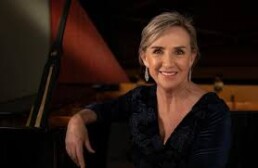
The Take Four Piano Quartet is a remarkable ensemble, each member bringing their unique experiences and insights to the world of classical music. Their stories inspire and resonate, offering a deeper understanding of the dedication and passion that fuel their art.

Just Property Celebrates the Soul of St Francis Bay
A fresh and innovative gathering in St Francis Bay. Offering good food. Supporting a good cause. Providing an excuse to mingle on a week night … and did we mention the welcoming G&Ts on arrival?
Just Property’s Wellness Event earlier this month ticked all of our boxes and did not disappoint. We caught up with the creative force behind this occasion, Meg Holden, to get the full story.
What an incredible turn out at the Wellness Event in St Francis Bay! The evening was hosted and inspired by Just Property Lifestyle, in aid of Spay it Forward – and we managed to raise well over R8000. Megan
Spay it Forward’s team have successfully sterilised over 1600 cats and dogs since they opened their doors 4 years ago. Their aim is to “raise funds to enable the sterilisation of dogs, cats, strays, ferals and to assist pet owners living on a limited income”. Visit their book sale at the morning market each month, and in the village – contact Pauline Hardy (084 789 7801) or Carmen Stevens (082 775 0122) if you are keen to get involved.


DD: So what was the event all about?
Megan: This specific event was aimed at all of the newbies in town, and the community as a whole, to get to know how many activities are offered in SFB and its surrounds. We wanted to be able to identify all of the different clubs and associations – so that people can join in, make friends and have fun. In spite of the chilly evening the event was humming with well over 100 guests and speakers!


Megan: We would like to thank each volunteer who spoke about all the tremendous activities offered in our town. The crowd was blown away by how many clubs, societies etc there are available to join! Most of us who attended didn’t realise how much was going on in the area.
This is also just a reminder that many drops make an ocean. We are all part of this town and we can all contribute positively!

So now there really are no excuses to sit at home, unsure what to do … join the birding, cycling, knitting, running, bridge, friends, naughty nautical, rotary clubs, just to name a few! The best part is that at least 15 other clubs and associations couldn’t attend – so when we do this again, we will have a whole new array of even more initiatives to join or support. If you would like to get involved in the next event, and share your club or association, just drop us a line on +27 76 699 9866
Megan: We would like to say a huge thanks to Dr Lana Pepler from DeNude who spoke about the benefits of detoxing; Nick from 22 Eatery for his healthy cooking demo, Liza Lippstreau from Body Roll, Steph Arndt Ernstein from the St Francis Bay Running Club and last but not least, the incredible Pauline Hardy and her formidable team who do the most incredible work to spay cats and dogs in the Kouga Region.
Matt Davies supplied the crowd with his delicious venison burgers (they were a sell out!) and Fitch & Leedes kept the crowd hydrated with their delicious welcoming drinks.
Events don’t just happen – the organisers of this event, all of the members of the Just Property Lifestyle Team, worked relentlessly to ensure it ran smoothly.


The Net Ninjas Score an Ace
Picture if you will, a beautiful spring Sunday in St Francis Bay. The sun is warming the air and you are enjoying a stroll. You happen to walk past the St Francis Bay Tennis Club. The rhythmic sound of ball hitting racket filters through the shrubbery. The grunt of effort, intermingled with the jubilant shout of success drifts over the hedge. Laughter. The clapping of hands from appreciative spectators rises above the other sounds. Interest is piqued, and curiosity leads you up the pathway to the clubhouse to investigate. It is alive with activity and good energy. Welcome to the inaugural Sea Vista Community Umbrella Tennis Tournament.

This is not like any other tennis tournament though. The competitors, all young girls (bar one brave boy) only began their tennis careers a mere four months ago. None of them had held a tennis racquet, let alone played a tennis match on a court, at the start of this year. What you see in front of you is astounding and noteworthy in today’s cynical, jaded society. It is what happens when the stars align and send a meteor to sprinkle a little moon dust over the court. Joking aside, it is what happens when determination to move out of one’s comfort zone (the Net Ninjas) meets a group of people with the time and energy to make things happen (the dedicated Community Umbrella ‘angels’), meets two young, humble men who care and want to make a difference (Noah and Lollie, the coaches), meets the generous citizens of St Francis Bay (the tournament sponsors and St Francis Bay Tennis Club).
DuneDaisies were honoured to be invited to check out the excitement and talk to some of the players – on and off the court. The coaches, Noah and Lolly were full of praise for the girls and super impressed with their perseverance and talent, not to mention amazed to witness the knock on benefits of their all round self development.

I’ve seen a 100% change in the girls since they began their tennis coaching. They are more social, they feel good about learning a new skill and they have really bonded well as a group. Coach Lollie


With the help of Stella and all of the amazing sponsors the tournament has come together better than I could ever imagine. I think that the girls’ sportsmanship and attitudes are remarkable – that is one of the highlights for me. And also seeing how far they’ve come, how well they are playing competitively. I’m just so proud of them.
Coaching the girls has impacted my life in a huge way. We’re now family and I love being able to teach them and have a positive effect on their lives. Our aim going forwards is to get the girls proper tennis kits, keep practicing and then play matches against other schools, clubs and tennis groups. Coach Noah


I like my granddaughter to play tennis as she gains respect through the sport and her mind has become open to future possibilities. She has changed through the tennis coaching – she has better manners, keeps time better and is a happier girl. Noah is wonderful. He gives the girls lifts to and from the court. We all really appreciate him. He’s doing a great job. Thank you for helping our children! Cynthia (Buli’s grandmother)
As the last tennis ball whizzes over the net and the scores are tallied, it is time for the much anticipated prize giving. The St Francis business community and individuals have dug deep and ensured that these girls are truly celebrated in style. First prize is a luxury canal trip for 4, courtesy of Captain Kev. Other winners receive gifts & vouchers from the St Francis Brewing Co., Bruces Ocean Museum Cafe, Full Stop Cafe, Shakti Shanti, Absolutely Water, Super Spar and the Kitchen, as well as prize money from Dawn Watt and Hixonia Nyasulu.
Noah, Lollie and the Net Ninjas would like to say a huge thank you to everyone who has helped so far; from the donations of tennis rackets and balls, to the St Francis Bay Tennis Club for allowing the twice weekly practices to take place, as well as hosting this inaugural event. A variety of family and friends were roped in to umpire, score and judge on the day, and Brad Peens took the awesome pictures for this blog. Stella sourced the prizes and added her magic wand to the proceedings – a huge thank you to you all!

The Net Ninjas will never forget their inaugural tennis tournament. The day that they realised they are champions, both on and off the courts.

Hiking the Leopard Trail
If ever you have a chance to spend a little time in the Baviaanskloof, you should leap at it. It’s the ultimate destination to switch off from the rest of the world and feel enfolded by nature. Besides a quirky treehouse, cave dwellings, khoi-khoi paintings, and Vero’s roosterbrood, there is the increasingly popular Leopard Trail.
The trail is a four-day/ three-night hike that traverses hills, valleys, mountain tops, rocky bits, scrubby flat terrain and lush garden-like paths – each with its own selection of fabulous fynbos and indigenous greenery. You will feel all the elements in one day – prepare to be blitzed by a howling wind and moments later bathed in sunlight in a tranquil and protected corner. You will climb to the peak of a mountain (in my case, on all fours), walk over undulating hills, shuffle down sides of mountains, meander through grassy plains and hop across streams on stepping stones.
It’s simply glorious.
So, read on if you’d like to find out more about what to expect on the Leopard Trail.
When to hike the Leopard Trail?
A group of us recently did this trail together (August, 2024) and had an absolute blast. The advantage of doing it in the winter months was that we experienced the full beauty of the fynbos. The proteas were in bloom, the buchu fragrant and we were mostly surrounded by greenery. In summer, while you can take advantage of the streams and pools to cool off, the vegetation might not be as lush. A winter hike also means that you can sleep later and spend the day hiking – not rushing to avoid the midday sun. Don’t get me started on the winter sky….


Slack-Packing
For those who don’t fancy carrying a heavy backpack, the Leopard Trail is perfect. Each person gets assigned a box that they can fill with all their stuff (food, clothing, sleeping bag etc). The boxes magically appear at the appropriate camp in the afternoon – no schlepping required.
A word on packing:
Ladies, pack like a dude. You don’t need any of the extra stuff – keep it simple: good socks and trail shoes, hiking clothes plus comfy clothes and shoes for the evening.
Dudes, don’t forget jackets and jammies.
The Three Leopard Trail Camps:
The Sleeping Huts
Each camp has three wooden huts with two bunkbeds in each hut (earplugs are a must unless you are immune to the variety of noises your bunkmates may unknowingly make – I know many a snorer who swears they don’t make a peep). The huts have four benches for your stuff and a basin to brush your teeth. That’s it. No plug points or lights. They are glass on the front and the back.
- Pros – you can lie in bed and see the stars at night.
- Cons – not much privacy for changing.
The three huts are positioned perfectly to allow for easy access, yet enough distance from the main hut.
The Main Hut:
This is where all the action happens and where the boxes live. Most likely, the first thing you will experience is the outdoor showers located on either side of the hut. The pure blissfulness of a hot outdoor shower to the soundtrack of the screech of the baboons hiding in the mountains is heavenly after a sweaty day of hiking. The porch of the hut looks onto the firepit, providing a perch to view all the fireside shenanigans (and under those stars, anything is possible).
Inside, there’s a lovely potbelly fireplace and a long dining table with benches for meals and card games. The kitchen is well-stocked and has a couple of gas-stove tops and pots. If the sun has shone all day, you might even have some light as well.
If you are travelling in a group, it’s a lot of fun to share out the meals. One hut per night. We feasted on curries, gourmet pasta and braai dishes at the long table every night. We also happened to have our local baker in our crew who constantly seemed to be pulling out spoils from his apparently bottomless box.
For moments when the conversation may lull, there is a little question card to prompt discussion and ruminate on the deeper meaning of life. Thank heavens for the icebox that chilled the wine…
The Loo:
Located fairly close to the huts, it’s still a bit of a stroll to have your early morning tinkle – there are no lights in the loo, but they flush and are clean.
Leaping Leopards on the Move: The Trail
Day 1: 9.75km
Most people are pretty excited to start the trail and set off on a happy, joyful trot. Within minutes, you hit the first ascent climbing about 150m by the second kilometre. These first kilometres can give you an idea of how your hiking buddies like to do things and where best you fit in the line.
Once on top of the hill, you are surrounded by scrubby, wind-blown fynbos and long grass. We even saw some wild horses who just stared at us bewilderedly. The path veers off to Gabriel’s Pool and you go past what must have been Gabriel’s house. Surrounded by mountains and scrubby vegetation, it does beg the question as to what made this man decide that this was his spot. The little pool situated in the valley between two craggy mountains was not much of a swimming spot at the time but provided some big round stones, a bit of shelter, and a dreamy setting for a pitstop.
The walk from there felt like a breeze and the grassy planes became a winding riverside pathway that led to Camp 1.
Day 2: 18km
This was definitely the hilliest day, peppered with constant climbs and downhills. The kind of day where you think, there can’t be any more hills and then one appears. Lots of stone covered serious-looking countryside with the odd sprinkling of purple-flowered bushes. There is a beautiful ravine to stop for lunch before continuing. Don’t be fooled into thinking the worst is over when you see the sign that says 2km to camp. There is more to come, including a rocky descent into Camp 2.
Day 3: 22km
For those of us desperate for a fynbos fix, Day 3 was magical. At times it felt like we were walking in a private garden with strategically placed proteas and other beautiful colourful blooms lining the hilltops and paths. The hills felt more manageable (although perhaps it was just the fact that one couldn’t help but go a little slower to take in all the beauty). The latter half of the day’s walk is through a beautiful valley where you cross countless dry riverbeds, some with a little water and others completely dry. The vegetation changes the deeper you get into the valley and the scent of wild geranium tugs gently on the breeze. Brightly coloured succulents growing in rock crevices and ferny-like plants make your final stroll a little more colourful. Out of the ravine, the grasses blow in the wind as you finally breeze into Camp 3.
Day 4: 13km
Your last day begins with a grassy meander that takes you to a stunning stream trickling between the high walls of mountains. For a little while all is quiet and still. Then, the ascent starts and before you know it, you have climbed those mountains and are standing on top of the peak. The wind is whipping you from all directions as you stand on top of the world. It’s mostly downhill from there as you make your way back to base camp.


Good personalities to have on a hike:
- The Baker/ Fine Foods Specialist (most valuable pre-hike): Someone who brings an array of delicatessen goods, including cheeses and breads along. All are available at “The Bakery.”
- The Entertainer: The bringer of good humour, positive energy and naughty vibes. Known for good pep talks and keeping morale high.
- The Dad: The voice of reason and logic. Someone to add balance and humour to any situation.
- The Wildcard: The person who keeps you guessing and amazed.
- The Jock: The quiet, handsome dude who is happy to lend a hand when the need arises.
- The Empath: Someone unfailingly sweet and kind who can balance any conversation.
- The Conversationalist: A sparkly personality who can keep the conversation going, even in the tough moments.
- The Nurse: The diagnostician and repository of medical wisdom to advise and treat medical ailments (even if gross).
- The One-Night Wonder: The normally quiet person who suddenly produces enough energy to ignite a party when least expected.
- The Hand-Break: The straggler who guarantees others a longer than anticipated break.
- The Healer (most valuable post-hike): The strongest and gentlest hiker whose hands can revive the weariest muscles.
Tips for Leopard Trail Hikers:
- Take advantage of the icy pool to soak your tired feet at the end of the day. It will help reduce swelling.
- Bring meds for spider bites or shake pants well before putting them on in the morning.
- There is enough space for good bottles of wine in your boxes if you pack carefully.
- Share meals, especially with vegetarians (our food is always tastier).
- Pilchards on crackers taste great in the middle of a hike.
- A sense of humour goes a long way and does rolling your glute on a small ball.
- The pasta spoon makes an excellent microphone, and the colander can amplify sound significantly if positioned correctly.
- Singing Shosholoza loudly can ease any pain and have unexpected results.
- Bring firelighters and order extra wood.
- Be grateful for the experience and watch how nature inspires kindness.

Bach & 4th Concerts - Chopin and Champers
On March 26, 2024, St Francis music lovers had the opportunity to hear a beautiful pianist from Port Elizabeth, Ciska Range, perform a delightful programme of music that took listeners on a musical journey through Austria, France, Spain and the United States.
As the days of printed programmes and pre-concert talks become less and less frequent, we thought we could perhaps do this differently and present a deep dive into the music for anyone interested in learning a little more about Classical Music. Why not take an hour and give yourself your own personal concert experience by listening to the music as you read? YouTube Playlist
Our concert starts with Mozart’s Rondo in A minor, K511.
Wolfgang Amadeus Mozart (1756-1791) was one of the most important composers of the Classical Period. In fact, in his day he was considered quite a celebrity and had an incredible output of work, composing over 600 works in his short life of 35 years. He was a child prodigy and entertained people with his musical skills by the age of five. At six, he wrote his first compositions.
Born into a musical family, Mozart’s dad was a respected composer and violinist employed by the archbishop of Salzburg. In those days, musicians seldom worked independently and were generally either in the service of the church or aristocrats. Their job was to produce music for various events and cater to the moods of their employers. At this point, music of this style was only available to those with money or position in society. So, it was natural that Mozart’s father expected him to follow in his footsteps, working in the employ of the church.


Mozart, however, had other plans. He had spent his childhood performing for the European aristocracy travelling from one castle to the next in bumpy and cold carriages. He decided to rather work on his own terms. This was a bold move for that time and Mozart went through many periods of financial strain, ultimately ending in a pauper’s grave. Despite his challenges, he was a playful man and composed best when he was in a good mood.
Playing before royalty from a young age gave him a certain amount of confidence and it is said that he proposed marriage to Marie Antoinette at age seven. He was also often called the most kissed little boy in Europe. As he grew, his reputation for being an exciting performer and improviser, as well as a composer grew and he was in demand in all the most prestigious courts of Europe. During his travels, he not only learned to speak fifteen different languages but was introduced to many different musical styles and tastes. He also met all of the most prominent composers of the time.
He married the sister of the woman he initially fell in love with and had six children with her, though only two survived. He called her his “little mouse” and they had a happy marriage. A visitor found them dancing together in their apartment one day as they had run out of money for heating and were dancing to keep warm. Mozart was quite a sickly young child, probably due to all the time spent in damp carriages, and grew into a short and thin man with a head too big for his body, and yellowy skin, scarred from smallpox. Yet, he apparently took great care in his dress and always wore the latest fashions.
Mozart’s Rondo in A minor was composed in 1787 in Vienna. A rondo starts with a main theme that returns in between other melodic material. The theme is pensive and melancholic, reminiscent of a lilting siciliano.
There are a few things about this rondo that are typical of music from this era.
- The left-hand plays more of an accompanimental role, lightly outlining the harmonic structure.
- There are some beautiful ornamental structures in the melody. There are times when this piece sounds more like fantasia than your typical rondo. Listen for the long trills at the end of phrases.
- Melody is king in the Classical era – Mozart was a particular master at this!
The Classical period was all about simplicity and balance and this piece is no different. Overly fussy playing will obscure the beautiful emotional quality of the work. The challenge is to convey the sadness and grief reflected in the music, while still staying true to the music. This rondo is special in that Mozart wrote out the ornamentation, normally this was left up to the performer to add.
This work was written toward the end of Mozart’s short life and demonstrates his maturity and life experience. Some say that it encompasses everything that is Mozart; the chiaroscuro and hints of playfulness contrasting with the more intensely emotional sections.
The next piece is Frederic Chopin’s Nocturne, op 27, no.2.
Chopin (1810-1849) was the true master of keyboard music, being one of the very first composers to devote himself entirely to this genre. Unlike Mozart, he only gave 30 concerts in his lifetime which is entirely disproportionate to the influence he had on other musicians. People say that no one has ever been able to capture the soul of the piano as Chopin did, nor has any other composer written as much music for the instrument.


Chopin’s mother was Polish and his father was a Frenchman who had come to Poland as a young man. Young Chopin was yet another musical prodigy and quickly outshined his teachers both in composition and performance. Robert Schumann, famously said “Hat’s off, gentlemen! A genius!” after seeing the publication of his Variations for Piano and Orchestra, opus 2 written when he was 17.
When he was around 20, he made the pilgrimage to Paris which at that time was the centre of all things cultural in Europe. The Romantic Period in music was just getting going and everyone looked to Paris. Chopin was immediately accepted by the artistic elite and was soon invited to perform for knowledgeable audiences and was in high demand as a teacher. In those days as a hot artist, one would go from one aristocrat’s chateau to the next and they had the privilege of boasting of the talent they hosted.
Chopin became intimate with the writer Aurora Dudevant who was six years older than him and wrote under the pen name of George Sand. Chopin’s association with her inspired him to new heights and levels of emotional maturity reflected in his music. He continued his liaison with her for nine years, but towards the end, he became really ill with tuberculosis. He died at the age of 39, having spent the last year of his life mostly in bed.
Nocturne, Opus 27, No. 2
The title of Nocturne was quite common in that time, but Chopin’s Nocturnes are distinct and were very popular amongst his contemporaries. Written to evoke the mystery and beauty of the night which was quite topical with writers and poets at the time, a nocturne can be whimsical and delicate yet also passionate and emotive. The two nocturnes, opus 27, were composed in 1835 and published the next year in Leipzig, Paris, and London, dedicated to the Countess Thérèse d’Appony, in whose salon Chopin often appeared.
There is a dreamy melody that glides sensitively over the keys with rippling broken chords in the left hand. The ebb and flow of the music can take you on a beautiful journey.
Music of this period was often written to be played in living rooms. The Industrial Revolution had helped make the pianoforte more affordable and it became quite common for middle-class families to have one in their living room. Composers began to write shorter pieces that could be played on a solo piano and have a life of their own. Often just a stand-alone piece. Composers also began to develop individualistic styles. They were ready to break rules and play with forms and ideas far more than their predecessors in the Classical period. This highly expressive and emotional style of playing became Romantic.
Moving on a few years, we now have Manual de Falla’s Cuatro piezas españolas (1909).
Born in Cadiz, Manual de Falla’s father was a businessman from a family of bankers and shippers and his mother was an excellent pianist. She was his first teacher and by the age of 14 he was already giving recitals. Falla (1876-1946) moved to Madrid shortly afterwards to study further and became interested in Spanish nationalism and how he could incorporate it into his style. He quickly gained a reputation for himself as one of Spain’s best pianists. Like many other pianists of his calibre, he moved to Paris and was warmly received by many of the big names of the time including Dukas, Albeniz, Faure, Debussy and Ravel.
The support of these noted musicians was to be invaluable in many situations, e.g., when Falla received a note from the publishing house of Durand, “The messieurs Debussy, Ravel, and Dukas have spoken to me of your Four Pieces for Piano. If you would care to send them to us we will be happy to publish them.” Durand offered him 300 francs for the works. “They paid you fifty francs more than they gave me for my quartet” said Debussy. “That’s what they gave me for The Sorcerer’s Apprentice,” said Dukas. “They didn’t pay me anything for my score of Catalonia,” said Albéniz. “And they didn’t want my quartet even as a gift,” added Ravel. Durand published Cuatro piezas españolas in 1909. “
With the world war on the horizon in 1914, Falla returned to Madrid and became increasing popular as a composer. In 1922, he felt the need for a more peaceful existance and moved to Granados. Once again fleeing a war, he left Spain for Argentina in 1939 and died there in 1946.


Cuatro piezas españolas, published in 1909 was dedicated to Albéniz, who died in the year of their publication, and bear a slight resemblance to the piano works of Falla’s older colleague. Albéniz generally gave the pieces in Iberia the names of particular cities or districts within a city; Falla uses names relating to entire provinces (“Aragonesa,” “Cubana,” “Montañesa,” and “Andaluza”), as Albéniz had done much earlier in his Suite española.
In the opening piece, “Aragonesa,” Falla borrows the popular dance rhythm of the jota of Aragon. Its incessant triplet figure is unmistakable, and scarcely a measure is to be found without it.
The dance of the Aragonese Jota is distinctive because of its use of heel-toe steps and small jumps which can occasionally become athletic leaps. The arms are kept curved and usually raised, moving up and down in front of the body. The dancers usually carry castanets and are dressed in colourful regional costumes (Northern Spain).
The second piece, “Cubana,” may seem out of place with the others, but Cuba was still closely tied to Spain as the Spanish-American war was still fresh in 1898. Based on the Cuban dance called the Guajira which is a flamenco dance. The Guajira is usually danced by a female dancer who uses a large fan and is often said to be a flirtatious dance, a dance to celebrate the lovely moments in life.

Falla has given this work the rhythm of the guajira, the most typical Cuban dance, characterized by alternations of 6/8 and 3/4. He sometimes contrasts these meters simultaneously between the two hands, making this small character piece metrically complex.
The third piece, “Montañesa,” evokes a landscape of the region of La Montaña near Santander (on the Northern coast of Spain). An exquisite Impressionistic introduction is followed by a lyrical section in the style of a Montañés folk song.
The final piece, “Andaluza,” provides a striking contrast to the preceding one. It is marked tres rhythmé et avec un sentiment sauvage (“very rhythmic and with a savage feeling”). This feeling is inevitable from Falla’s expert use of grace notes to give the opening chords a metallic “clang,” suggesting the rasp of the guitar.
Richard Rodgers, arr. Stephen Hough “The Carousel Waltz” (from CAROUSEL)
The “Carousel Waltz” is an arrangement of a waltz taken from the Broadway musical ‘Carousel’ which was named by Time magazine as the best musical of the 20th century. It premiered in 1945 and was performed 890 times in its first run. As the second musical produced by Richard Rodgers (music) and Oscar Hammerstein II (book and lyrics) – the first was the big hit, ‘Oklahoma’ – the pressure was on to create something as successful. The story for Carousel was taken from the play “Liliom” written by the Hungarian, Ferenc Molnar in 1909. The original was set in Budapest but Rodgers and Hammerstein decided that Maine might be a more appealing backdrop for their musical.
Carousel is not a particularly happy story or even a love story, for that matter. It’s the story of an angry young man who hurts those around him, leaving a trail of destruction in his wake. A young man, Billy Bigelow who works as a carousel barker falls for millworker, Julie Jordan. It’s love at first sight as their eyes meet while he is beckoning people to ride the carousel. They become fixated with one another and their passion ends up in Julie falling pregnant. As a result, they both lose their jobs and face some challenging financial issues. Under a lot of strain, Billy is often physically abusive to Julie and typical of this era, Julie stays quiet and tries to put on a brave face. Billy, in an attempt to provide for his unborn child, commits a robbery. Unfortunately, he gets caught and decided it would be better to rather stab himself than face the consequences.
After his death, he goes to a robber’s heaven and gets given one chance to make things right with Julie and his unborn child, but has to wait 16 years in purgatory until this will happen. Once this time has elapsed, he returns but can choose when he wants to be visible. There is a situation where Julie is sobbing and Billy, in the guise of a friend of her father’s, offers her the star she stole. She slaps his hand and drops the star as Billy becomes invisible again. Julie does for a moment feel his presence though. Then Billy is at is his daughter’s high school graduation ceremony. They are given advice not to let their parent’s mistakes follow them through life and invited to sing the old song “You’ll Never Walk Alone” together. At this point, Billy whispers that this is true in her ear and they all end up singing the song together as the curtain goes down.
“The Carousel Waltz” is what Rodgers composed in lieu of an overture. In his mind, the only instruments that were ever heard in an overture were the brass as there was typically so much shuffling around going on in the theatre before the curtain goes up. As the waltz is playing we see Billy fulfilling his role as carousel barker and then his eyes alight on Julie. As the waltz is playing Julie gets on the carousel and we see them fall in love.


The arrangement of this piece for piano was done by Stephen Hough.
Stephen Hough, an Australian citizen of British descent, is an extraordinarily fascinating person. Not only is he a composer and celebrated concert pianist, but also a published author (not only on books about music), blogger for The Daily Telegraph and award winning poet. He has exhibited his artworks, is a visiting professor at the Royal College of Music in London, the International Chair of Piano at the Royal Northern College in Manchester and on the faculty of the Julliard School.

Bach & 4th Concerts - Sundowners, Soup and Strings
Bach & 4th Concerts in St Francis Bay
South of Bear: Sundowners, Soup and Strings
There is nothing like a good dose of uplifting music to shake the winter blues away. St Francis music lovers will be getting together on Saturday, July 27th for an evening of heart-warming and jolly string music at the winter Bach & 4th Concert.
If you’re feeling stressed, a bit down or even just need an immunity boost, an evening of classical music might be is just what the doctor ordered according to a study conducted by the Royal Philharmonic Orchestra in London during COVID. Add of a good glass of wine and a warming bowl of gourmet soup to the experience and winter might seem a little further away. Our concert features an amazing trio of string players called South of Bear perform their Wanderlust program. For those who like to know a little more about the music before they listen, I have done a deep dive into the stories behind the compositions.
As the name suggests, the Wanderlust program is diverse and from far-flung places. We start in the Medieval period and go all the way to a freshly composed piece written by one of our performers, Jan-Hendrik Harley. You will hear music written by the legendary Perotin from Notre Dame – the first person to write three lines of music on top of each other, as well as an arrangement of the most performed cello piece today – written over 300 years ago. Find out how Bach submitted a job application in the form of six concertos and the composer who wrote the most-played violin concerto written in the last 50 years is a fiddler at heart.
Can you tell me which fiddle tune almost hit #3 the charts in the ‘70s and has now become a football club anthem?


The trio performs on a variety of string instruments. The more familiar instruments are the violin, viola and double bass, but you will also hear the less common Baroque guitar, mandolin and Swedish Nyckelharpa. As you may imagine, there is not an abundance of music for this combination of instruments, so most of what they play will be arrangements.
The program starts in the 13th Century. I have linked the titles to YouTube performances so that you can get a sound bite to whet your appetite.
Perotin – Beata Viscera
The program starts in the Medieval Period with a chant called Beata Viscera composed by a French composer named Perotin (ca 1200). Considered to be one of the first composers to write three- and four-part music (polyphony), Perotin made a name for himself at the Notre Dame Cathedral in Paris where he served as a music master.


At this point in music history the only people writing music down were monks and church musicians, without them we would have no knowledge of what music was like back then. Perotin’s predecessor, Leonin put two voices together where one sung plainchant (a simple chant melody attached to a liturgical text) and the other a melody over it. Perotin took it to the next level by adding up to four melodic lines over the chant melody – quite mind-blowing for those days.
Johann Sebastian Bach – Prelude from Cello Suite in G Major and Brandenburg Concerto No. 6, Adagio
Next up are two arrangements of well-known pieces by the Baroque composer, Johann Sebastian Bach (1685-1750). Things had moved on quite substantially in music history from the Medieval Period. Major and minor tonalities replaced modes and the system of tuning instruments changed to adapt to having keyboard instruments around for the first time. J.S. Bach was a German composer often called the father of the Baroque period. He was a brilliant organist and churned out music, mostly for the churches where he was employed, at a prolific rate. Part of his job description was to write new music every week for the Sunday Mass. On special days in the church calendar, he had to write something more substantial. Additionally, Bach was an educator – having nineteen children must have given him much experience in this – and ran a choir school at the Thomas Church in Leipzig. A number of his keyboard pieces were written to give his students practice in working in all of the tonal keys.
Bach was interesting character who showed great determination and tenacity from early on in his life. Apparently, he walked 450km to hear the organist, Dietrich Buxtehude play. He hated to feel pushed into a corner and there are some accounts of him brawling with students or quitting jobs when things didn’t go his way (he was once imprisoned for 30 days for this). He never lost a keyboard-duel and loved coffee so much he wrote a piece of music about it. At the age of 65, he had a cataract surgery done by a travelling medical man and ended up dying not long afterwards. I am guessing the post-op eye-drops containing pigeon blood, mercury, and pulverized sugar might have poisoned him. Nevertheless, he is one of the composers that stand out in music history where nothing is the same after his death.
The prelude from his first Cello Suite in G Major is one of his most well-known instrumental pieces. I am sure you have heard it played in many movie soundtracks. The Brandenburg Concerti, of which there are 6, were written for the Margrave of Brandenburg. The story goes that Bach was looking for a new job and wrote the concerti in the hopes of impressing the Margrave (surprisingly, he didn’t get the job). The sixth Concerto was written for two solo violas (called viola da Gambas) – our trio will only be performing the 2nd movement which is actually written for just the accompanying trio (and no soloists).
Marc O’ Connor – Appalachia Waltz
The next piece is composed by a man who is defining a new style of American classical music strongly rooted in American folk music. Fiddler, guitarist and mandolin player, Marc O’ Connor, directs his energy and talents towards establishing an American School of String Playing and has been recognised for his efforts and contributions through Grammy’s, awards, and prizes. He has been invited to perform at the White House for several presidents and was also asked by the United States Information Agency to be a cultural representative on six continents. O’Connor is definitely a man to keep your eyes on – his Fiddle Concerto released by Warner Bros has become the most performed concerto written in the last 5 years.
South of Bear is playing the Appalachia Waltz from O’Connor’s Appalachian Suite. Appalachia is a geographical area in the Eastern United States and is very mountainous. This region has strong cultures and traditions that centre around the community – quilting, pottery, wood carving, poetry and music. Bluegrass and fiddling can be heard everywhere – it’s the kind of place where music is still communal and it is not uncommon for people to get up and dance when the mood is right.
Elder Joseph Brackett – Simple Gifts
Up next is the Shaker song “Simple Gifts” made famous by Aaron Copland but written by Elder Joseph Brackett in 1848. The Shaker community was a small group of people who left the England to find religious tolerance in the United States. They believe in simplicity, equality, celibacy and communal living. Songs were used as vehicles to unite everyone. Everybody should sing and songs should be simple enough for it to be easy to sing together.
Appalachian Traditional Tune – Lonesome John
This is a fiddler’s reel that will no doubt get your foot stomping.
Jeremy Crosmer – Lullabies
Jeremy Crosmer is an incredible artist and has distinguished himself both as a cellist and composer. Besides being highly accomplished and educated he is the composer and arranger for the GRS Music for Health initiative which pairs symphonic musicians with music therapists to bring classical music to hospitals. Crosmer composed four hours of meditative music which can be heard on a music channel created for the DeVos Children’s Hospital. What makes him special is his ongoing work on making classical music more accessible to audiences who are not familiar with it. He wrote ten lullabies for two cellos. In his words, ‘The darker lullabies emphasize the melodic line in the “Cello Scuro,” while the lighter ones highlight “Cello Luminoso.” When played back to back, they tell a musically imagined story that progresses from home to adventure to peace.’
Simple Gifts Lyrics
‘Tis the gift to be simple, ’tis the gift to be free,
‘Tis the gift to come down where we ought to be,
And when we find ourselves in the place just right,
‘Twill be in the valley of love and delight.
When true simplicity is gain’d,
To bow and to bend we will not be asham’d,
To turn, turn will be our delight,
Till by turning, turning we come round right.’


Traditional (Purcell/ Playford) – Lilliburlero
Around 1688, the tune of Lilliburlero became a popular street song sung in English taverns and barracks to mock the arrival of Irish regiments in town after James II began relocating the soldiers to England. Forty years earlier, the lyrics had been put to the tune to satirize the appointment of a Catholic Lord Talbot over a largely Protestant Irish population and what it would mean for them. The song wasn’t initially as popular as it later became.
‘Lilliburlero’ was the watchword used by Irish Catholics during the Irish rebellion of 1641.
The march melody of Lilliburlero was said to be composed by Henry Purcell (1659-1695) but was later published by John Playford (1623–1686) in a method book for recorder called ‘The Delightful Companion.’
Traditional – Mrs Farquharson of Inverey
Historically, this reel is interestingly placed after Lilliburlero. It was round about the same time that John Farquharson of Inverey, also known as the Black Colonel, burned Braemar Castle. I can only imagine that Mrs Farquharson of Inverey was his wife and fellow Jacobite.
This Scottish reel comes from Roberts Petrie’s Collection of Strathspey Reels and Country Dances published in 1790. The Farquharsons were Scottish nobility and their clan was one of the fiercest and noble in Scotland.
Traditional – The Scotch Cap
Published in 1651 in John Playford’s The Dancing Master, the Scotch Cap is a dance. The words ‘Scotch Cap’ can refer to numerous things including the leather cap put over a prisoner’s head so that he could not communicate with other prisoners or a lighthouse, but in this case it refers a relatively slow dance.
Traditional – Portsmouth
Another one of John Playford’s arrangements, Portsmouth is a traditional folk dance tune and is similar to a Scottish or Irish hornpipe melody. The tune may sound familiar to you because it was used by Ralph Vaughn Williams in an arrangement for military band called Sea Songs as well as the 2nd movement of the English Folk Song Suite. It was also the theme song for the BBC television series called Billy Bunter in the 1950’s and then in 1976, Mike Oldfield made an instrumental arrangement of the tune. This single became hugely popular and hit #3 on the charts in the United Kingdom. Since then it has been used in movies and more importantly has become the theme song for the British soccer club “Portsmouth FC.”
Jan Hendrik Harley – Wanderlust
Jan Hendrik Harley composed the next suite called Wanderlust. I am sure he will tell you all about it himself!
O. Jansson – Scandanavian Dance Suite, Kyrkmarsch
Olov Jansson (1927-93) from Hov in Östervåla was a very skilled folk fiddler who also played some classical music. Compared to the others in his area, he had a high-quality violin and bow that, combined with his talent, set apart from other local helped to make him heard above any group of fiddlers. He borrowed the theme from the Beethoven violin concerto in dm and turned it into Kyrkmarsch/Church march. You can also find it arranged for choir in four parts.
Emma’s Waltz
This is a traditional Finnish waltz – it’s apparently a standard piece in the Nyckelharpa repertoire.
Byss-Calle – SlangPolska
Carl Ersson Bössa, otherwise known as Byss-Calle (1783-1847) was born to Belgian immigrants named Boussard, which in Swedish became Bössa (Bössa also means gun or shotgun in Swedish). Although his day job was as a herring fisherman and bargeman, Byss-CalleIn became a legendary nyckelharpa player in his day. Thanks to one of his pupils, Mats Wesslén, we have notation for 57 of his compositions, the most famous being the Slangpolska.


Betty's Sea Vista Township Tour
Fondly known as “China” by many of its inhabitants, the Sea Vista Township is a vibrant residential area located next to the industrial area of St Francis Bay. It is home to an eclectic mix of people, speaking anything from Afrikaans to Chichewa mixed in with a bit of English. The atmosphere feels alive and pulsating with strains of music coming from all corners. Dogs are everywhere looking for scraps or a sunny spot to nap and exist alongside people going about their daily business. On the weekends, the streets are busy and noisy, especially around the taverns. Sea Vista residents live amongst each other, not behind doors and fences. After work or on weekends, people bring their chairs outside and kuier with their neighbours, everybody knows everyone else’s business! The smell of braai meat wafts through the air and there’s always chatter and music.

I hardly knew anything about Sea Vista until recently (even though I live a few kilometres from it). Nothing in my daily life required me to go beyond Tarragona Road. Yet, I was often struck by how much activity and celebration there seemed to be on the other side of the road after hours. I imagine it would be hard to feel lonely in a place like this. When the opportunity to take a township tour with a local guide came about, I seized it – eager to understand more about what life is like for others in my community.
Betty Anoster is our tour guide (and possibly one of the most captivating and resilient people I have ever met). Her hugely successful tours were curated for foreign guests at the Cape St Francis Resort who wanted to learn more about local culture. The tour is a slow stroll through Sea Vista guided by Betty and depending on how long your shebeen stop is, takes about 2 hours.
Talhado
The first stop on the tour is Talhado. Tucked away on the edge of Sea Vista, is a sweet preschool that has been nurturing and educating the youngest Sea Vista residents for the last 26 years. We are met by the charming and gentle Chamel Malgas, the school secretary. The school has four classes taught by qualified teachers in Afrikaans or isiXhosa with a total capacity of 100 children. As a Montessori preschool, Talhado focuses on self-directed activity, hands-on learning and collaborative play. As we walk through the school we see happy children, eager to say hello and give us a smile or a jump.
The school runs solely on donations and charges parents R200 a month (this may not sound like much to some, but as we near the middle of the year, when tourism is low and expenses are high, parents do struggle to come up with these funds). To ensure that the little ones go home with a full belly at the end of the day, the Lunchbox Fund serves the children two cooked meals a day, lovingly prepared by the school cook, Bridget. Talhado has a large playground with a lovely jungle gym as well as a vegetable garden made using recycled materials. I can imagine that when it’s playtime this space is encapsulated by a bubble of joy.
It becomes evident as we tour the school that this is so much more than just a preschool. Under Cathryn Hempel’s community-minded leadership, it serves others in the area as well. In the afternoons, the kitchen transforms into a space to teach sewing classes. There are also plans to convert the media centre into a dance studio. Chamel tells us about a group of young dancers in Sea Vista who are currently taking classes at Salt and how the transport there and back is often an issue. Having a dance studio that is easily accessible would make a world of difference.
This preschool is special and undoubtedly has a far-reaching impact. Chamel tells us with pride how when they track Talhado children through primary school, the top ten typically begin their education at Talhado. Her mood changes to one of concern when she starts to talk about the Sea Vista Primary. There are around 550 children at the school and each grade has only two classes with between 45 and 50 in a class, although the largest class has 58 children. The Co-op has funded 15-20 assistants for the school, but the funding dries up in June and the teachers will be left on their own again). From Grade 1 to 3 the language of instruction is either isiXhosa or Afrikaans. In Grade 4, this changes to English or Afrikaans. Xhosa-speaking children have to adapt quickly and often get lost along the way. Even Talhado does not offer classes in English and English is minimal in their foundation phase. I simply can’t get my head around this – how can these children be expected to cope with a sudden change in language?


Sea Vista Sports Field
After saying goodbye to the gorgeous little people, Betty takes us on a stroll around the corner and shows us the sports field. To our dismay, the fields are locked behind two gates. Apparently, the fields are only unlocked for scheduled matches and on Wednesday afternoons for rugby practice.
With a wistful smile, Betty tells us how the Sea Vista Sports Field was the local after-school hangout place, “Everyone would gather there to practice and run around”. She played netball in a team with her friends, and whenever there was a match, there was always an excited crowd to cheer them on. It was a big deal. She played in the ‘Hulettes’ and they would often play against other teams with equally cool names, such as the ‘Peacelovers.’ Betty talks openly and honestly and tells us how she feels the community has lost control of their home. They should rise up and object to things like the locked sports field and the large classes at the primary school.
Our tour continues and by now we have picked up a friendly pack of dogs with lots of personality to escort us.
The Bahlalis
As we walk, Betty tells us how much Sea Vista has changed in the last five or so years. Post-COVID, more people have been attracted to the area and the township has grown. Sadly, many residents are struggling financially, and alcohol and drug abuse is becoming more of an issue. The police are understaffed and don’t have enough manpower to deal with the many problems plaguing Sea Vista. Criminals are released from prison after a few days and resume their old games, only to be arrested again later. Out of necessity, the community has taken it into their own hands to make sure there are consequences for crimes. Neighbourhood watches called Bahlalis will discipline people who are found stealing, raping or committing violence. They are known to expel criminals from the community by walking them out – if ever you see someone with a suitcase followed by an angry crowd, you can guess what has happened.
The Nightlife
The tour continues and as we approach Rosie’s, we launch into a discussion of what the nightlife is like in Sea Vista. Taverns are open 24 hours a day and parties carry on all night, especially if there is a good DJ. Rosie’s, apparently the most popular bar in town, was in the throws of a facelift so we didn’t get to go inside. Betty tells us that her tours used to include a visit to one or two of the taverns and it was often hard to get her group to leave.
The next stop was Lulu’s and we had a quick chat with the charming manager. It didn’t go unnoticed that the price of beers here is half of what it is in the village and the bar also functions as a bottle store. There’s a pool table and a few booths, already occupied with patrons (at 10am). Strolling through Sea Vista, we go past a few Spaza shops that stock everything from hairpieces to cabbage – small bags of chips must be a top seller as there are crates of them in every shop.
Chisa Nyama and Amapiano
I can just imagine a Saturday afternoon in Sea Vista starting with a haircut while catching up on local gossip. Then, grabbing a Russian and Chips for the kids at Rosie’s Take Away and heading to the chisa nyama guy for a chop and maybe a vetkoek. We could then saunter to Lulu’s for a round of pool and a few beers. The kids are in and out, and fully occupied with their chommies. On the way home, the Spaza shop would have a Coke and a packet of Nik-Naks – all this within a hundred steps and accompanied by the shared soundtrack of Amapiano wafting through the air.
The Clinic, the Library and the Community Centre
After Lulu’s we head towards the Clinic. The clinic always has a full waiting room with lots of people needing meds for various conditions including tuberculosis and HIV. Once a week, a doctor visits for the more serious cases referred to by the nurse, but in general, treatment is administered by the onsite nurses who clearly have their hands full. The big rule is that you must have a clinic book – no book, no help.


Next door is the library – probably my happiest surprise on the tour. As you walk in, you are greeted by Sesetu’s magical smile. The three librarians working there are so welcoming and engaging, they make you want to check out a book! Priscilla is upstairs in the children’s section which is a hive of activity after school. On that day, it was International Play Day and Vula had set up multiple games – ready for action.
From the library, we could peek into the community hall. This is the place often used for funerals, celebrations and public meetings. It’s a safe and central venue but is apparently quite a challenge to book. In the distance we could hear the laughter of little children from the creche sponsored by Pam Golding.
Nomvula’s Knitters
Nomvula’s Knitters is typically the last stop on the tour. This small business runs out of a shop in the Industrial Area off Tarragona Road and is a creative and colourful hub for talented knitters who supply the wholesale knitting market in South Africa and abroad. Pop in and browse through the beautiful knits or buy a few balls of wool. The knitters are always hard at work producing beautiful clothing and home goods and will welcome you with a smile.
As we headed back to our car, I felt so grateful to Betty for giving us this tour and having the initiative to offer something like this to the community. She says that there are seldom South Africans on this tour and it is mostly foreigners who are interested. As a local, I benefitted from this tour. We live in a country home to many different cultures and people from many walks of life. Compassion comes from a point of understanding and acknowledgement and is key to living peaceably together. Thank you, Betty for sharing your experiences with us.


Blossoming young minds & old souls
Although many of us would wish that “life is a bed of roses” (as in Christopher Marlowe’s poem), the truism that the thorns (or rather Bon Jovi’s “bed of nails”) will more likely impact and dominate our daily lives, our moods & actions, pervades. Looking after your mental health has never been so critical as in today’s highly pressurised and demanding society. It is a catchword, a mantra to repeat at the gym, a heartfelt query aimed at those who we care for.
The statistics make for terrifying reading. 1 in 5 adults in the USA, and almost as many here in SA, experience mental health disorders; those affected are almost twice as likely to develop cardio vascular & metabolic disease. And mental illness does not discriminate against age; a latest poll indicated 70% of South African children aged 15-24yrs needed help to improve their mental wellbeing, and in the USA, 3 million adolescents had thoughts of suicide (UNICEF; NAMI; SSM).
Help however, is at hand, in our own beautiful town, nogal! And whether you are feeling depressed, stressed, can’t sleep at night or just need a change in the pace and direction of you life’s path, please do read on about the Art of Living Foundation (AoL). We managed to chat to both Elizabeth Meiring and Susan Botha of AoL and Matt Davis, co-founder and coach at St Francis Bay United (SFBU). What lies ahead in the next few few paragraphs may well change your life – it has for one of us Daisies as well as the budding young soccer stars of SFBU….
.

DD: We heard that you are the inspiration behind bringing the AoL & its affiliated courses to St Francis Bay. Can you tell our readers a bit more about yourselves and the Foundation?
Elizabeth: In 2003, Elisabeth Rautenbach and Stella Platinga attended a lifestyle and spiritual festival in PE and was introduced to AoL. They learned to do bastrika (a breathing method), were intrigued and motivated to organise the first course in Kouga for 20 people.
During the next few years, some teachers came and stayed on Elisabeth’s farm (including me), taking Happiness Programs and Art Excel Courses (part of the AoL suite of courses) at Seavista Primary. The community would hold short kriya (breathing meditations) followups locally. We found the breathing techniques and knowledge were of great benefit and helped us gain a broader perspective on life. We were keen to make the courses available for the whole community – whether king or pauper, EVERYONE can benefit.
Susan: I am JBay born and bred, and had discovered AoL during my studies at University of Cape Town. I had been finding life tough and the AoL techniques and life-skills changed my perspective from struggling to light. I loved the idea of shifting from being passive in life to being part of the solution, so I came back to this area to share my experience with all who seek this for themselves. I have since taught several hundred adults and children from all walks of life including the general public, schools, youth leadership training programs and in prisons. In this volunteer role, I have driven many, many miles in an effort to leave no person behind between Gqeberha, JBay and St Francis Bay – where Stella and Eliabeth have continued to share the love all these years.
The Art of Living (AoL) Foundation is a happening. Sri Sri Ravi Shankar, the founder, was quietly sharing spiritual knowledge and meditation, and the unique Sudarshan Kriya (SKY) that came to him after 10 days of deep silence, with people. And organically it has grown into a volunteer-based organisation in 180 countries with 35,000 teachers who have spread the benefits to millions across the globe.
A basic premise is that world peace starts from inner peace, and we strengthen society by strengthening the individuals within it.

DD: What do you think makes the AoL unique?
E & S: The depth! It’s like the ocean – you can gaze at it, paddle ankle deep, surf some waves, or deep dive – the choice is yours. We’ve tried many different modalities and practices and while they all have some merit they simply don’t have this depth … after a while you bottom out.
AoL shares authentic ancient yogi wisdom that has stood the test of time and is more relevant than ever in this modern era. There are many ‘life-hack’ fads based on one or other of the techniques … but none we’ve found has the whole vast deep package, backed with guidance from true masters. The amazing impact the founder, Sri Sri has had in the world is evidence that he walks the talk and works tirelessly yet joyfully to put a smile on everyone’s face. We are touched and inspired by his effective and selfless service.
DD: Can you describe in 3 words how has it impacted on your every-day life?
E & S: Empowering us to bring happiness to living versus waiting for life to line up and ‘make’ us happy. (not 3 words!)
DD: You are planning an Art of Happiness course later on this month – happiness can be elusive for many of us in these stressful times. How can this course help, what are its main aspects and most importantly, how can we sign up!
E & S: Nothing robs you of your happiness like stress – whatever the underlying reason. Yet we’re not taught at school or at home how to truly clear stress from our system. Many of us live in hope of circumstances or something outside of us to make us happy. But this makes us victims in life with the mind stuck in repetitive complaint, frustration or negativity. At some stage we realise …. its kinda like chewing very old tasteless chewing gum! Exhausting and yech. But how to stop?
The Happiness Program is experiential – you will feel a shift in just a weekend. You’ll leave not only feeling positive, calm and light, but also equipped with tools and a home practice to handle whatever life throws at you. The central technique is the unique Sudarshan Kriya (SKY). The results are backed by many peer reviewed studies now, but best is to trust your own experience.
Key benefits
- Quickly & Effectively Reduce Stress with the power of your own breath. Soothe your physiology and come to a calm and positive state of mind. This has helped many with anxiety, depression and addiction too.
- Build Resilience with mind mastery, so you won’t get bothered by issues that used to create frustration, impatience, worry and more.
- Make Meditation Easier and Relax Deeper – Sudarshan Kriya brings your mind to a place where meditation happens with ease. Guided meditations and low impact gentle yoga allow you to experience your beauty within.
- Most people say they Sleep Better, become Healthier, have Abundant Energy and Feel Great.
Learn more and register here for the next Happiness Program in St Francis
DD: What would you say has been your most impactful experience to date?
E & S: Watching people arrive looking tired and somewhat downtrodden by life, and in just a few days looking bright and fresh with a twinkle in their eye. People often say things like: “I feel like a weight has been lifted off me”. We’ve had many cases of people coming out of depression, self-loathing, suicidal ideation, and all manner of stress, anxiety and even middle-class-malaise. However they arrive, they always feel better at the end of a course, and with continued practice the benefits continue to grow and deepen. There is always a moment on every course we teach where we find ourselves shedding a quiet tear of wonder and gratitude at being able to be part of this movement of love.
DD: The AoL also offers really amazing programs for the youth, not just us older Daisies – what is available for our local children and how do you think they can benefit from taking part?
E & S: AoL offers some 52 programs for all people in all walks of life! Here in this area we offer courses for children and teens that are fun and light yet give them empowering life-skills that help them avoid many pitfalls and instead have an ‘unfair advantage’ as they grow into adulthood. We have free courses for people with no or low income and our paid courses are affordable and the funds go towards service projects. It’s the principle of ‘a stitch in time saves nine’. Giving children these outstanding life-skills early is possibly the biggest gift and best foundation they can receive.

DD: You (together with willing assistants, Stephen & Zelda) recently completed a 4-day workshop with a group of children from the St Francis Bay Sport for Youth Project (aka St Francis Bay United Football Club). How did that partnership arise?
E & S: Stella created the Community Umbrella forum so that all community workers could collaborate and support each other with resources. We were wanting to teach courses to children. Sri Sri encourages us to reach children, teens and youth. As the Dalai Lama said: “If every 8-year-old in the world is taught meditation, we will eliminate violence from the world within one generation.” Stella introduced us to Matt from St Francis Bay United Football Club, and he was curious to bring beneficial practices to his team.
DD: What do you hope the kids will take away from these 4 days?
E & S: That they feel empowered and know they have options about how they experience life going forward, regardless of the circumstances. That may sound a bit big … but we are sowing these seeds. Two of them wrote us a short note about the course:
“It took away all the stress I had before coming here and it also helped me to stay calm.” Sipho
“After learning about sugar I have reduced my sugar to only 5 teaspoons in the past days. The breathing, I have seen it helped me over the days.” Zozo


DD: Can you tell our readers more about the other work that you and your partners are doing, and plan to do, in our local Sea Vista community?
E & S: Yes! On 6-8 May we taught over 400 children from grade 3-7 at Sea Vista Primary, where the principal is a visionary legend. Stella and Susan have worked with the school consistently in smaller ways over time and built a relationship there. We’d love to teach the whole school annually, take followups with the children regularly, & teach adult courses for teachers and parents. Our bigger vision is to bring this program to ALL St Francis schools and their communities.
DD: So, how can we help? Do you need volunteers or donations – what can we do?
E & S: If you’ve not yet had a taste of the instant joy of being a volunteer doing service – we invite you to join us. The journey starts with attending the Happiness Program yourself. We’d love help to start :
- a nature outing / hiking club for Sea Vista kids and money will be needed for basic gear, transport, and light refreshments on outings, and
- an empowering movement for girls (could include sport but we’d like it to be broader). The Sea Vista boys have soccer and they need supporting too, but to get going with the girls we need local young women with leadership and facilitation skills and a passion for our young girls.

INTERESTED? FIND OUT MORE…..
Thi
s seven minute video gives a good sense of the Art of Living Foundation. The SA website provides info on local and online courses. Our service initiatives fall under AOL’s projects organisation the International Association for Human Values (IAHV) – website & facebook.
Sri Sri’s knowledge is best experienced through video, but again, come on a course and raise your energy so you can appreciate the subtleties and depth with your heart and not just your head. And we’ll point you to all the resources.
DD also chatted to Matt Davis for his feedback about the course. But first, a little background for those of you who haven’t yet heard of the amazing work he has done for over 100 St Francis Bay youth ….
Matt : Thanks, it actually all began in August 2019 when I started volunteering coaching some kids from Sea Vista. From there I noticed there was a need for youth soccer coaching in the community. William and Inga Brooks from Village Square then noticed us and started sponsoring kit and equipment to get us off the ground and that is what shaped the start of the project. The main objective was to keep the kids off the streets and bring them into a safe active environment where we could train and coach them soccer skills.
DD: Sport for Youth is not only about football though – you strive to achieve your mission of providing ‘a safe environment for the youth of Sea Vista Township and surrounding communities’ through life skills programmes and community projects – please tell us more.
Matt : Yeah, we started with football, which teaches kids a lot of life principles in itself but I always felt we had to bring in some other programs to gel with the sport. Currently we run a life skills and environmental awareness program every Thursday, before we start with practice. We are also actively involved with the Kromme EnviroTrust beach clean ups and whenever they need extra hands to make a difference to the environment. But we are always open to new collaborations for our boys to get involved in!


The boys really enjoyed it, especially some of the younger ones. They learned breath work, yoga and to just be peaceful in those moments of silence which is quite rare in the townships. The kids that finished the course were super stoked and had that sense of pride. Was good to see!!
DD: What inspired you to sign up with the AoL for your group?
Matt : I met Susan, who is really cool and she told me about the program. I thought it would be great for my boys to learn something new and the art of breathing seemed like a great opportunity.
DD: Did anything surprise you during the sessions and what were the main challenges, if any?
Matt: I feel just getting full commitment from the some of the kids and teenagers is always a challenge but those that came every day really enjoyed it and were happy when they got their certificate on the last day. I think even if you are getting the message across to 10 out of 30 kids then you doing a good job.
DD: Have you noticed any changes since completing the course – both on and off the soccer pitch?
Matt: We have been doing some breath work before games to focus and calm down and it seems to be working. We will definitely join another course in the future.
DD: Your organisation is going from strength to strength – what’s next?
Matt : Our aim to to become the best team in Kouga , we just finished 2nd in the top Kouga League so hopefully next season we can win it . We also really need to get our own facility so we can improve the standard of football in the community and run programs out of it for the youth. Its proving to be abit of a struggle but we will keep pushing till we get there.
DD: So, how can we help? Do you need volunteers or donations – what can we do?
Matt : We would love to have volunteers who are interested in soccer coaching or just helping out in any of our programs. We have recently introduced a monthly supporter subscription whereby you can donate a R100+ a month to our project. I would be glad to talk this through with whoever would be interested. You can also check out our website where you can find our newsletters (posted every 2 months).


Astrid Forbes and her Solar Journey
Astrid Forbes is one of those remarkable women who is as at home in a boardroom as she is on the beach. Her gorgeous ready smile and compassionate nature, coupled with her intellect and sharpness make her someone you won’t easily forget. She is a nurturing mother, and loyal friend and loves having a houseful of people to cook for (must be her Italian genes) but is by no means a pushover and holds her own in a male-dominated industry.
As the co-founder of Genergy, she and her business partner, Terry Bilson, have watched as their company has gone from being a small business, back in the days when people were still sceptical about renewable energy, to one of South Africa’s top commercial solar providers. From their beginnings installing solar water heaters in Khayelitsha, they have graduated to the field of big players in the industry. They have recently completed a 5MW (Megawatt) Solar PV Power Generation Plant. They are currently busy with a 3MW Car Port Solar PV Power Generation Plant in the Eastern Cape and another 3MW ground mount Hybrid Solar Plant in the Western Cape.
In August 2021, Astrid and her beautiful family made the move from Port Elizabeth to St Francis. As with many parents of coastal kids, they were spending weekends chasing the surf. So, to make life simpler, they bought a rambling fixer-upper that could accommodate their large family and Nonna, as well as the never-ending stream of guests.
A while ago, we chatted with Astrid to learn more about Genergy and the inner workings of the solar industry. You will be amazed – there is so much more to it than one imagines.


DD: We know Genergy is involved with renewable energy. Can you tell us how you started in the industry?
AF: In 2008, we started as an ESCO (Energy Services Company to Eskom). There were incentives to take load off the grid and this was done with energy efficiency rather than renewable generation. This meant looking for opportunities to reduce the demand on the grid, for example, by making more efficient hot water.
We began by installing solar water or hot water facilities for changing houses in the mining sector as they use a lot of hot water for showering between shifts. We also got involved in a CDM (Clean Development Mechanism) project launched in Khayelitsha, Cape Town where we did the first installations of low-pressure hot water systems on RDP homes.
This project was so special because as it made such a difference to the community involved. We trained residents (including females) to do the installations and maintain the systems. We noticed the impact that having access to hot water to have a bath in the townships made in lowering health issues amongst the community in winter. Inevitably, after a few years, financial incentives by Eskom ended and these low-pressure hot water programs ceased to exist.
In the field of renewables, we have always had solar photovoltaic panels that create electricity from the sun. However, it was typically a very expensive return on investment. So, Genergy waited and watched prices as more and more manufacturers came online, especially in China. Then prices of panels started becoming more affordable and the technology improved to a point where the same-size panels became more efficient. The big milestone was reaching grid parity in 2017.
Finally, as the price of electricity matched the investment for solar it made sense to install solar panels and it became much easier to sell. The minute that happened, we got involved. The transition was quite easy as we already had experience working with solar energy, all we did was train our team to do roof installations. We still do large-scale hot water systems, but it’s not a big part of our business. Our focus now is large-scale solar PV.
DD: What attracted you to this industry?
AF: After moving back to Port Elizabeth from Johannesburg when I had kids, I wanted to find something that would allow me to work from home (I had two small kids under the age of one). I had worked as an accounts manager in the advertising industry previously so was looking for something similar and after working a couple years in the advertising industry, I met Terry Billson who had just founded Genergy, and I knew this was something that interested me. In January 2008, he launched Genergy and I became part of the founding team.
DD: Genergy has been offering renewable energy for over 16 years now. Has the uptick of loadshedding and the demand for solar impacted you and what are some of the challenges facing those in the industry?
AF: Although it has been quite bad over the last year, it’s not the first time we’ve had increased power cuts. The difference is that in 2008, when it all started, we still had hope that things could improve. Now, the general feeling is that Eskom is broken and if you’re going to live in this country, you need to have an alternative plan to survive.
Non-Compliant Homes: For solar, the recent years have been hugely impactful, especially with the huge need in the domestic sector. There are a lot of newcomers on board who are not always doing compliant installations. Everyone is learning as they go, and the challenges brought about by low electrical standards and homes that have been poorly wired make things harder in the domestic space. In many instances, we arrive at a job where electrical wiring isn’t compliant and you have to troubleshoot until you can locate the issue. There are all kinds of issues, especially as houses have grown over time and things weren’t done properly. So, we have to make the house compliant before we can even start an installation.
Affordability: Last year they released tax incentives for commercial solar which will continue this year, the domestic solar tax incentive has now expired. We had load-shedding for all but 30 days of 2023 – 2024 is expected to be similar. There’s also talk about the risks of a complete grid failure. The repercussions would be disastrous, even if you have solar. Cell phone towers will be down, meaning no communication or banking – not to mention water and sewage systems. So, I think that industries that are able to help alleviate the demand on the grid, should certainly investigate solar opportunities for their facilities.
It would be beneficial if there were easier financing options out there as this is a major hurdle, especially in poorer communities, although we are seeing a huge improvement on this front in recent times. South Africa needs to roll out larger-scale projects that can provide energy to entire communities (mini-grids and mini-off grids) and not just industry, this is just one of many of the problems we face in South Africa. It’s a tricky environment where theft and corruption are rife – luckily South Africans are quite resilient and creative.
DD: Do you have any inside information on the development of large-scale photovoltaic solar systems in our area and what are some of the challenges you are encountering?
AF: Compliancy Process and Municipal Involvement:
There has been movement at government levels and local municipalities where they are now allowing large-scale arrays. It’s been such a big hurdle to get across to get all the compliance boxes ticked and get large-scale farms online to where they are producing power and either feeding a grid or a community. We completed a 5MW solar farm in Somerset West and the compliance side of things was very complex – you don’t just generate 5MW and switch on. Timelines are also an issue. There are so many applications and both Eskom and municipalities are inundated. Sadly, many municipalities don’t have the skills to deal with these applications.
It is all new and legislation is very specific (although sometimes blurry) when it comes to system configurations and connections. So, you end up knocking on doors, constantly trying to push for outcomes and get your design and systems approved so that you can enter the build phase, get online, and go live. Additionally, these boxes need to be ticked before financiers will fund these kinds of projects. If there’s even a small chance that you won’t meet the strict compliance parameters, they will not take the risk. Large-scale solar farms can take up to two years to get approved and grid impact assessment often takes months as well. Legislation is one of our biggest challenges.


DD: As a female in a male world, do you have any funny stories to share?
AF: Some of my Chinese suppliers call me Mr. Astrid. Imagine their surprise when they realise that I am not a mister! I don’t have too many funny stories, although it is a challenge at times being a female in a male-dominated profession. I am very conscious of this and over the years have learned that it is better to listen and observe first and then pass comment once I have the full picture. This way tends to garner more respect from others.
Terry often says that the softest thing about me is my teeth! I have no idea how he gets to that – but I guess it makes everyone feel uneasy when I am quiet. I speak my mind when I must and in difficult situations, when someone is out of line, I will say what is needed. I try not to speak out in anger, as that rarely ends well.
DD: What are some of the challenges with this kind of business?
AF: Skilled Labour:
Finding and retaining technical and engineering talent is very hard as these skills are in high demand and not many people who have the right training. We train our employees and I think this is something we do well. It also helps us retain staff. We understand there are incentives to go to bigger cities, so we try to create an environment that values its employees and recognises and rewards their achievements and efforts. This has been a wonderful process. It is great to see comments on social media from family members or friends congratulating our employees on their work.
Unpaid Engineering Time for Quotes:
We are one of the few industries that often don’t get remunerated for engineering time. We’re expected to tender which takes hours of unpaid engineering time. It’s not just quoting components; to tender correctly, you must design the full system to quote for the components.
Staying True to the Mission:
“Dedicated to quality, efficient, renewable systems to create a more sustainable future.”
At the moment solar is such a needed industry that our demand is more than we can meet, and we have to turn some clients away as we can’t deliver the quality service we uphold if we are working beyond our capacity. Genergy has grown substantially in the last 12 months. Many of our competitors are trying to stay as fair as possible when it comes to pricing and not take advantage of the current need, our environment is very competitive. We constantly remind ourselves that we are in renewables, and we have to stay true to our mission which is to deliver turnkey quality projects and provide maximum savings to our clients.