
Meet Camila Nicolau - top female adventure racer!
With the 2023 Adventure Racing World Champs around the corner, teams are gearing up to start their big challenge. Anything can happen during the race, and they need to be prepared for every scenario. Besides getting all their equipment in order, transition boxes need to be packed at 25kgs each, topography maps studied, and the area scoured on Google Earth. Strategies for coping with the intense physical and mental challenge that they are about to face have to be reviewed and absorbed – as little as possible should be left to chance.
Amidst all this activity, Camila Nicolau, one of the top female adventure racers in the world, graciously agreed to spend an hour with us to tell us more about her journey to the top of this awe-inspiring sport.
DD: Camila, adventure racing is not a common choice of sport for an athlete, what first attracted you to it and how long have you been racing?
CN: My mother! I started adventure racing twenty years ago because of her. My first sport was white-water kayaking. The owner of the rafting company did adventure racing and was always trying to get me involved. My mother had already started racing and was also tried. At the time, I didn’t enjoy aerobic exercise much so didn’t even consider it, but she persuaded me to join her on a race as part of her support crew. Back then, each team had to get their own boxes to the transitions so there were always many other people involved who had to get the boxes from one point to the next. I loved the whole experience and decided to give it a try and started training. I studied architecture at university, so had the necessary skills to navigate and read maps. As this is a big part of the race, as well as the kayaking, I just had to improve my other skills. In 2003, I did my first race and thoroughly enjoyed it. I did a short race with two of my university friends. We made the top ten (but from the bottom)! Neither of my teammates ever raced again, but I was hooked.


In 2005, I did my first expedition race and since then I have done two or three a year. There is so much to learn from this sport. This is what really attracts me to it. It’s a good way to test yourself as it’s incredibly hard. It’s like a laboratory where you put yourself into stressful situations with other people – a social challenge.
I think this reflects in your life. One becomes so much more tolerant and you know how to deal with difficult issues and other people. The mental strain is immense, and the race is so intense, all the while having to make things work with your team. They say it’s like living 5 years in 5 days because you experience so much every time you do this kind of thing.
The team that wins is not the team that doesn’t make mistakes, but rather the team that knows how to deal with problems more efficiently and can work their way through. It is impossible to spend over 100 hours together and not to slip up. No two races are ever the same. For example, Iron Man is a very hard race and to do it you create a formula to be successful. In adventure racing, you need to create 100 formulas to allow for all the variables.
The training before is not only physical but also mental. Physically, you have to be very fit. I train every day, usually alternating running with cycling. I run about 15-80 km a session and towards the end of my training period, I run more than cycle as the trekking part is more demanding. At least with cycling, you can relax a little when you go downhill, but it’s not like that with trekking.
DD: What is your strength in your team?
CN: I am the team captain, so I am very organised and take responsibility for everything except navigating. During the race, I know that the beginning of the race is always hard for me. So, during this period, I get the lightest pack and less gear. From around the middle to the end of the race, when the others may be struggling more, especially psychologically, I find my strength. It seems that in adventure racing this is a skill that more women are good at, and they can motivate their other team members and keep everyone together as things get harder towards the end. This is when I take the heavier backpack and try to support them more mentally.


DD: Is your team for this race an old team or a newly formed one?
CN: Three of us in this team have raced together for about two years. Obviously, my husband and I have been together for years, but Jonas only recently joined us even though he has been racing for more than 15 years. Jay comes from Thailand and is also an old racing friend of ours, like Jonas. We always had good synergy with both of them and they have the experience and the skills to match ours or complement our skills, so we feel very good about our team.
DD: How do you find the right team?
CN: Finding the right team is very hard and it takes years to get it right. It’s like finding four puzzle pieces that fit perfectly. The balance in the team is important and everyone needs to be good at different things. My husband and I always race together, we also train together. But Jonas lives on the other side of Brazil and Jay is from Thailand, so we don’t train together. But, because we have never all raced in this group, we decided to come to South Africa ten days early to spend some time together as a team and talk through our strategies.
DD: What is the biggest challenge in the race?
CN: The start is definitely the hardest part for me. The first two to six hours are difficult because everyone is trying to get ahead and moving as fast as they can. Personally, I don’t understand why they waste so much energy in the beginning and go at a pace they can’t sustain, but we have to keep up or else we will lose time. As I mentioned before, my team understands this and supports me through this.
DD: Have there been any race experiences that have stood out for you?
CN: Every race is different, even after twenty years of racing. I started racing very young. I am 38 now, but the average age for this kind of race is 42. I think the wisdom that comes with age and the ability to strategize really helps.
DD: Do you have any sponsors or get any funding from Brazil to do the race?
CN: We don’t have any sponsors, but we get some help from the government through various programs, these paid for our flight to South Africa. Finding funding is our biggest challenge in Brazil.
DD: We know that you and your husband also have a business together. Could you tell us more about that?
CN: We coach people to prepare them to do adventure racing. This involves getting them physically strong enough for the race and getting them mentally ready for the challenges they will face in a race. Our program is all online. We set up a daily training schedule for them based on the intensity they would like and the timeframe they have until the race. Once a month, we check in to talk about their progress and then also cover topics such as strategy, nutrition, hydration and mental approach. The other topics are as important as being physically fit.
DD: Is this your first time in South Africa?
CN: Yes, it is and we love it so far. We haven’t had much chance to see too much but I am sure we will see a lot during the race. It’s such a great way to see a country and get a taste of the culture.
DD: Is there anything that worries you about the race being in South Africa?
CN: There is nothing about the landscape or environment that we are worried about, but it’s communicating with people in shops, for example, that is different. On another race, we went into a shop to buy water and they gave us a bag of water (not a bottle). It was completely unexpected, but we had to deal with it.
DD: When you finish the race, how do you feel?
CN: First you sleep for about 16 hours, then you wake up to eat and hydrate and then you sleep again. This continues for about a week. My husband says you resort back to being a baby. This time, we have to do a presentation at the conference which is actually making me more nervous than the race. I think they will have to bring in a couch for me to speak from! Thankfully, it’s a topic we deal with every day so it will be easy for us to speak about it.


TEAM BRAZIL MULTISPORT 2022


Tending your Daisies
Most of you will have tried to grow a thing or two, whether it be a lemon tree in the back garden, some mint by the tap, a decorative pot of basil on your window sill, or even just your child’s straggly school-project runner bean. We at Dune Daisies applaud you for your efforts and have faith that they have not been in vain, whatever your success rate (disclaimer: we both confess to having killed the odd plant or two, entirely by accident). In our books, any attempt at planting deserves a daisy high five.
We also understand that this time of year is particularly trying for those attempting to grow the odd salad green. It’s just too cold, there’s not enough sun and the back garden has become a football pitch/dogs running track/weed-infested jungle while your back was turned. Well, as we have often mentioned, we are here to make your lives that little bit sparklier. So please do read on to find out how, what and where you can grow some edible greens during these winter months.

On your marks…
First up, you need to assess what space you have to grow your greens as that will determine your ultimate seed/planting choice. Here are a few options:
1) Indoor windowsill/Indoor pots
We do not all have the luxury of sprawling acres of garden in which to plant. Fear not – there are a variety of greens that will happily grow inside in a pot or otherwise well-drained container inside your house. Herbs are particularly useful to have on hand on your kitchen windowsill when preparing meals. A sunny spot behind a warming glass will allow you to grow summer fruits and veggies, deep into the winter months (think along the lines of the season extending benefits of greenhouses).
2) Planting boxes
Timber planting boxes that stand a few feet off the ground are not only amazing for those who have tiled/concrete gardens, but have the added benefit of being moveable – this flexibility allows you to maximise sun and shade around your house during the different seasons. During winter, you should aim to place your planting boxes in an area protected by the wind, but receiving maximum sunlight and warmth. Increase your available planting area by placing your planting box against a wall and allowing winter greens, such as peas, to climb up. You will not only be able to harvest more greens, but you will also beautify your erstwhile bare wall.
And for those who cannot source planting boxes, old car tyres will work just as well – and they can be stacked on top of one another to create deeper planting mediums.
3) Garden beds
The winter growing options available to you as the ‘ground gardener’ will all depend on how much sunlight your winter garden bed receives. Remember that the number of hours as well as the intensity of sunlight in winter is drastically reduced when compared to the sizzling summer sun. If you are lucky to have a well sheltered spot of garden, that gets its fair share of winter sun, plant from the list we have provided.
4) None of the above
If you are struggling to find the right place and spot to plant your winter garden, put word out there in your community, get together with a friend or two and make it happen. There are inspiring examples of kerbsides becoming blooming edible gardens, old recycled cars sprouting onions from their open bonnets and cooperative garden clubs for those that want some company whilst donning their green fingers.


perma·cul·ture (noun)
“the development of agricultural ecosystems intended to be sustainable and self-sufficient.”

WANT TO LEARN MORE & BECOME A GARDEN GURU?
Permaculture design course Courses – Permaculture Design
Get set…
So, now that you have earmarked where you are going to plant and what you are going to plant, a vital component determining the success rate of your green fingers project is your planting medium (ie: the soil). And not just any soil will do. We recommend getting in touch with either Clint at the Farmyard Nursery (Facebook), John Davies or Andrew at St Francis Bay Organics to obtain a couple of bags of affordable, top-grade potting soil/vermicast/compost to give your plants the best chance in life. And please don’t forget the importance of good draining before the soil gets chucked on!
And plant…
Okay, the time has come, you have done your research and created the best possible planting place and medium for your winter garden and you have sourced the appropriate seeds and seedlings. Now comes the fun bit. Remember to space out your plants/seeds with an eye to the size of your future harvest – no self-respecting bean wants to be too close to those pesky, sprawling swiss chards. Check online or on the back of seed packets for spacing recommendations. Watering in these drought-filled months will always be an issue; be mindful of how often and when you water your plants – top tip: utilise the last dregs of your fur baby’s water bowl, catch the extra water used to prime your coffee machine and collect your dish wash water in the sink – your veggies and our local dam levels with thank you. One last word on waterwise gardening (and this really deserves its own blog); one cardinal rule is to never have any bare soil showing in between your greens. Yes, we know that it looks tidy and pretty to all you A-types out there, but it’s just not sustainable. Breathe in, allow a bit of wild into your garden (whether it be a pot/container or bed), mulch away and ensure that every bit of water you pour around your plants gets utilised (and not evaporated or runoff).

DIG DEEPER:
Websites: Life is a garden https://www.lifeisagarden.co.za/growing_a_veggie_patch_for_beginners/
Seeds for Africa: Planting guide for the Eastern Cape
https://www.seedsforafrica.co.za/pages/eastern-cape-vegetable-planting-guide
BEDSIDE READING TO INSPIRE SLEEPY SEEDLINGS:
Jane’s Delicious Garden

FILL UP YOUR SEEDLING & SEED SHOPPING BAG
- Co-op in Humansdorp
- Garden Gallery SFB
- The Farmyard Nursery
- Green Box
- Online heirloom seeds
- SF College has seeds and seedlings for sale.
- Seeds for Africa
- SandVeld Organics
- Living Seeds

And don’t forget….
Gardening is a lesson in patience, gratitude, determination, empathy and … more patience. If at first you don’t succeed, have another go, just please don’t give up. As when you bite into that first winter-grown bean or fill your sarmie with some fresh, crunchy, just picked lettuce, you will feel thankful for these small blessings.
PS All soils are NOT created equal:
- Potting Soil – for planting in containers
- Vermicast – to add to soil to help with water retention and nutrients
- Compost – to add to soil to boost nutrients


Keen for a Dip?
For many of us, swimming in the ocean is something done at the height of summer, often to cool off after a spell of tanning. A brief, refreshing dip. There may even be some Dune Daisy readers brave enough to take it one step further, don a wetsuit, grab a board and ride the blue, peeling waves deeper offshore. But how many of you willingly and unwaveringly take to the ocean, day in and day out, come rain, shine, wind, fog (and everything in between), to cold water swim? To brave temperatures chilly enough to numb your extremities and make your teeth chatter? Well, if you do, you belong to a growing group of like-minded folk. Not extreme athletes, just regular people like you and me. People who get a physical and mental boost from taking time out in nature, immersing their bodies in the cold ocean, supporting their fellow ‘dippers’ and performing this invigorating and somewhat crazy ritual every day.
Interested? Think you are up for the challenge? Well, you are in luck, as St Francis Bay has its very own cold water dipping group, aptly named the ‘Naughty Nauticals’. And they are celebrating the upcoming Winter Solstice with a special early morning swim – find out more about them in the interview below with founding member Sandy Coffey, and take the plunge this Wednesday to honour the Solstice!


THE NAUGHTY NAUTICALS
It all began when my brother asked a simple question on Christmas Day 2020. He just said, “I don’t know why you are not swimming every day”. Right then and there I committed to getting into the water every day for a year. Rain, sun, wind, hail, lightning – whatever came my way. Of course, it was easy because it was summer, but by May, I was starting to realise that I had to dig deep. But it was too far into the year to give up, so I just carried on.
“Being a St Francis Bay local as opposed to a SFB holidaymaker are two vastly different things: As a non-local it can time to feel part of the community and find your “tribe”. Joining the Nauticals has made all the difference.”
Debbie Andrew

For 18 months, I swam alone. No one seemed remotely interested. Except for my friend Willem Bosman. He came to me after a dinner braai one day and said he wanted to “try it out”. It was winter, so I never thought he would. But he did. And he hasn’t missed a day since. Slowly he began bringing newcomers. And before we knew it, there was a committed bunch of ocean dippers. And that’s when we gave ourselves the name “Naughty Nauticals”. And even got T-shirts made for us! So that is how it all started. Today, it’s a robust, fun, brave group of interesting human beings.
We ocean dip (not to be confused with actual swimming training!) every morning at 7.30 am at Grannies Pool. Most stay for a warm-up coffee after the dip. Ages range from 16 to 85. There isn’t much of a routine. Whoever pitches up gets in and joins the fun. No pressure to stay in for any length of time. Whatever suits. No rules. Except that you have to get your hair wet!! There is a lot of talk about what the temperature of the water is. A LOT. So much so, that one of the dippers brings a thermometer to check!
I got to hear about Wim Hoff after about a year of my solo swims – and I did a whole lot of research. I wouldn’t consider us Wim Hoffers, rather, cold water immersion fans! There is so much research to back up the amazing effects of cold-water immersion – increased immune response, clearer minds, sharper responses, better sleep, and of course, daily discipline.

“I joined the crew after losing a bet with a mate – the best bet I ever lost. It has introduced me to a new group of mates and unique experiences. Even though not a regular at the moment, I always “catch on where I left off” with the bunch. Amazing way to start the day!”
Trevor Gascoyne
Personally, my body has gotten used to that cold water – on the odd occasion where I have been unable to swim because of work commitments, my body misses it. There is an addiction I can see happening! A good one.
The hardest part is definitely getting in. And there is no easy way. I find it best just to dive in, rather than go in slowly. Best part is 10 minutes after the swim. All the endorphins rush around your body and there is a beautiful sense of being alive. And of course, there is the ocean. I have learnt more about tides, wind, moon, sun and the ocean in these past three years than during my whole life.
We don’t really have any rituals, except if it’s someone’s birthday – then we stay for cake and coffee (thanks to Bruce’s Cafe for deliciousness!). And now we are planning our first Winter Solstice event. Anyone and everyone is welcome on the 21st June, 7.30 am. Come and be part of the fun!
If it’s your first dip, here is my advice: warm up your car beforehand; wear water shoes so your feet don’t get torn by the rocks, and bring a warm jacket to wear after. You will find it very uncomfortable for the first two minutes in the water, and then the magic happens. Your body gets used to it and realises there isn’t any actual danger and it starts to normalise. Don’t get out before that happens. And then, with curiosity, see how your day pans out. I’ll bet something good happens.
If I had to pick one word to sum up how I feel after my morning swim, it would be: ALIVE.


“It’s been a blessing to join the Nauticals. My first dip was a few days after I experienced a traumatic home robbery in Johannesburg. The early morning routine helped me to connect with my feelings and surroundings, the natural beauty of the area and the morning light, the joy and discomfort I felt as the curious otter circled us, the kindness, the humour, and discovering the stories and talents of my fellow immersers truly helped me heal.”
Gill Stern
“Last year I ended up in a coma for two weeks and in hospital for three months. I have always loved the sea but was concerned to go back to the water as I was paralysed on my left side. When Willem’s wife, Leanne told me about this group of swimmers, I was excited although afraid as I didn’t want to hinder the others, but oh my word, I was overwhelmed by the kindness, support, help and encouragement, and getting back into the water has helped me with my physical and mental well-being. I feel my healing process has accelerated and I have benefited greatly from both the swimmers and the ocean.”
Karen


“When Sandy Coffey invited me along to join her one day, in the middle of winter, I couldn’t resist. Primarily driven by the challenge it presented, I was also curious! That first swim is still vivid in my mind. I battled to breathe for the first 30 seconds but the sense of calm and accomplishment I felt as my body surrendered to the temperature was life changing. The rest is history. It is more than a year now and every day I crave the soothing feeling of cold water rushing over my skin as I take the plunge. It is that and the discipline it takes (together with the addictive pheromones my body exudes) that brings me back for a wonderful start to the day. Combine that with the daily changing beauty of the surroundings, the seagulls, the jumping fish, the odd inquisitive otter swimming with us, the enduring camaraderie and laughter we have in the water and the post dip coffee, being a Nautical is a no brainer!”
Willem Bosman
And if you find yourself further afield, fear not as there are cold water swimming groups in almost every bay and tidal pool around our coastline. Read on for the backstory on the Atlantic Waterbabies from Camps Bay in Cape Town. This intrepid group has been cold water swimming since 2015 and was even showcased on Carte Blanche!
DD: What motivated you to take the plunge?
Atlantic Waterbabies: Most of us had heard about the Wim Hof method and the various benefits of cold water swimming and were keen to try it out. The pressure from friends who were already hooked on it already was also a huge impact! The oldest member of the Waterbabies (Helen Boonzaier, 85yrs old) had so much FOMO when she saw our seemingly crazy bunch of people swimming in the freezing Atlantic that she just had to join!
DD: Tell us a little about your group
AW: We swim every morning at 7.30 am at the Camps Bay tidal pool or in the ocean, depending on the conditions and there can be anything between 5-20 swimmers at a time. Ages range from 30-85 years old and our backgrounds are as varied as the weather. Our only rule is that you immerse for a full 20 mins. We don’t follow the Wim Hof breathing method but do love the philosophy behind Cold Water Cryotherapy.
Some of us prep for the morning dip with some tea and crackers, or a morning meditation and writing ritual. Others set their alarm, get into auto-pilot mode, don’t think too much about what the weather conditions look like outside, and drive to the pool to meet the group.
DD: What motivates you to take the plunge every morning?
AW: There are so many reasons to keep dipping, including communing with the swimming crowd and chatting nonsense with each other; feeling the connection to the water and nature; the deep sense of peace; feeling the movement of the water, and of course the post-swim coffees and hot baths! The hardest parts are to take the first step of getting up in the cold, wet, dark winter months and to get past that moment of having to take off your warm fluffy robe and walk into the ocean.

Sink or Swim? Know your cold-water lingo
Wim Hof: Welcome to the Official Wim Hof Method Website
Cryotherapy: What Is Cryotherapy? A Guide to Cold Therapy | Everyday Health
Waterbabies on Instagram
https://instagram.com/atlantic_water_babies?igshid=MzRlODBiNWFlZA==
https://instagram.com/coldwatersocialclub?igshid=MzRlODBiNWFlZA==


DD: What changes, physically and emotionally have you noticed as a result of your morning swims?
AW: Apart from some members feeling years younger, there is no doubt that cold water swimming and the associated social interactions help to increase energy levels, boost the immune system and lighten emotional head space. The sense of comradeship and community, the coming together of like-minded people, has really become so important for our dippers and really has helped them through some very tough times. And for many, this seemingly simple ritual has provided the much-needed reason to get up in the morning – it really is the best way to start your day!
DD: Do you have any other rituals/ceremonies included as part of your group?
AW: We love it when a birthday comes around as we do a birthday circle in the water, singing and splashing and celebrating the birthday guy/gal. We also, of course, have our much-needed coffees post dip and we have had some wonderful swim gatherings on dry land; weekends away, nights at the opera etc. We have a sister group, The Mermaids, who swim after us (they get the sun!) and love to do full moon and Solstice swims.
DD: What advice would you give to someone interested in starting cold water swimming?
AW: All you need to do is try! The best thing to do is that once you have taken that first plunge, do it every morning for 6 days – then you will be hooked – your body and mind will demand more!
DD: And if you could sum up how you feel after your morning swim in one word, what would that word be?
AW: ALIVE, AMAZING, HAPPY, ENERGISED, RESET, FRESH, COLD
Well, fellow daisies, we are keen to give it a try and whether you are in St Francis Bay, Scarborough, Salt Rock or Syndey, why not take a dip into the ocean this Solstice? Celebrate the turn of the season with the pull of the waves. Immerse you body, free you mind and make a new friend or two. As Sandy so astutely said “if I can get into the ocean every day, then what else am I capable of doing?”


Cultural Daisies - The Russian Romantics
There is nothing quite like the music of the Russian Romantics. It’s evocative and breathtakingly beautiful – folkloristic simplicity and passionate complexity on a dramatic journey together. If you have never spent time with this music, this is your chance. It’s not often we get to hear three magnificent pieces performed live in one afternoon (especially in this neck of the woods). Prepare to get lost in the rich harmonies and beautiful melodies as they carry you away to where ever it is you want to go. Escapism at its purist – trust me, it’s worth trying and all you have to do is listen.
On Sunday, June 11th at 3 pm in the Feather Market Center in Gqeberha, the East Cape Philharmonic Orchestra will be performing music by Alexander Borodin, Sergei Rachmaninoff and, of course, Pytor Illych Tchaikovsky. They will also be featuring one of my favourite pianists, Nina Schumann.
Russian music from the Romantic period is particularly special because it has a distinctly Russian flavour. Composing in a style that was nationalistic was encouraged and well-received by Russian critics and audiences. In fact, if a composition sounded too Western and not evocative enough of Russian music, it was harshly criticised and often shunned by the public. Borodin was one of the main proponents of this style and getting his stamp of approval went a long way in Russian circles. Tchaikovsky’s style was typically Russian in many ways but provided a bridge to Western music which is why he was the first Russian composer to achieve real international acclaim and put Russian music on the map. Rachmaninoff was the youngest of the three, so bridged into a different era of music. I am sure when you listen to the concerto you will hear how well-suited it is for movie soundtracks or more popular music.
The opening work entitled the ‘Polovtsian Dances’ is taken from the opera Prince Igor by Alexander Borodin (1833-1887). In a nutshell, the story is about a complicated military campaign initiated by the Russian Prince Igor, who decides to wage war against the Polovtsian people, a Tatar tribe. Their campaign is however botched and Igor and his son get captured. These dances are taken from the end of Act 2 where the Polovtsian people are showing the prince some of their culture with dance and song.
As you will hear, Borodin’s music is evocative of distant lands. Notice his mastery at taking a melodic motif and weaving it through the fabric of the music. I love the folksy vibe added by the tambourine and the many cymbal crashes. Near the end, the trombones play at full force – hopefully, they’ll hold back enough so that you can hear the rest of the orchestra!

Borodin was often known as the composer who didn’t compose enough. He did, in fact, have another day job as a highly respected chemist and medical doctor. Besides doing valuable scientific research, he was passionate about education and was instrumental in founding the first medical college for women in Russia. Composing was his side hustle. Hard to fathom, as he was one of ‘The Five’ (not to be confused with our Big Five) – a group of composers from St. Petersburg, dedicated to creating a nationalistic style of Russian classical music.
Borodin was the son of a Georgian prince and a Russian army doctor’s wife. For obvious reasons, he was never acknowledged as the prince’s son and was registered as a serf. Serfdom aside, he still enjoyed a comfortable life supported financially by his father, which enabled him to thrive in academic and musical circles. In his thirties, he married a pianist named Ekaterina Protopovova (a real tongue twister) and together they adopted several daughters. This is probably where his passion for women’s education took root. Never a particularly healthy guy, suffering from heart conditions and bouts of cholera, he dropped dead at a ball at the tender age of 53 whilst apparently wearing full Russian costume. Some say his death was caused by fatigue, wearing multiple hats in the workplace and caring for a wife who was ill as well as his daughters had taken its toll.

Dig Deeper
When was the Romantic Period in Music?
- Between 1820 and 1900
Some facts about the Romantic Period?
- The Romantic period has nothing to do with romance, just more drama and passion in the arts.
- It’s hard to describe in words (hence all the flowery adjectives).
- Composers dig deep to find their own voice/ style, often drawing inspiration from nature, magic, folklore or deep emotion.
- You can expect to hear lots of contrasts, lots of louds and softs.
- People start making music at home (not just in castles and churches)- this is when the middle class started buying pianos for their living rooms.
- Symphony concerts become public events.
- Anyone can study music.
- The technical capabilities of instruments improve.
The Featured Daisy

Facts about Nina
- Piano professor at the University of Stellenbosch
- Holds degrees from the University of Cape Town, University of California in LA and the University of North Texas
- Married to a pianist, Luis Magalhaes – they are the award-winning TwoPianists duo
- Has 2 children
- Won all the major South African music prizes, as well as some international competitions
- Given over 140 concerto performances with orchestras in South Africa, Germany, Portugal, Scotland, Armenia and the United States
- Has 40 concertos in her repertoire
- Is a cancer survivor
- Lives and performs with Parkinson’s disease
Read more: Nina Schumann – A Great Year Ahead
Rachmaninoff’s Piano Concerto No. 2 must be one of the most famous pieces of music ever composed. It has always been one of my favourite compositions, not only because of the gut-wrenching horn solos, but the solo piano leads you through this glorious voyage right from the beginning. Written in three movements, each is uniquely beautiful. It begins with slow piano chords that then cascade into swelling arpeggios as the strings play the opening theme. The melodies are passed between the instruments, each having a moment to sing out and add to the drama. The second movement starts with slow chords in the strings leading into an arpeggiated passage in the piano that then accompanies the clarinet as they pass the melody back and forth. Close your eyes and let the music wash over you as the drama and intensity builds. Listen especially for the magical horn solo that really digs in. The third movement presents a change of mood and tempo, lightening things up with a little brightness and cheekiness. Lots of flashy runs and big chords in the piano. The concerto comes to a close with a big tutti section (everyone playing at the same time) and a couple of bombastic cymbal crashes.
As you watch the pianist, I am sure you can imagine the skill required to perform such a piece of music. Rachmaninoff had massive hands, he had a reach of twelve white notes on the piano with one hand. He was also a world-renowned concert pianist and so he wrote his compositions to suit his hands, in many cases playing the premiere performance.
Rachmaninoff was born in Russia in 1873 (d.1943). His talent for music was recognised at an early age as both a performer and composer. At the age of 18, he wrote his first piano concerto which was very well received. He continued to climb in Russian society and became a well-known musician in the elite musical circles, eventually also touring as a concert pianist across Europe. In 1910, he caused quite a stir by marrying his cousin – in Russia this was illegal. They had a daughter and when the Russian Revolution began, the three of them left St. Petersburg on the back of an open sled to seek asylum in the United States, via Helsinki. On arrival in the United States, they had to start from scratch, having had to leave all of their possessions and wealth behind. It didn’t take long before he was performing again but didn’t do as much composing as before. After living in New York for many years, he eventually moved to LA and apparently built a house that was a replica of his house in Russia.
One of the central themes of Rachmaninoff’s life seems to have been his struggles with depression and anxiety. After hearing of Tchaikovsky’s death from cholera in 1893, he went into a major depression which impacted his productivity. Not long after recovering from this, he experienced another decline after what he perceived as the failed reception of his first symphony. His second piano concerto was the first major work to come after a long period of composer’s block. Treatment with hypnotherapy and supportive therapy helped draw him out of his funk and compose again. Perhaps this is why the second concerto has such depth with moments of darkness swelling into uplifting waves of passionate expression. I usually feel completely exhausted and emotionally drained after listening to it!


Fortunately, the interval will give you a chance to recover and prepare yourself for one of Tchaikovsky’s greatest works, his Fifth Symphony. Once again, this is manna from heaven if you are a horn player as it has some of the most exquisite solo passages in the orchestral repertoire ( I am sure the other instruments have great solos too).
Tchaikovsky shares a number of similarities with both Borodin and Rachmaninov. Although Borodin was the elder, they were more or less contemporaries. Besides the fact that they both died at the age of 53, both Tchaikovsky and Borodin studied something else other than music. Tchaikovsky studied law and worked as a legal clerk for a while. When the opportunity arose a few years into his career, he left the world of jurisprudence and joined the new St Petersburg Conservatory to study music.

Much like Rachmaninoff, Tchaikovsky’s life was also governed by depression and disappointment – hard to believe knowing what an impact he has had on classical music and that most people in the Western world could recognise at least one or two of his tunes (whether they know it’s Tchaikovsky or not). One of six children, he was sent to an all-male boarding school at the age of ten. Sadly, his mother died of cholera when he was 14. In his thirties, he was briefly married to a Belgian soprano only to have the marriage end in failure after a few weeks. Later on in life, he had a close relationship with the wealthy widow of a railroad tycoon, who became his patroness. Interestingly enough, they agreed never to meet even though they exchanged written correspondence for the fourteen years she supported him. One can assume that much of the adversity and depression in his life was related to the fact that he was gay. Homosexuality was illegal in Russia at the time which forced Tchaikovsky to keep his private life very much under the radar. There is often speculation that his final sixth symphony was written as his own requiem – he died shortly after its completion. There is no evidence to suggest suicide and records show he died of cholera, nevertheless, people always seem to prefer a more dramatic story.
His Fifth Symphony or the ‘Fate’ Symphony starts off ominously with clarinets playing in their lower register accompanied by strings. Sadness and despair are palpable throughout, interspersed with sections of joy and positive energy. Can you hear hints of Russia in the music? In the second movement, the highlight has to be the very long horn solo (this has nothing to do with the fact that I am a horn player). Another beautiful and evocative movement. This contrasts nicely with the lightness and almost carefree feel of the Valse in the third movement. The final movement does have a bit of a heroic feel to it and once again gives the trumpets and trombones a chance to play out (their favourite thing to do). I know you will love this symphony. Tchaikovsky didn’t base it on a particular idea or story officially, but some believe this was his ‘fate’ symphony, written to communicate the sadness and loss he felt throughout his life.
 We hope you have enjoyed our cultural adventure. Please let us know if you go to the concert and how you enjoyed it. Do you have a favourite composer of the three?
Feel free to post any questions you may have, even if it’s a restaurant suggestion for after the concert.

Meet the Conductor
- One of South Africa’s up and coming conductors
- Lives in Stellenbosch
- Winner of 5th SA Conductor’s Competition
- Has already conducted the Cape Town Philharmonic Orchestra, the Mzansi National Philharmonic Orchestra, the Free State Symphony Orchestra, the Johannesburg Festival Orchestra and the Cape Town Pops
- Studying piano with Nina Schumann and Luis Magalhaes
- He’s off to Scotland in September to continue his conducting studies
Ever wondered when to clap?
- When concertmaster walks on
- When conductor walks on
- After the first piece
- When soloist walk on
- At the end of the 3rd movement (not before)
- Beginning of symphony
- End of fourth movement
- Then you can clap as much as you like
Sources
- Britannica, T. Editors of Encyclopaedia. “Aleksandr Borodin.” Encyclopedia Britannica, February 23, 2023. https://www.britannica.com/biography/Aleksandr-Borodin.
- Dianin, Sergei (1963). Borodin. Translated by Robert Lord. London: Oxford University Press. ISBN 9780313225291.
- Minhall, Anne-Marie. “Borodin: Polovtsian Dances – musical thrills from the chemist who composed too little” https://www.classicfm.com/composers/borodin/guides/polovtsian-dances-anne-marie-minhall/(Accessed on 21/5/23)
- Poznansky, A.. “Pyotr Ilyich Tchaikovsky.” Encyclopedia Britannica, May 3, 2023. https://www.britannica.com/biography/Pyotr-Ilyich-Tchaikovsky.
- Taruskin, R. and Seroff, . Victor Ilyich. “Sergey Rachmaninoff.” Encyclopedia Britannica, March 28, 2023. https://www.britannica.com/biography/Sergey-Rachmaninoff.
SPOTIFY PLAYLIST LINK:
https://open.spotify.com/playlist/6Div2aYBhzthN8djZ5Yu6l?si=1d6df1a6f0ce46ef

Everything we wish we had known before...hiking a multi-day trail
A common utterance over cups of morning coffee at Dune Daisies Headquarters is “we wish we’d known (…) before we (…).” Which is then followed either by inspired Google searches or cringeworthy laments. Surely, we can’t be the only ones who have wished for such things? When we started to note them down, the list was substantial, and we would love to share them with you.
This month, we’d like to start with unpacking (‘scuse the pun) “everything we wished we had known to pack before we went on our multi-day hike.”
Hiking as a form of exercise and adventure has become vastly popular. There are trails over mountain ranges, through forests and hugging rugged coastlines. In our neck of the woods, there are a variety of established trails, ranging from one hour to five days, 2kms to 90. However, your enjoyment of these hikes can be marred by your degree of preparedness.
It’s one thing to forget your water bottle when you take the dog for a half an hour amble down the road and quite another when you have 5 hours to get to your next pit stop with not a drop to drink. It could actually become a safety concern. Luckily, there are no excuses to be properly kitted out as the marketplace is literally flooded with every piece of equipment you could ever dream of taking with you (including things you didn’t!).
Congratulations, you have taken the plunge and booked your first ever multi-day hike! Once the payments, dates and hiking party have been finalised, your organisers will provide you with all sorts of information on your upcoming adventure; distance & average duration of each day’s walk, accommodation options, points of interest, transport details and … what to pack. This last item will depend on how long your trail is, but we (together with some of our trusty hiking buddies) have narrowed down a few must-haves to include. So that you don’t have to declare “I wish I’d known to pack that before I went on my hike”. Interested? Come and let’s pack your bag….
Hiking day pack
Depending on whether or not you are slackpacking or carrying all your gear, your requirements for a day pack will vary. If slackpacking (we love this option!), it’s important to have a good quality day pack that can fit the following: space for 3ls liquid; sarong (for drying off after swims & lying on when you take a much needed rest); buff (you can wet your buff beforehand and keep it in a ziplock bag for that extra coolness if hiking in hot weather); lunch pack and long sleeve top or lightweight jacket (for a range of weather). The day pack should have good back support and ideally have zips on the waist belt to pack your phone (for pics), sunscreen and easily accessible snacks.
Overnight bag/pack
Again, this depends on the requirements of your particular hike, but stick to the ‘less is more’ adage and you won’t go wrong. A small pillow and good quality sleeping bag (that’s not your auntie’s ‘70’s double duvet version) will reduce your packing size. And if you happen to be sharing a bunk room/tent, don’t forget the eye patches and ear plugs to ensure a good night’s rest!


Dig deeper: Hiking Routes
- Seal Point/Wild Side trails (www.kougatourism.com/walk-on-the-wild-side) / (https://foster.org.za/seal-point-2/)
- Chokka Trail (https://chokkatrail.co.za)
- Baviaans Camino (http://www.baviaanscamino.com)
- Leopard Trail (https://gobaviaans.co.za/project/leopard-trail-general-information/)
- Otter Trail (www.sanparks.org)
“ You’ll need special shoes for hiking – and a bit of a special soul as well.”
Terri Guillemets

Grab a bag
- Hiking shops: www.capeunionmart.co.za, www.takealot.com, www.naturehike.co.za
- Second hand gear: www.gumtree.co.za or visit your local seconds shop
- Borrow from a friend


Water bladder
These are very nifty water packs that you fill up, put in your day pack and allow you to suck water/liquid from an attachment that snakes over your shoulder. They come in different sizes from 500mls to 2ls. Benefits: you don’t have to hold up your walking crew while you stop, lug out your water bottle, drink, put it back in, ho-hum (you get the idea); when empty, the bladder becomes literally weightless; you can add ice if walking in hot temps or an isotonic drink if you need extra hydration. Drawbacks: they can leak! Ensure that your water bladder is intact and sealable before your hike, otherwise you’ll end up with a soggy bottom (trust me, we have been there!).
Micropore / Vaseline / Zambuck / Vicks
You will thank us when you include these to carry in your day pack. Tape micropore over any ‘hot spot’ that you may feel will erupt into a blister and sabotage your walking enjoyment for the day. Those who wish to err on the side of caution can tape each toe in the morning before the day’s hike (just make sure there is no dirt to cause friction). To eliminate any potential abrasion, you can always liberally apply Vaseline or Zambuck in between your toes and all over your feet – the theory is that any small particles of sand/dirt will be unable to find purchase on your skin and cause blisters. Zambuck is a fabulous all-rounder for stings, blisters & moisturising lip balm, plus the packaging is iconic. An evening rub with Vicks can help soothe even the sorest of feet. While we are on the topic of feet, a great tip we received is to take your shoes and socks off when you stop to rest – let those hard-working feet take a breather while you do.
Tyre & transport savvy
There’s a good chance the start of your trail is found at the end of a long dirt road. And so remember to pack your common sense and reduce your car’s tyre pressure. Softer tyres are less likely to puncture. Make sure you have directions to your destination on hand. Cell reception is patchy in the wilderness and GPS is not helpful, so clear, concise directions are a must-have.
Energy
We’re talking battery power here, not muscle power; for cameras, rechargeable headlight batteries, cell phones, etc. A power bank is super useful even if your accommodation claims to have solar. Infrastructure can fail in the wild, and it’s good to be self-sufficient where energy is concerned.
Hiking sticks
Hold on, hiking sticks? Believe us. Beg, borrow or buy a pair, and you will not be sorry. Your hiking sticks will become your favourite accessory. They will help you scramble up that rocky incline, stop you from wobbling off that ledge and give you a much needed support to lean on when your breath leaves you. Another plus is that even though they come in pairs, you can use just the one and lend its pair to your walking buddy.

Snacks & lunches on the go
Everyone loves a snack and as your body exerts itself up those mountains, it will thank you for the added nutrition and energy. There are many online sites to browse for self-prepared trail mix inspiration (www.thepioneerwoman.com) and delicious salad options (or you can try out our cabbage salad recipe).
Earth friendly toiletries
Remember to pack biodegradable nappy bags for when you need to ‘go’ en route. Even if you dig a hole, do NOT leave dirty loo paper lying around. It’s a big no-no. Shampoo bars and environmentally friendly soaps are also a must-have to pack. Many rest camps have showers that drain straight into the earth. There’s no room for chemicals in the wilderness.
Dry Bag
These are worthwhile accessories ranging in size from 5-50l. Perfect for the times when it’s poring with rain or you are fording ice cold rivers and have items that need to stay dry. Bring a dry bag to your hike and know you’ll be helping out your hiking partners.
Ice
It’s one thing to have tepid water to drink while you are hiking and quite another to have warm beers waiting for you at your destination. Plan ahead (as far as possible) and make sure someone has thought about your post-hike beverages.
Meditative moments
Sociable animals that we are, it’s natural that we have heaps to share and discuss with our hiking buddies. But make it a ‘thing’ that you start each morning’s hike with a 1/2hr-1hr silent spell. No talking, no chit chat. Just silence. The effect on the group dynamic will be profound and you will all benefit from the inner reflection whilst immersing yourself in the wilds.
And finally, a Dune Daisies must-have: don’t forget to pack your sense of humour …
Let us know what else you think us daisies should pack next time we hit the hills!
Cabbage salad
1/4 cabbage or biggish baby cabbage
1 each of the following – red onion, beetroot, large carrot, tart green apple
a root of ginger
a handful of raisins
a handful of mixed seeds, eg pumpkin, sunflower, chia seeds, cashews
a block of mature cheddar (chopped into small squares) or 1 tuna sachet (can omit for vegetarians).
Olive oil & salt to taste.
Chop finely, mix and divide amongst your hiking pals.


Walking amongst the Daisies - The healing power of nature
Have you ever returned home after a walk on the beach feeling revitalised and bursting full of good cheer? And have you ever watched your kids (or fur babies) sleep ever so soundly after a good run in the park? Yes?
Well, did you realise that you were not simply taking the dog out for a walk or getting fit? You were also visiting mother nature’s medicine chest. One that offers a cornucopia of treatments for not only physical ailments, but anxiety, depression, learning disorders, fatigue … the list goes on.
We are all too aware of the widespread soul ‘sore-ness’ of ourselves, our friends and our communities. Often, a visit to the doctor is the first port of call. Medication, together with (hopefully) some kind of therapy is prescribed. Sometimes this works, most often not.
But how cool is this – doctors around the world have woken up to the fact that pharmaceutically based medication may not always be the answer (or the only one). Those in the know are actually prescribing time in nature as the medicine. Instead of taking the latest antidepressant, a daily walk into the forest or hiking on a nature trail is written on the doctor’s note. Patients in Canada, New Zealand, the UK and Japan have all enjoyed such ‘green prescriptions’. And the benefits of spending more time in nature are astounding, especially for kids.
It’s something that we have always intuitively known, but lost as society has further dissociated from nature. Well, Mother Nature is calling us back – and it’s time to heed her call.


The next time you are feeling tired and a bit cranky (and let’s face it, it happens to the best of us), grab your child, your dog, your bestie or even just your water bottle, and head outside. To the water’s edge, the sandy dune, the fynbos trail or even just to go stand under that gorgeous milk wood tree over there.
And take a moment. And another. And just breathe. And just listen. And just be.
I can guarantee that when you walk back inside your front door that you’ll feel better equipped to deal with what was next on your to-do list.
We really should update ‘mother knows best’ (personally I’m a fake it ‘till I make it kind of mum) to ‘Mother Nature knows best’. Because she really does.


“Nature itself is the best physician”
Hippocrates
Dune Reading

Hardman, Isabel (2020), The Natural Health Service, Atlantic Books, London, UK ISBN978-1786495907
Dig Deeper
Wild Green Sally (Nature writer and conservationist)
“You should sit in nature for 20 minutes a day … unless you’re busy, then you should sit for an hour.”
Zen saying
Animal assisted: petting farms / building relationships with dogs and horses
Arts & crafts: creativity outdoors (in a park/forest) for inspiration or using natural materials such as clay, grass in an outdoor setting
Conservation: pairing of protecting spaces in nature with physical exercise
Dark nature: stargazing at night
Green exercise: running/bike riding in nature
Therapeutic horticulture: growing food in community gardens
Wilderness therapy: group hiking, making shelters

Lighting the Daisies - The Seal Point Lighthouse
Surrounded by gentle trails, idyllic rock pools and vibrant reefs, the Seal Point Lighthouse is irrefutably the most elegant and gracious lady in our community (and believe me, the competition is stiff). She maintains her perfect posture even with waves crashing at her feet and wind whipping her form. With her generous warm glow, it’s hard to imagine that at one point she was said to be loneliest lighthouse in South Africa.
Her story began in 1875. After nearly two centuries of shipwrecks, it was time to cast a little light on the situation. Cape St Francis is situated on the most south-eastern point of the South African coastline. It is the point where skippers need to alter their course if navigating around the country. Many ships take a shortcut and come close to land. Sadly, many come a little too close and came a cropper.
The designer of the Bird Island Lighthouse, Mr. J. Flack, and the lighthouse builder, Mr. B. Godfrey, were appointed to build a lighthouse at Seal Point and made the arduous trip by ox-wagon from Port Elizabeth taking a week to get here. Construction began on the structure using local rock and sand (some say you can still see where they removed blocks from the surrounding outcrops). They laboured at it for a couple of years until it was finally complete in 1878. Sadly, Mr. Flack died of typhus a year into the project and never got to see his lady all aglow.

At first there was nothing else in the area, only the lighthouse. The lighthouse keepers were supplied with provisions by local farmers, but lived a relatively solitary existence. Gradually, people began to explore the area and a few even decided to build holiday homes. Who would have thought it would become the thriving community it is now?
The Seal Point Lighthouse has now become a hub of activity thanks to a group of local entrepreneurs. The bottom floor of the lighthouse consists of two wings, each housing elegant and luxurious accommodation. The central portion of the lighthouse displays pictures of the old lighthouse keepers and the far end is used as a pop-up shop during the season.
Buy a ticket at the amazing Nevermind kiosk next door to climb up to the top of the lighthouse. Unless the weather is shoddy, it’s open daily from 10am to 3.30pm. As the stairs are rather narrow, only a limited number of people can go up at the same time, so be sure to check out how many people are before you. I went up with my 8 year old daughter and, although she really enjoyed the experience, was a little scared going up and down the last few flights of stairs which are very narrow and steep. Of course, the thrill of being at the top and the magnificent view wiped out her fear.
There is a small, old building next the lighthouse that is under conservation protection, but am sure will be renovated into something fabulous soon. We’ll keep you posted!

PS There are three buildings next to the lighthouse. Formerly a penguin rehabilitation centre run by SANCCOB, the closest one to the lighthouse is the fabulous Nevermind restaurant. Nevermind never disappoints and appeals to all – from the tiny tots to the connoisseurs. The furtherest building from the lighthouse is called Salt. Salt has a yoga studio used by local instructors and smaller private therapy rooms. Doing yoga with a view of the the Cape St Francis Beach is indeed a special experience.
Dig Deeper
- It took 839 days to build.
- At 27.75m, our lighthouse is one of the highest stone masonry structures in South Africa.
- She was illuminated for the first time on 4 July 1878.
- The strength of the illumination is measured in candlepower – initially it burnt 15 000 candles visible for 28 nautical miles. By 1931, the candlepower had increased to 2750 000 (still only visible for 28 nautical miles)
- Currently, the light is automated and monitored in Port Elizabeth.
- The fog horn tends to sound after load-shedding.
- All it’s 154 steps are encased in the lighthouse, only the last couple of flights are more like step ladders.

Whoops a Daisies
Sadly, this stretch of coast has seen many shipwrecks. Apparently, if you factor in all the shipwrecks known and divide it by the length of the coastline, there would be a wreck every kilometre. We pay tribute to the lives lost at sea, by naming the streets of Cape St Francis after various shipwrecks. If you would like to see a few pictures of the ships that came a cropper, visit Jill’s Groovy Scoops, grab a scoop of deliciousness and check out the mini-museum in the shop.

Dune Reading
The Seal Point Lighthouse Official Website : Find all the details about accommodation, Nevermind, tower tours and much more here.
The Heritage Portal: A more comprehensive history of the lighthouse.
The Lighthouse’s Facebook page: News about all the happenings at the lighthouse and in it’s surrounding cottages.
The St Francis Kromme Trust: Shipwrecks: This website has an amazing amount of information about the local area, including some fascinating stories about some of the shipwrecks.
Surfline: The real story of Cape St Francis: Craig Jarvis writes a wonderful story about the how things evolved in Cape St Francis.
Simpson, RN, The Monument Around Us, 2006: NL Hulett: An essential read about the story of the Hulett family and St Francis.
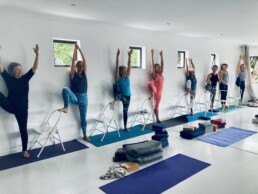
Blissful Daisies - Sharon and Iyengar Yoga
Not too long ago, I was looking for an original birthday present for a friend. Inspired by the impressive number of yoga teachers in our community and the whole peaceful, earthy vibe in St Francis, I bought a bunch of yoga classes for us to do together. Explaining that we were both beginners, I was directed towards Sharon van Niekerk’s classes as she describes the poses in detail and uses props to help coax your body into position. This sounded perfect as I doubted that I could even touch my toes at that point. I am not sure when it went from being painful to something I couldn’t do without, but Sharon’s class has been life-changing for me.
DD: Have you got any advice to anybody that would like to start yoga?
SHARON: Be consistent. If you’ve never done it before and you are not naturally a flexible person, it’s not going to be easy. It’s not a quick fix. The discipline is what comes.
Discipline your body, discipline your mind, and you will have the results that you are looking for.
My yoga teacher, David, used to joke and say that when new people want to come to class, he asks them to get down on the floor, and then get up. If you can’t get up off the floor, you should find a class that does chair yoga.
DD: Do you think your class would be suitable for a beginner?
SHARON: Yes, but only if you’re in good shape. Obviously, if you are somebody who has been sedentary for a long time, an older person, or are not naturally flexible, you will struggle.
DD: What motivates people to start doing yoga?
SHARON: Usually because they feel old age starting to creep up on them. Maybe they feel stiff and parts of their body are in pain; it is very rarely for spiritual reasons. However, people also want to start yoga because their mental state is a little bit out of whack, and they want to feel calm.

Iyengar Yoga with Sharon
Monday: 8.15-9.45 (186 St Francis Drive)
Wednesday: 8.15-9.45 (186 St Francis Drive)
Thursday: 8-9.30 (The Pound)
Saturday: 8.15-9.45 (The Dance Studio – Village)

DD: Why Iyengar Yoga and how is it different to other styles of yoga?
SHARON: When I started yoga in the 90’s in Cape Town, it wasn’t as big as it is now, but everybody raved about this guy, David Jacobs, and he was an Iyengar teacher. When I started with him, I realised that it was quite scientific and that appealed to me.
There has to be a reason and a benefit in doing something.
For example, why must I stand on my head? Because it is putting pressure on the crown of the head which creates activation of the pituitary and pineal gland, two important hormonal glands. Pineal is also connected to the third eye – there’s a lot of info one can go into. Generally, beginners aren’t really interested in all of that, but the more advanced you become, the more you understand.
From a physical perspective, why do you do head balance? Because turning upside down flushes fresh blood into all the organs, it works your shoulders, it works the spinal extension and gives you a good stretch. There are also spiritual and mental benefits. So, that’s what appeals to me about Iyengar.
DD: I read that he was very close to Yehudi Menuhin who said that Iyengar was his best violin teacher.
SHARON: Yes, he did yoga with Iyengar for many years and their association probably helped make Iyengar Yoga so popular in the West. Sivananda and Pattabhi Jois (Ashtanga) Yoga also had many followers. I like to call these yogis the Classicists.
Classical Yoga appeals to me because they have thousands of years of knowledge, they’ve got the text. Iyengar translated many books, wrote books himself and taught around the world. He was a seriously intelligent man. I watched a lot of his videos and there was something about him that really clicked with me. If you have the option, you should find a teacher that you click with because that will make you more consistent.
DD: And what about the props? Was that his idea too?
SHARON: Yes, that’s one of the things that makes Iyengar Yoga different. He was a very sickly child from a very poor background. He had tuberculosis and was a skinny little guy. On one of his school holidays he was sent to his sister who was married to Krishnamacharya who was the godfather of their lineage. He said, if you want to do yoga, just do it. So, he wasn’t given much instruction and just started. He soon realised how good it made him feel and as he improved, he was asked to demonstrate his skills. This was often before royalty or other dignitaries as a form of entertainment or spectacle to show what the incredible things his body could do. Eventually he started helping others get the poses. This made him think that there are others who might be weak or sick and suggested they use a wall or a block to make the posture easier.
Having said this, if you have a look at his book, Light on Yoga, you will see he didn’t use any props. I don’t force anyone who doesn’t need a prop to use one. Of course, everything is always changing and is not static. Over the years they found that if you do shoulder balance flat on the floor all the time, depending on the shape of your neck, you can hurt your neck. That’s why I insist on using props for this pose. Using props also involves humility, realising your own limitations and what your body is able to do and isn’t.

Facts about Sharon
Lives in Cape St Francis
Has two dogs
Owns a landscaping business
Studied Fine Art and Horticulture
Completed 3 years of Iyengar Teacher Training

DD: Do you have a favorite pose?
SHARON: Shoulder balance. It didn’t come easily to me when I started, but now it’s so valuable. When I had my cataract surgery and couldn’t do inversions for two weeks, I really felt the difference. It’s actually called Sarvangasana, meaning ‘all limbs’. When you are upside down your muscles are working against gravity, your organs are getting a rest, especially the heart. When you finish the inversion the organs get fresh blood. Also, the pressure of the chin into the thyroid gland stabilises your metabolism – these are some of the physiological benefits. From a mental point of view, it quietens your mind. It is given for respiratory problems, because when you are upside down the diaphragm has to push up against the gut and the intestines, so it tones the diaphragm and makes it strong. It also reaches different parts of your lungs when you are upside down. That’s why consistency is so important. At first it is hard and then with time it becomes easier. Then you start to see the other benefits.
DD: I like how you correct us in the classes. You are constantly manipulating our bodies to nudge them into the right position.
SHARON: That is called adjusting and another trait of Iyengar Yoga. There is always someone in the class doing this, not necessarily the teacher. One of the reasons I think Mr. Iyengar was such a guru was because when he adjusted someone in his class, you could see the whole body just fall into place. Almost like an electric shock. That was his gift – the ability to use the finest touch to put you in position and be sensitive.
DD: If you couldn’t do yoga, what else would you do?
SHARON: I would like to swim beautifully and do capoeira or parkour.


