
Navel worx - the only South African supplier of essential oil remedies for the navel.
Dune Daisies are excited to introduce you to another one of St Francis’ fabulous entrepreneurs, Cecielia Grant. A few years ago, she started a business called navel worx that makes Ayurvedic inspired blends of essential oils which are applied on the navel. Each blend is a remedy for range of specific ailments and has proven efficacy.
DD: How did you wind up living in St Francis Bay?
CC: I had been coming here on holidays to break away from the rush of Gauteng and then bought a unit at the port. St Francis was my holiday destination. My core business, although I currently do this to a lesser degree, is corporate incentive travel where I take groups overseas. In 2020, when travel suddenly died globally I started spending more and more time in St Francis and eventually decided to relocate.
DD: How did navel worx begin for you? What’s the story behind its inception?
CG: As I mentioned, I was in the travel industry and worked extensively abroad. On my trips, I enjoyed visiting various spas throughout the world as I found it a quick way to recover after a journey. Check into a spa and a day later you already feel better. It was in these spas that I was introduced to Ayurvedic medicines. The birth of my granddaughter in 2020 reminded me of the navel and the umbilical cord. I put these two ideas together, (Ayurvedic medicine and the navel) and started looking for a product that focused on essential oils for the navel. When I couldn’t find anything, I decided that this might be just the perfect niche for me.
DD: What a special beginning! Could you give our readers a little more information about the benefits of using essential oils in your navel and what navel worx does?
CG: The core lies in our recipes. There are ten of them and they are all based on Ayurvedic medicine. We use ancient recipes that have stood the test of time. Using navel oils is not a new idea and we did not come up with these blends, rather they are tried and tested Ayurvedic remedies used to treat certain ailments.
To create the most effective and potent product, we are very careful and mindful about how we source our oils. Each oil is of the highest quality possible, is 100% pure and produced under stringent conditions. To respect the recipes implicitly, we import these oils from all over the world. Unfortunately, there are no local oils that match any of the recipes yet.
DD: When we received our package from navel worx, we were blown away by the beauty and attention to detail in the presentation.
CG: We are working on having all our packaging being as natural as possible and to give back as much as we can. We really enjoy using local people to do things and even sending plantable packaging with seasonal seeds. Nowadays, people aren’t getting the shopping experience, so we are trying to stimulate the senses when you receive a navel worx order. Each package is individually scented based on the oils ordered.
DD: What would you say makes navel worx unique?
CG: The application of pure essential oils, that are not compromised in any way, in and around your navel makes navel worx special. There is not another South African brand that has created a product specifically for navel application.


It’s also about taking a moment for yourself. Every morning, I use RESTORE. I don’t leave the house without it as it feeds my skin from the inside. We should all do this as we spend money putting creams on our skin but that only treats the first three layers. The moment the cream is gone, our skin is dry again and we need to reapply it. We should feed our skin from the inside.
DD: Could you tell us a little more about the application process? Is there an ideal way to apply the oils?
CG: We have different ways of presenting our oils at a spa. A popular option is to include a navel ritual as an add on experience after a head massage. The experience begins by warming the belly button with a heated cloth and then applying a few drops of the oil in the navel. The scent of the oils is activated by the heat and a gentle massage. The main thing is that the skin around your navel absorbs all the oil. Essentially, you can do it any way that works for you. If you have a little roller and are feeling stressed out at work, reach for your CALM and rub it around your navel (making sure none gets on your clothing) and take a deep breath. You will feel better in moments.
It’s also a lovely ritual to have as a family. If you have a teenager that can’t study or focus, or they are nervous and restless, take a moment with them and apply some REST oil on their navel. This small ritual shows affection and is a way of communicating that you care.


DD: Navel worx has a unique product and the idea of navel oils might be quite foreign to many people. Who is your intended target audience?
CG: Honestly, the world! But more specifically, the Indian market is an easy audience for us as they are familiar with Ayurveda. They know what it’s all about. My current community is a difficult market, the Afrikaans boere seuns. To try and convince them that they should use a gentlemen’s oil and include it into a daily self-care routine is quite a hard sell. Their response is generally, “Really?”
But I do think every man should use it. A lot of people in my social circles are from farming communities or game lodges. At some point in their lives, almost all of them have been bitten by a tick. They don’t realize that even if you didn’t get tick bite fever, that little tick causes awful bacteria that grows and stays in your liver. So, as you age and carry on with your life, you have ailments and issues and have no idea what is causing them. Meanwhile, it’s these bacteria in your liver that are responsible. The myrrh and frankincense in our GENTLEMAN’s oil kills that bacteria. My uncles have been using this oil for a few years. I see them once or twice annually and they have said to me that they are not sure why, but they are feeling better. So, I ask if they are using the oils.
They respond with the usual “yes, yes, yes, we use it daily.”
They are not so spoilt that their wives to put it on for them, but they really seem to be feeling better than they have in years.
I always chuckle to myself after their visits as I have my range of oils in the guest bathroom, and I can tell that they have been trying them during their stay.
It’s really very similar to when you take vitamins or supplements. Why do we take them and why do we believe in them? This is like another thing we do to enhance our health and becomes part of our routine. It’s not a quick fix, but with regular use it will make a difference.
People who use IGNITE to slim down see differences in their measurements over time. As we get older, we tend to battle with hormonal issues and weight gain. IGNITE will help your body change to where your sugar cravings are less and the taste of sugar changes. Your digestive system will become more regular, and you’ll probably drink more water. It essentially kickstarts your metabolism.
DD: Cecielia, this almost sounds too easy. A friend of ours commented that if it’s that easy and all you must do is rub oil on your belly, then why aren’t we all doing it?
CG: The thing is that it not a quick fix. You are more likely to lose centimetres before you lose weight. Even in a week, you see a difference.
DD: Do you have any tips for people using navel oils for the first time, other than using it consistently?
CG: Do not to spoil your clothing. You don’t want to wear a beautiful nightie and have it stained with navel worx ginger oil. Make sure it is well absorbed before you put clothing against it.
Enjoy it. For some of the blends, you will only see a difference after continuous use. But others will show immediate results. CALM will calm you down and REST will put you to sleep. It definitely works. Our tummy oil, EASE, is wonderful if you feel bloated or have eaten something that is making you uncomfortable. You get quick results with these oils. Ultimately, using essential oils should be a way of life. It’s a part of your own self-care and loving yourself.

DD: The instructions on the card in the package say that you can’t use more than one oil at a time.
CG: Mixing the oils will disturb the balance of the remedy that you’re using. So, wait at least 12 hours before using a different remedy. I am 65 years old and worry about feeding my skin the way I should, so I use RESTORE as part of my daily routine. I also have rheumatoid arthritis. RELIEF is great for this and something I use every day. I don’t use any other medication at all and can still move everything!
There are also different ways to use the oils. For example, at Christmastime when I know there will be pudding and all kinds of other things that are delicious, but not great for you, I start using IGNITE to boost my metabolism. But I still never mix the remedies, just like you don’t drink tea and coffee together!
DD: Can you share any success stories?
CG: We have a lot. The easiest success was from our GENTLEMEN’s oil which eased the symptoms of gout for many men. I’ve also had people come back after using RELIEF saying it has cured their gout. IGNITE has also helped a lot of people shrink. Of course, weight gain from hormonal issues is one thing and takes longer to manage, but if your weight gain is caused by bad habits, IGNITE works quickly.
DD: Where are the oils sourced? You mentioned that you were working towards getting your packaging as sustainable as possible, we wondered whether all the oils are certified organic.
CG: I’m not quite there yet. I’d love to work towards that and be able to tell you exactly where the oil comes from. But, now, I’m buying from wholesalers. I still take the trouble to find out where the oil is produced because I wouldn’t want to use Canadian spruce oil, for example, that’s cut down a forest to harvest the trees.
The only problem with sourcing only organic oils is cost. For example, I’ve just bought Roman chamomile, which is very precious. It comes from France and costs R48,000 per litre. The moment it arrives in South Africa, I pay all the taxes which adds to the cost and makes it very pricey. For that reason, I use wholesalers who can tell me where it comes from. This way I know the farm but don’t buy directly from them. I would like to get there eventually though.
DD: Do you have you any tips for those wishing to start a business?
CG: Firstly, you must have a sense of humour and believe in the product that you are selling. Realise that you are going to learn a lot more than what you ever thought you knew. Sincerity is important and pays off eventually. Just persevere.
DD: Do you have a favourite oil?
CG: RESTORE is like my multi-vitamin and I use it every day. I also use RELIEF daily. Honestly, I use them all except GROW because it makes all your hair grow (not just the ones on your head).
DD: Do you have a 5-year plan?
CG: I don’t have an official strategy, but I would like to reach a lot of people and show them that nutrition and nature will get you a lot further than what chemicals will. We are so quick to reach for that sleeping tablet, yet it has all kinds of other negative effects on our on our being. We don’t consider for a moment that just maybe nature can help.
I’d also like navel worx to be at a point that were we can show that we are giving back to Mother Earth and showing respect.
DD: You have also mentioned that you are thinking of moving your factory to St Francis Bay. Is that still your plan?
CG: Currently it is in Pretoria, but I am submitting plans and then I will definitely move it here. Our factory is not huge, it’s just a space that has to be very clean – there cannot be any dust in it. The oils are very strong, and we cannot mix more than two recipes a day as it will affect us too badly. The oils need to be heated and vibrated and then they can be blended. There are only three of us in the factory and we must always wear masks.


Creative daisies in our midst - meet Gail Petrie!
One of the many things we love about St Francis is that so many amazing people live in this relatively small community. Dune Daisies are particularly fortunate to have not only an absolutely lovely neighbour, but an exceptionally talented advertising agency director living just down the road. I bet you have noticed the beautiful pictures on our equally fabulous website! Well, Gail Petrie is the creative eye behind all of this creativity and we thought you might be interested to find out more about this local daisy blooming in our dunes.
DD: Gail, we have received many compliments for the pictures on our website and we have you to thank for them. What we really love about your pictures is that they show how well you know St Francis. Can you tell us about your history with this village?
Gail: I first came here on holiday with friends in 1981. I had such a wonderful experience that I went home and told my mom how much I loved it. She promptly organised a holiday for us, was smitten and right there and then put an offer in on our house. We moved in a year later and since then it has become the house where our family gathers. For all of us, it is a place of healing and laughter, very close to our hearts To this day, it is still the place where all the family and friends come every December.
DD: How has St Francis changed since you first started coming here in 1981?
Gail: When we first came here, we would have to drive to PE if we needed something as the only shop was the convenience store at the petrol station. All the roads were gravel and sand. But, the hotel was amazing – I wish we still had it! The community and all the holidaymakers would always get together there and everyone had a blast.
For me, the saddest thing now is how much the beach has changed in St Francis Bay. When we first started coming here there were Hobie Cats everywhere and Hobie Beach was busy. We could walk to the river mouth at high tide with about 20m of beach.
DD: When and why did you decide to move to St Francis permanently?
Gail: I moved here permanently after my divorce two and a half years ago. St Francis has always been a place of healing and peace for me, it was my getaway. I had often heard that you shouldn’t live or work in a place that you need to have a holiday from. This helped me decide that St Francis might be a good place to base myself, surrounded by nature. I also knew that my boys love coming here and that they can’t stay away for long, especially when they need some time out.

Gail Petrie Life Coaching
- Tel: (082) 375-7115
- http://gailpetriecoaching.co.za
GAP Advertising
- Creative Campaigns. Marketing Strategies. Design. Publishing. Event Management and Photography.
- Website: http://www.gap-advertising.co.za
- Email: gail@gap-advertising.co.za


Devon (25)is a computer scientist and is following his passion and working for the South African Radio Observatory (Meerkat Telescope and SKA project). He’s based in Cape Town.

Brandon (27) is a commercial fixed-wing and helicopter pilot and runs his own solar company (Lovemore Crescent is lit up thanks to Brandon).
“One of Gail’s most special moments was climbing into a plane built by my son and husband and flying over sunset rock.” GAIL
DD: What challenges have you faced working remotely or by relocating?
Gail: When I arrived here I was thrown into one of the busiest periods of my career. My biggest challenge has been making sure that I find time for me and my dog Scamp. Taking her out for a walk and spending enough time outdoors, so I try to make this a priority.
Regarding my work situation, I can’t pop into all the events I am organising, so I have to be selective in deciding when to make the trip. Other than that, it’s been amazing. If someone had told me ten years ago that I could work remotely, I would have done it then!
DD: You are a lady of many talents, you have an advertising agency, are a professional photographer and also a life coach. How have all these things played out in your life?
Gail: When I was twenty, I moved from Bloemfontein to Johannesburg on a modelling contract. After a few years, my work as an art director got the attention of the Edgars group and I ended up working for them. It was seven of the most wonderful years of my career; we worked hard, played hard, and I learned so much.
When I got married, I didn’t want to leave my kids at a creche, so went out on my own. One of the companies I had done freelance work for waited for this to happen and then scheduled a meeting with me on the first day my company opened. At the meeting, I was awarded a multi-million rand account. Not bad for the first day of business. I ended up working for them for the next ten years. Honestly, I was fortunate in that I landed many wonderful and high-profile clients, including some of the top private schools in Johannesburg. It all just fell into place. And this was in addition to L’Oreal where I was the agency for 15 years. One particularly fun project we worked on during that time was the launch of the Golden Scissor Award which became the world’s most significant ethnic haircare award. Work has been consistent over the years and I have built wonderful relationships with my clients.
During that time, I always had this feeling that I wanted to study Psychology. I got to the point where I started looking for courses that I could do in the evening, but I kept putting it off as I was so busy and was still raising my two boys. Eventually, about twelve years ago, I did an ontological life coaching course. It was life-changing and at one point I thought about giving up the agency to do life coaching. A part of the course involved doing biometric and aptitude tests. The feedback from this was that I would be most successful if I could find something that balanced my creative side with my emotional and empathetic side. This struck a chord in me and kept on going around in my head. Perhaps I didn’t have to give up on my creative side. So, I kept the agency and when I started looking at life coaching, I went at it from a creative perspective. I tried to approach my workshops creatively. How could I do the one-on-one sessions more imaginatively than just sitting and chatting? That’s when the ‘Who am I’ and the ‘Choosing Me’ workshops were born. They are based loosely on my life and the lessons that I’ve learned over the years. It’s been incredible still being able to do these things from St Francis.
DD: Can you tell us more about your workshops and life coaching?
Gail: When I was in Joburg, my life coaching workshops were with ten people. But at the moment, I am just offering one-on-one coaching with an eye on moving back to groups later. It’s basically looking at the lens we look at life through, how the things that have happened to us in life have impacted us. How we move forward and what we have learned from our experiences. And finally, making the changes necessary to live your dream life.
DD: And how are you living this?
Gail: A lot of people think that because you are a life coach, you must have it all figured out and have all the tools. But for me, it’s about continuous learning. The need to learn on a deeper level to experience things. I often think that some of the things that I’ve been through in my life have been there to teach me how to help other people in those situations.
I have found it very interesting how at different stages of your life, different people show up in the coaching. For example, after my divorce, I found I was coaching people that were in bad relationships, following that I found myself working with those battling with balancing work and life. After that, people struggling with the empty nest syndrome and then I went through a period where most of my clients had experienced a lot of trauma. That’s really how I concluded that the things we experience are all lessons.
DD: What life lessons have you learned from each of these directions?
Gail: The biggest life lesson I have learnt is to allow what is, to be. If you fight things, you bring fear into them and that never has a good outcome. Also, to get up each morning grateful for all that you have.
DD: How about as a mother?
Gail: I am so fortunate and have been blessed with having two incredible people in my life, my sons. They have taught me so much about resilience and kindness, they bring an abundance of unconditional love into my life.
My gran used to say, ‘this too shall pass.’ The lesson I learnt from that is that, it will pass. But, what lessons have we learned when it has passed?
If we don’t learn from our mistakes we keep inviting the same stories back in – the same hamster wheel spinning around. That’s how we build resilience.
DD: What has your experience been as self-employed? Would you give any words of advice to businesses starting out?
Gail: For me, it was always about following your passion, that’s something I have tried to teach my boys as well. If you don’t follow your passion, you cannot possibly find what you are looking for. And I think in my case, that is why everything fell into place because I was always doing this. It was the same with photography. I had studied it as part of my training as a graphic designer and loved it. So, when I was working for L’Oreal at one of the Golden Scissor Award events, the photographer didn’t show up and luckily, I had my camera with me. I ended up taking the photos and L’Oreal was so blown away by my work that they asked me to take over the photography for future events. Again, it just happened that I was thrown into that side of my career. Something that was always my passion became a business and I tried never to lose that passion even in the business side of it.
DD: Looking forward, how would you like to focus your energies?
Gail: I am currently working on a life coaching book that I believe is quite unique. My goal is to have it published by the end of the year. The agency keeps ticking over, but that’s also taken an incredible shift. It used to be all retail, but now I am focusing on education and pharmaceuticals. The pharmaceuticals in particular have been fascinating because I have learned so much about diabetes and what people go through. At one of the events we put together a program where doctors were actually walking in patients shoes using AI. We are trying to bring empathy and observation back into the pharmaceutical world as it’s something that’s often missing.
Dune Daisy readers, we have this wonderful person in our community, so utilise our local talent. If you would like to learn more about yourself and begin a journey of self-discovery, contact Gail about her “Who am I?” workshop. Read on to find out more and check out her website: http://gailpetriecoaching.co.za

Know your Daisy, Gail:
- Born in Bloemfontein and grew up on a dairy farm in the Free State.
- Her happiest memories are connected to the farm and her two kids.
- Gail is an animal lover and has Scampi, a golden cocker spaniel (her sidekick), two cats and a very chatty parrot named Scruffy (often to be heard saying ‘goodbye’ in the background when Gail is on a call).
- Her favourite food is homemade pasta and making pizza with her boys.

“We see the world not as it is, but as we are.”
Albert Einstein
So, who am I?
The “Who am I” program is a coaching journey for discovering who you are and living your dream life.
A powerful practical approach for understanding how you function, learn and change.
Who am I?
How do I view the world?
By taking an honest and detailed look at the story you have been writing about your life, at both the good and bad decisions, strengths, wishes and dreams, and regrets, you will open the door to understanding “Who am I?”
Discover the lens you view the world through and the story you are writing. Are you living into limiting beliefs? Acknowledge what has worked for you and feels right, as well as things that haven’t gone as well and leave you with heaviness and sadness.
This is a journey to discovery of self.

Donate your threads, Daisies!
THE STREET STORE: LET’S HELP CLOTHE ALL THE DAISIES IN ST FRANCIS BAY
The indignities of poverty are profound, multifaceted and often disguised behind the public ‘face’ of poverty. Truthfully, how many of us have wondered what happens beyond our cash donations and clothing drop-offs at the local thrift store? As morally uncomfortable as it may be, have we ever put ourselves in the position of someone who has no idea where their next meal will come from, or how they will survive the next chilly night with threadbare clothes? Imagine what it must feel like to have no choice in what you receive or what shape your gifted clothes come in.
Well, thankfully for us at Dune Daisies, all of our readers out there, and for the over half a million fortunate recipients across the globe, an amazing team in Cape Town have. Enter the Street Store, the world’s first ‘free’ store for the homeless and those in need. Created in 2014, by M&C Saatchi Abel’s Kayli Levitan and Max Pazak, the Street Store aims to provide a unique ‘shopping’ experience, one which restores dignity and pride to the act of receiving clothing donations. To date, over 1000 stores in 100s of cities across the globe have sprung up on street corners, in community halls and school playgrounds – anywhere where there is a need and a free space to set up ‘shop’.
The concept is beautifully simple. Anyone can host a Street Store by registering on www.thestreetstore.org and taking the Street Store pledge. They are then given free access to downloadable & printable cardboard designs. These documents are available in over 14 languages – testimony to this initiative’s global reach. Once the printed cardboard hangers are ready, the donated items are hung up (in whatever ‘free’ space has been chosen) and a shopping experience is created. Volunteers then help ‘customers’ to browse the options and choose desired clothing, all in a safe, relaxed, dignified environment.
What’s more, St Francis Bay will boast its very own Street Store next month. We caught up with Sam Harpur, of local NPO Heart-Strings, who is the driving force behind hosting this incredible initiative.


DD: Hi Sam, Dune Daisies heard that you are the inspiration behind bringing the Street Store to St Francis Bay. Can you tell our readers exactly what the Street Store is?
Sam: The Street store is a concept that originated in Cape Town and has become a global success story. It is the world’s first rent-free, premises-free, free pop-up clothing store for those in need. It gives those in need the dignity of a shopping experience without having to pay for anything. Everyone deserves the opportunity to choose clothing instead of just getting clothes handed down to them.
DD: What made you want to bring this concept to our home town?
Sam: We were fortunate enough to get invited to a talk by Mike Abel from M&C Saatchi Abel, as part of a Client Care investment function. It was during this talk that Mike introduced the Street Store concept as one of his passionate community projects. When we heard about it, we immediately felt that it could be a project that would make a meaningful difference in the lives of our community members. And so the 1002nd Street Store, in St Francis Bay, was created.
DD: You mentioned while we were chatting that you plan to meet with key community leaders to discuss how to make sure that the items reach those who need them the most.
Sam: We are in the process of coming up with an invitation system. We will be working with community leaders to identify the community members who are in the most desperate situations and then extend an invitation to these people. We don’t want a situation whereby we only have sufficient clothes to assist 100 people and have 500 arrive on the day. Logistically it could be tricky to manage large crowds of expectant people.
DD: Has this type of community work been a long-time passion of yours?
Sam: We have always had a heart for people and reaching out but really felt a strong call to make a meaningful difference when moving to St Francis Bay. We love that we can live in a small town and invest our efforts into our community.
DD: Can you tell our readers more about the other work that you and your partners are doing in the community? (keep an eye out for future posts delving deeper into what these awesome ladies are busy with)
Sam: Our Non-Profit Company called Heart-Strings has been born out of a love for community and has recently been officially registered. We are 3 women, having moved to St Francis, that have a common heart and different passions. Kim Cornish, a nurse, has a heart for well-being initiatives in the community. Nicola Lyle, a High School Teacher, is passionate about making a difference with the youth and hopefully investing her effort into the future high school we foresee in St Francis Bay. I am Early Childhood Development trained and determined to create a stronger foundation at the grassroots level and am passionate about increasing early literature exposure.
DD: So, how can our readers help with the Street Store? Do you need volunteers or donations – what can we do?
Sam: Our most immediate need is for the donation of clothing, without clothing we don’t have a Street Store. We are appealing for men’s, women’s and children’s clothing. Items can be dropped off at the Client Care Offices in the Old Village Shopping Centre, behind Calibre Security and next to Off The Menu Restaurant.
We are also always looking for extra sets of hands to sort clothing, to assist in organizing the event and assist us on the day.
DD: Can any kind of clothing be donated?
Sam: We would be so grateful for any and every bit of clothing including shoes, hats, bags and jackets. We will sort them by gender, size and type.
DD: What if we have items that are not in great condition – should we bring them along anyway?
Sam: We are appealing for items that are still in good condition as we really want this to be an opportunity for these community members to choose lovely items of clothing that they would be proud to wear.
DD: We heard you may be sharing more at the SFB Brewery’s next Story Slam – can you tell us a bit about that?
Sam: Yes, we are very excited to have been invited to the next Story Slam on the 20th of July. My husband, Frank, will be sharing information about the Street Store and how our community can get involved. There will be an opportunity to drop off donated items at this event.
DD: Can you suggest any additional sources that keen readers can follow up on?
Sam: We have recently been awarded the distribution rights, for our area, for an incredible early literature program called Book Dash. We have over 326 children in the Sea Vista Community that will be receiving their own books in the next few weeks. These books are in English and their home language. The website is www.bookdash.org. This is a great resource for free digital children’s books. I have also been reading an incredible book called Mission Possible by Tim Tebow. It is a great book of faith, living mission-minded and finding your purpose.
Know your daisy
I was born in Johannesburg in 1983. I am very lucky to be a wife to Frank and mother to Madison (14) and Troy (12). We have three furry family members – Satara, Kyra and Chloe. We relocated to SFB 1 ½ years ago, post covid, and have been establishing a beautiful life in our small town. Having chosen a complete reset, we are investing our time into our children, building our businesses and community projects that are close to our hearts. We love the outdoors, especially adventuring into the African bushveld at every opportunity we can get and exploring our new backyard (the Eastern Cape).
I love running and feel blessed every time I put my takkies on and get to run around our scenic beach town, it still takes my breath away (because of its beauty and because I am unfit). My favourite place in St Francis is Bruce’s Coffee Shop where we can sip on a delicious cappuccino while we look out onto our magnificent ocean. In my downtime, I enjoy reading, spending time with my precious family and watching my daughter horse ride and my son play soccer.

So to all the Dune Daisy readers out there (and your aunties, friends & neighbours), this is a call to action to gather up your unwanted and unused clothes and donate them to this amazing cause – you will be helping not only the environment (Small Town Swaps & Sustainably Dressed Daisies – Dune Daisies ) but also the less fortunate who call this beautiful place home.
.

Susan Rae Fox and the St. Francis Animal Rescue

Anyone who has spent time in St Francis has come across the St Francis Animal Rescue, whether it be at the market, on Facebook, at a fundraiser or even if you have ever driven through Sea Vista on a Thursday afternoon between 2pm and 4pm.
Susan Rae Fox is one of our very special daisies in town. She started this organization seven years ago and has achieved mind-blowing results, having touched so many lives in this community, both furry and human (we even have a four-legged daisy as part of our Dune Daisy team, Milly).
Dune Daisies couldn’t not feature this fabulous lady and the St Francis Animal Rescue.
DD: How long have you been running the St Francis Animal Rescue and where were you before coming here?
SRF: Before coming to St Francis Bay, I lived in Durban where I was Managing Director of an advertising and marketing agency. I retired to St Francis Bay with every intention of spending my time writing books and completed four, before establishing St Francis Animal Rescue in 2016. I set up this charity to do my best to help the great many neglected, starving, unsterilized dogs wandering the streets of Sea Vista
DD:We know you do so much for the dogs and cats in Sea Vista, could you tell our readers more about what the St Francis Animal Rescue does?
SRF: In 7 years, St Francis Animal Rescue has made a very significant difference in the lives of cats and dogs living in Sea Vista. We have changed the diet of the majority of cats and dogs. Where once they used to eat table scraps, bread and pap, and forage the streets, these animals now eat pellets which we subsidize and sell into Sea Vista Spaza Stores so that the food is available and affordable.
We sterilize approximately 4-6 dogs per week. Cats are also sterilized regularly, though in smaller numbers. Many are feral cats, trapped by our Cat Lady, Jodi Kruger who works tirelessly to keep St Francis Bay free of unsterilized ferals.
We have removed over 70 dogs from chains by building fences around their properties to keep them safe and stop them from roaming – a principal reason why most dogs are chained. We vaccinate 50 pups and adult dogs every month to keep them safe from life threatening diseases. We also vaccinate against Rabies and through two campaigns have vaccinated over 850 dogs to prevent the spread of this lethal disease.
St Francis Animal Rescue responds to calls for help for medical care, particularly for dogs who have been injured in car accidents, wounded through cruelty and abuse and burned. We take sick dogs and pups for medical attention and provide home visits to monitor their progress. Our welfare vet is the Humansdorp Vet Clinic where a team of caring vets and nurses help treat all dogs and puppies in need of medical help.
We regularly remove dogs and pups from neglect and cruelty and do everything possible to rehabilitate and rehome them with loving families. Over the years hundreds of dogs from Sea Vista have been rehomed throughout the Eastern Cape and even beyond into Gauteng and Cape Town. The challenges we face result from extreme poverty and lack of education. People continue to breed pups as a means of providing an income to feed families. Cruelty is rife, not only inflicted upon dogs, but children and women.
DD: What are some of the greatest challenges you face?
SRF: One of the greatest challenges we face, is to persuade people to bring their dogs indoors at night to keep them safe and to develop a stronger bond with the family. Dogs left outside are at the mercy of the weather and are often stabbed or hurt by drug users and drunkards coming home late from the taverns.
The way we overcome this challenge is to regularly bath and groom dogs to keep them clean and treat them for fleas and ticks. Once clean and brushed, it is much easier to persuade owners to bring their dogs inside at night. Each dog is given a blanket to sleep on, once they are indoors.
Another challenge is to prevent an influx of puppies and adult dogs coming in from Humansdorp, JBay, PE etc. Our sterilization program is seriously compromised by people bringing pups and dogs from outside areas, so that our numbers of breeding dogs continue to grow, no matter how many we spay and neuter. Some of these from PE etc, are pedigree breeds like Huskies, Boerboels, Jack Russells and Border Collies. None of these breeds do well in Sea Vista and it becomes our problem to do our best to sterilize them so that they cannot breed.


DD: How can locals get involved (what kind of volunteer opportunities are there)?
SRF: In terms of Volunteer opportunities, St Francis Animal Rescue is always looking for new animal lovers to join our team.
We run an outreach every Thursday afternoon (2pm-4pm), where we feed, vaccinate, spray pups and adult dogs for fleas and ticks and deworm all puppies.
- We vaccinate pups on the first Thursday of every month and provide basic wound care for cuts, burns, bites and ear and eye problems.
- We regularly treat and heal dogs with mange problems.
- Pups and adult dogs are bathed and groomed at our bath station.
Volunteers are always needed at our outreaches.
We have a team of transporters who take dogs from a specific pickup point every Wednesday and Thursday to the SPCA Assisi in Humansdorp, to be sterilized. Transporters are invaluable though they need to have a spacious vehicle to transport dogs in crates, two per car.
Our fundraising team is also in need of volunteers. We work together to devise ways and means to raise funds to support our charity and ensure it’s sustainability.
This is one of the greatest challenges we face and it is difficult to continually raise funds in a small village with many people suffering from donor fatigue.


DD: Any happy or fascinating stories that really stand out in your memory?
SRF: There are more stories about experiences in rescue than I have time to tell. One which is particularly memorable is the following.
We work a great deal rescuing Pitbulls from horrific cruelty. In one instance, a male Pitbull, chained for a long time, was regularly beaten with sticks. We approached the owners and attempted to negotiate a way for him to be removed from a chain. We offered to construct a fence and gate and provide a large kennel for him.
The owners refused all offers of assistance and became rude and threatening. We asked the SPCA for assistance and their inspector left ‘letters of warning’ at the house
At our wits end, we convinced a friend to dress up as a policeman, visit the house and ‘confiscate’ the Pitbull, which he did. We kept Jock in kennels for 3 months to put on weight and had him assessed by dog trainer, Philip Van Heerden, who judged him to be gentle, despite years of suffering from monstrous cruelty.
Jock was adopted into the happiest home and has been living a wonderful life for many years.
In a similar case, Reg was a male Pitbull used for breeding. He was chained to a filthy mattress, surrounded by his own faeces, and left in a dirty courtyard, without food and water. A neighbour alerted us once the owner went away for a weekend.
With help, we cut through the gate padlock and sawed through Reg’s chain and removed him to kennels. After a bath and a good meal, he looked a different dog.
Reg now lives the happiest life in Bathurst with a bachelor who loves this dog like a child.
DD: What are the annual fundraisers to look forward to?
Our Golf Day is coming up, and this is our primary Fund Raiser every year. We will be hosting our usual Bingo Nights, Cake Sales and collaborative promotions with key sponsors. Coming up at the end of the month is our Flowers through the Homes event on July 29th. We are also celebrating Mandela month by trying to collect 67 bags of dog and cat food.


The St Francis Animal Rescue website is very comprehensive and has all the details about volunteering and upcoming events. Be sure to check it out – we even have a dog blog!

Keen for a Dip?
For many of us, swimming in the ocean is something done at the height of summer, often to cool off after a spell of tanning. A brief, refreshing dip. There may even be some Dune Daisy readers brave enough to take it one step further, don a wetsuit, grab a board and ride the blue, peeling waves deeper offshore. But how many of you willingly and unwaveringly take to the ocean, day in and day out, come rain, shine, wind, fog (and everything in between), to cold water swim? To brave temperatures chilly enough to numb your extremities and make your teeth chatter? Well, if you do, you belong to a growing group of like-minded folk. Not extreme athletes, just regular people like you and me. People who get a physical and mental boost from taking time out in nature, immersing their bodies in the cold ocean, supporting their fellow ‘dippers’ and performing this invigorating and somewhat crazy ritual every day.
Interested? Think you are up for the challenge? Well, you are in luck, as St Francis Bay has its very own cold water dipping group, aptly named the ‘Naughty Nauticals’. And they are celebrating the upcoming Winter Solstice with a special early morning swim – find out more about them in the interview below with founding member Sandy Coffey, and take the plunge this Wednesday to honour the Solstice!


THE NAUGHTY NAUTICALS
It all began when my brother asked a simple question on Christmas Day 2020. He just said, “I don’t know why you are not swimming every day”. Right then and there I committed to getting into the water every day for a year. Rain, sun, wind, hail, lightning – whatever came my way. Of course, it was easy because it was summer, but by May, I was starting to realise that I had to dig deep. But it was too far into the year to give up, so I just carried on.
“Being a St Francis Bay local as opposed to a SFB holidaymaker are two vastly different things: As a non-local it can time to feel part of the community and find your “tribe”. Joining the Nauticals has made all the difference.”
Debbie Andrew

For 18 months, I swam alone. No one seemed remotely interested. Except for my friend Willem Bosman. He came to me after a dinner braai one day and said he wanted to “try it out”. It was winter, so I never thought he would. But he did. And he hasn’t missed a day since. Slowly he began bringing newcomers. And before we knew it, there was a committed bunch of ocean dippers. And that’s when we gave ourselves the name “Naughty Nauticals”. And even got T-shirts made for us! So that is how it all started. Today, it’s a robust, fun, brave group of interesting human beings.
We ocean dip (not to be confused with actual swimming training!) every morning at 7.30 am at Grannies Pool. Most stay for a warm-up coffee after the dip. Ages range from 16 to 85. There isn’t much of a routine. Whoever pitches up gets in and joins the fun. No pressure to stay in for any length of time. Whatever suits. No rules. Except that you have to get your hair wet!! There is a lot of talk about what the temperature of the water is. A LOT. So much so, that one of the dippers brings a thermometer to check!
I got to hear about Wim Hoff after about a year of my solo swims – and I did a whole lot of research. I wouldn’t consider us Wim Hoffers, rather, cold water immersion fans! There is so much research to back up the amazing effects of cold-water immersion – increased immune response, clearer minds, sharper responses, better sleep, and of course, daily discipline.

“I joined the crew after losing a bet with a mate – the best bet I ever lost. It has introduced me to a new group of mates and unique experiences. Even though not a regular at the moment, I always “catch on where I left off” with the bunch. Amazing way to start the day!”
Trevor Gascoyne
Personally, my body has gotten used to that cold water – on the odd occasion where I have been unable to swim because of work commitments, my body misses it. There is an addiction I can see happening! A good one.
The hardest part is definitely getting in. And there is no easy way. I find it best just to dive in, rather than go in slowly. Best part is 10 minutes after the swim. All the endorphins rush around your body and there is a beautiful sense of being alive. And of course, there is the ocean. I have learnt more about tides, wind, moon, sun and the ocean in these past three years than during my whole life.
We don’t really have any rituals, except if it’s someone’s birthday – then we stay for cake and coffee (thanks to Bruce’s Cafe for deliciousness!). And now we are planning our first Winter Solstice event. Anyone and everyone is welcome on the 21st June, 7.30 am. Come and be part of the fun!
If it’s your first dip, here is my advice: warm up your car beforehand; wear water shoes so your feet don’t get torn by the rocks, and bring a warm jacket to wear after. You will find it very uncomfortable for the first two minutes in the water, and then the magic happens. Your body gets used to it and realises there isn’t any actual danger and it starts to normalise. Don’t get out before that happens. And then, with curiosity, see how your day pans out. I’ll bet something good happens.
If I had to pick one word to sum up how I feel after my morning swim, it would be: ALIVE.


“It’s been a blessing to join the Nauticals. My first dip was a few days after I experienced a traumatic home robbery in Johannesburg. The early morning routine helped me to connect with my feelings and surroundings, the natural beauty of the area and the morning light, the joy and discomfort I felt as the curious otter circled us, the kindness, the humour, and discovering the stories and talents of my fellow immersers truly helped me heal.”
Gill Stern
“Last year I ended up in a coma for two weeks and in hospital for three months. I have always loved the sea but was concerned to go back to the water as I was paralysed on my left side. When Willem’s wife, Leanne told me about this group of swimmers, I was excited although afraid as I didn’t want to hinder the others, but oh my word, I was overwhelmed by the kindness, support, help and encouragement, and getting back into the water has helped me with my physical and mental well-being. I feel my healing process has accelerated and I have benefited greatly from both the swimmers and the ocean.”
Karen


“When Sandy Coffey invited me along to join her one day, in the middle of winter, I couldn’t resist. Primarily driven by the challenge it presented, I was also curious! That first swim is still vivid in my mind. I battled to breathe for the first 30 seconds but the sense of calm and accomplishment I felt as my body surrendered to the temperature was life changing. The rest is history. It is more than a year now and every day I crave the soothing feeling of cold water rushing over my skin as I take the plunge. It is that and the discipline it takes (together with the addictive pheromones my body exudes) that brings me back for a wonderful start to the day. Combine that with the daily changing beauty of the surroundings, the seagulls, the jumping fish, the odd inquisitive otter swimming with us, the enduring camaraderie and laughter we have in the water and the post dip coffee, being a Nautical is a no brainer!”
Willem Bosman
And if you find yourself further afield, fear not as there are cold water swimming groups in almost every bay and tidal pool around our coastline. Read on for the backstory on the Atlantic Waterbabies from Camps Bay in Cape Town. This intrepid group has been cold water swimming since 2015 and was even showcased on Carte Blanche!
DD: What motivated you to take the plunge?
Atlantic Waterbabies: Most of us had heard about the Wim Hof method and the various benefits of cold water swimming and were keen to try it out. The pressure from friends who were already hooked on it already was also a huge impact! The oldest member of the Waterbabies (Helen Boonzaier, 85yrs old) had so much FOMO when she saw our seemingly crazy bunch of people swimming in the freezing Atlantic that she just had to join!
DD: Tell us a little about your group
AW: We swim every morning at 7.30 am at the Camps Bay tidal pool or in the ocean, depending on the conditions and there can be anything between 5-20 swimmers at a time. Ages range from 30-85 years old and our backgrounds are as varied as the weather. Our only rule is that you immerse for a full 20 mins. We don’t follow the Wim Hof breathing method but do love the philosophy behind Cold Water Cryotherapy.
Some of us prep for the morning dip with some tea and crackers, or a morning meditation and writing ritual. Others set their alarm, get into auto-pilot mode, don’t think too much about what the weather conditions look like outside, and drive to the pool to meet the group.
DD: What motivates you to take the plunge every morning?
AW: There are so many reasons to keep dipping, including communing with the swimming crowd and chatting nonsense with each other; feeling the connection to the water and nature; the deep sense of peace; feeling the movement of the water, and of course the post-swim coffees and hot baths! The hardest parts are to take the first step of getting up in the cold, wet, dark winter months and to get past that moment of having to take off your warm fluffy robe and walk into the ocean.

Sink or Swim? Know your cold-water lingo
Wim Hof: Welcome to the Official Wim Hof Method Website
Cryotherapy: What Is Cryotherapy? A Guide to Cold Therapy | Everyday Health
Waterbabies on Instagram
https://instagram.com/atlantic_water_babies?igshid=MzRlODBiNWFlZA==
https://instagram.com/coldwatersocialclub?igshid=MzRlODBiNWFlZA==


DD: What changes, physically and emotionally have you noticed as a result of your morning swims?
AW: Apart from some members feeling years younger, there is no doubt that cold water swimming and the associated social interactions help to increase energy levels, boost the immune system and lighten emotional head space. The sense of comradeship and community, the coming together of like-minded people, has really become so important for our dippers and really has helped them through some very tough times. And for many, this seemingly simple ritual has provided the much-needed reason to get up in the morning – it really is the best way to start your day!
DD: Do you have any other rituals/ceremonies included as part of your group?
AW: We love it when a birthday comes around as we do a birthday circle in the water, singing and splashing and celebrating the birthday guy/gal. We also, of course, have our much-needed coffees post dip and we have had some wonderful swim gatherings on dry land; weekends away, nights at the opera etc. We have a sister group, The Mermaids, who swim after us (they get the sun!) and love to do full moon and Solstice swims.
DD: What advice would you give to someone interested in starting cold water swimming?
AW: All you need to do is try! The best thing to do is that once you have taken that first plunge, do it every morning for 6 days – then you will be hooked – your body and mind will demand more!
DD: And if you could sum up how you feel after your morning swim in one word, what would that word be?
AW: ALIVE, AMAZING, HAPPY, ENERGISED, RESET, FRESH, COLD
Well, fellow daisies, we are keen to give it a try and whether you are in St Francis Bay, Scarborough, Salt Rock or Syndey, why not take a dip into the ocean this Solstice? Celebrate the turn of the season with the pull of the waves. Immerse you body, free you mind and make a new friend or two. As Sandy so astutely said “if I can get into the ocean every day, then what else am I capable of doing?”


Father's Day - Should we still be celebrating these Hallmark holidays?
In an age where inclusivity is encouraged and enforcing gender stereotypes is frowned upon, why do we make such a big deal about days that celebrate a particular gender and role? Why are we still bothering with these Hallmark holidays? Shouldn’t we celebrate our parents every day?
Does anyone consider how Father’s Day feels for the child who has lost their father or has an absent dad? It’s not an easy day and only reinforces what is missing or lacking in their lives. Or does anyone consider how it feels to be in a blended family where one loves like a father and does oodles of fathering but is not the biological father? Think of the family that has two mothers. Has society not evolved enough to where it can figure out a better way of celebrating traditional familial roles?
Besides, what can you learn from your father that you can’t from your mother? In a world where mothers can be breadwinners (the latest data reports that 41% of households in South Africa have a female breadwinner) and fathers are stay-at-home dads or moms do the ‘Iron Man’ and dads sew school play costumes, finding an answer to what only a dad can teach is more challenging. I know so many people who have lost a parent at a young age and grown up with only one parent. One parent fulfilling both the roles of mother and father – breadwinner and nurturer. Having two parents will always be better than having one – double the love, double the resources, and double the time. But given that there are 2.6 million single-parent households in South Africa (almost 30% of all households) and about 70% of those households are headed by women, I wondered if the children in those 1.8 million families would be lacking in anything in particular because they were not brought up with their father.


Don’t fret the small stuff. Dad taught me how to put life into perspective. There are bigger things to worry and stress about. There’s no point worrying about silly irrelevant stuff.
Be happy and grateful for the life you have. Remember how privileged you are to have the life you have and be happy
Ant to Ella


We accept that everyone is different and that nobody’s parents are the same. Children have individual needs and can even choose their own pronouns. As traditional gender roles slowly evaporate, is it even relevant to ask whether a dad teaches something a mother can’t?
The answer is probably not going to be popular (and maybe a tad unwoke), but I do believe men and women have different things to offer, especially as parents. Children learn things from their fathers that are unique. Of course, this is not to say that if you don’t have a father, you won’t learn these things, just as every parent has a varied approach. But sometimes the process of questioning something is useful. As a widow, mother of a young daughter, and someone who lost their biological father at an early age, this was a valuable exercise and I have gained some insight into what I can do to be a better parent to my child. It also made me realise that even though a biological father may not be present, many other male role models can fulfil these needs. Brothers, uncles, stepdads, cousins and even family friends play an important role and I should not forget to thank them for all they mean to us. All of these men have stepped up for us and play an important role in my child’s life, so I am enterally grateful to them.
The following list is based on conversations I have had with some of my special people (and even Chat GBT) about what it means to be a father and how they are different from mothers. By no means is this scientific data and it definitely doesn’t apply to everybody, but rather a simple list of observations.
No. 1. Dads like to play rough.
Somehow this comes instinctively to men. Flinging toddlers around upside down holding only one foot, wrestling on the floor with teenage boys larger and stronger than them, throwing kids into the pool – sound familiar? Yet, somehow it all ends up okay (even if there are a couple of tears). Dads will never be as careful as moms when it comes to playtime and kids love and need a little roughhousing!

No.2. Dads help build self-esteem for their children.
Our Dune Daisies dad, Ant has taught his kids to surf. Surfing teaches many things besides having the ability to stand on top of a board and ride waves. The first is obviously respect for the sea, but another vital skill is to acknowledge their fears and have confidence in their abilities.
The only thing to fear is fear itself. Dad said that to me when we were paddling out on one of the biggest days in the Transkei surf. He gave me confidence and taught me to be calm in stressful situations and to just breathe.
Ella
No.3. Dads teach us different ways to communicate.
Whomever your father is, he will communicate differently to you than your mother. My father always spoke to people with respect in an urbane and friendly way. Never talking down to people and not differentiating his tone for anybody. He had a knack for making people feel comfortable and people responded to him well. I think because he always managed to find a common ground.
No.4. Dads give solid dating advice.
Dads know men better than women do. That’s a fact. So, when your dad says “Never bring home a man who doesn’t like Liverpool,” (as Ant did to Jemma) you listen.

No.5. Dad jokes are the best.
I admit, I outsourced this to our friendly AI chatbot and this is what I got:
- Dad, did you get a haircut? No, I got them all cut!
- Why don’t scientists trust atoms? Because they make up everything.
- What do you call a fake noodle? An impasta.
- I told my wife she was drawing her eyebrows too high. She looked surprised.
- What do you call a can opener that doesn’t work? A can’t opener.
- Why did the scarecrow win an award? He was outstanding in his field.
- Why don’t skeletons fight each other? They don’t have the guts.


No.6. Dads show us how to love hard.
A dad loves his children unconditionally (much like a mother does), but also knows how to love hard. For example, a child may come home from swimming and say that they absolutely hate it and plead to give it up. Moms might be more inclined to let the child stop the sport, while a father will put down his foot and insist they continue. He reminds the child of all the benefits of being able to swim well (especially living in a coastal town) and is unwavering in his opinion. This is loving hard – not making popular decisions, but rather those that will help the child later on in life. I know this is an over-generalization, but I have seen this play out in so many scenarios that I found it worth mentioning.
No.7. Dads give their daughters affirmation.
Nobody loves a daughter like a dad does. A dad has a special and enduring love for his daughter that is unique. She knows that he thinks she is wonderful and adores her. He is the first man she will love and he sets the bar for any men that come into her life as she gets older. Knowing that your dad loves you, gives a girl confidence and affirmation. Think about how different it feels when a mom tells her daughter she is beautiful compared to when a dad tells her the same thing.

No.8. Dads show their sons how to be men.
It is often said that a dad is a son’s first hero. Sons look up to their dads for advice and guidance and often try to emulate them in many ways. Men try to lead by example and demonstrate the value of grit and hard work. A dad understands what it is to be a man as he has walked that path and can show his son the way.
No.9. Dads have different skills from moms.
Sometimes a dad’s skill set involves power tools and toolboxes, other times it can be herding cattle or using a lawnmower (especially if you have a farm in the Baviaans). My dad had a wonderful financial brain and was good at taking calculated risks, teaching us to think our decisions through carefully before diving into a new situation.


No.10 Dads like to play sports or do physical activities with their kids.
Dads are also more inclined to get out there and run around with a ball with their kids or get really involved in watching their sporting matches. Let’s face it that in general, men enjoy flinging around frisbees or hitting balls with bats more than moms do. Because they like doing stuff like that they also have some useful hints about how to tackle or how to kick at the right angle. While playing sports together, they also teach their kids how to push themselves a little physically and in pushing themselves and achieving a new goal they realise that they can do more than they think they can.
For many dads, playing sports with their children is a way to be present in their lives. Something that guarantees uninterrupted time and constant interaction.

When in doubt, paddle out – immersing yourself in the sea or water. Nature is the best thing. It grounds you, improves your mood and brings overall happiness.
Ant to Ella


Ten things I wish I had known in high school - for our younger daisies!
A while back I was asked to speak at my old high school, and the thought of trying to find something relevant to say to a hall full of teenage girls was daunting. What on earth could I say that would be meaningful and uplifting for them? I think when you are fifteen you think that adults should have it all figured out. Of course, we know life doesn’t quite work like that and we learn as we go. But to tell a bunch of kids that hardly any of the adults really know what they are doing didn’t seem like a good idea. So, I outsourced my dilemma to my old schoolmates, asking them what they wish they had known when they were in high school and the following is a compilation of our thoughts.
No.1. There is life after school and lots of it.
Everyone remembers sitting at long school assemblies where some or other speaker tells you that these are the best days of your life and you should make the most of them. Over and over again, we heard the same message. But looking back, while there were definitely good times in high school, life got better and better after school. Each decade is richer than the last. There is something about learning to accept yourself as you get older, being able to put aside all the insecurities of your younger self. And at some point, you realise and accept that you are who you are; you can’t change how you look, how you feel and what you like. This is when the fun begins. You start wearing whatever you fancy or speaking your mind (knowing that it might not be well-received) and life gets better and richer.

No. 2. Marks and grades aren’t everything.
In the real world, you are not constantly tested upon factoids and getting an A+ isn’t necessarily always the best thing. Sure, your parents are happy when you get good marks, but I am positive they would be just as proud if they knew you had figured out how to manage your time well, knew and accepted your limitations, and learned to use your resources. These are skills you will need when you leave school. Nobody will ask you what you got for your maths exam in a job interview, but rather what skills you have – can you communicate effectively, can you problem solve?
These things are not taught in books, but rather through applying knowledge you have gained and using what you have. By no means am I advocating, just chilling out and doing nothing (I am sure teachers and parents would kill me for that) and make no mistake, there is no substitute for hard work. But rather, it is more important to enjoy the educational process. Ask questions, discuss and explore areas or things that fascinate you. Find something you love to do and really go for it! This could become a refuge for you later on in life.


Believe it or not, failure or disappointment can be the best thing to happen to you. At these dark points in your life when you feel like you have not succeeded or have not achieved what you set out to, you have the choice to either wallow in what ‘could have been’ or to see it as an opportunity to challenge yourself and adjust your mindset.
When I look back on my life and remember points of change, I remember them often being hard, but I learnt so much about myself and realised that it is not so much what happens to you, but rather how you choose to see the situation. This is how you build resilience – the ability to cope, even when things are tough. This is how you grow. Embrace failure and use it as a springboard to something even better.

No. 4. One size does NOT fit all.
There are many paths to success. You don’t have to do what everyone else is doing. In fact, some of the most successful people in the world did not follow a conventional path to success. There is always so much talk about going to university in high school. This may surprise you, but I really wish everyone didn’t go to university. There are so many different paths one can take to achieve one’s dreams. I am sure you have heard of Steve Jobs, Bill Gates, Henry Ford, Beyoncé, Walt Disney, Oprah Winfrey and Richard Branson. Can you guess what all of these people have in common? None of them graduated from university and some only found success later after doing something else first.
Don’t be afraid to break out of the mould (because more often than not, that mould is something you have cast yourself and it is your barrier to change).


No. 5. Love yourself.
Just be yourself and accept who you are. You don’t have to fit in. You can be different and you are lovable, no matter how much you like to march to the beat of your own drum.
Someone once told me that you have to love yourself before anyone else can love you (obviously excluding parents, family members and besties). Loving yourself isn’t about vanity or arrogance. It’s about accepting who you are and being comfortable in your own skin. Nobody is perfect and no one has it all figured out. Even when it looks like they have everything together, most of us have our own insecurities. Your inner dialogue is so important. Watch the words that you speak to yourself because they will predict your future.

No. 6 Enjoy being a woman.
There has never been a better time to be a woman. There are more opportunities now for women than ever before. Don’t let anyone tell you that you can’t do something. You can achieve whatever you set your mind to doing, whether that is being a mechanic or surgeon. Being a confident and successful woman doesn’t mean you have to put aside feminity. Enjoy all that this can mean.
No. 6 Embrace being a man.
If there were ever a time when we needed strong men, it is now. As the world we know changes on a daily basis, we need men more than ever who are not afraid to stand up for what is right. Men who value integrity and are not afraid to voice their opinions without resorting to violence.


No. 7 Choose your friends wisely.
Surround yourself with people who build you up and don’t break you down. Your peers have a greater impact on you than you realize. Another good friend of mine who is a forensic psychologist explained to me how the group you identify with or the friends you hang out with as a teenager have even more influence on your actions than your parents do. So, choose your tribe wisely and be aware that they will shape who you become later on in life. These friends are gold. Treat them as such.
Local activities to build confidence and make new friends:
- Take up lifesaving.
- Start art classes.
- Learn to surf.
- Volunteer with the St Francis Bay Animal Welfare.
- Start playing an instrument.
- Play soccer with the lads on the village green.
- Make friends with a person older than seventy.
- Get a part-time job.
No. 8 Look forward.
All you have is now and we all need to protect our future. So, stop looking back and focusing on what has been. Look towards a positive future and be part of the change that needs to happen to make it what you want it to be. Be conscious of the world around you and know that the future is defined by your mindset.


No. 10 Be kind. No exceptions.
My final point is probably the most important of all and if you don’t remember anything else, just remember this – you will never regret being kind and your kindness may have a greater impact than you will ever realise.
A few years ago, I was having a rough time. Nothing was going as planned, I had cancer and was feeling exhausted and deflated. On my way to radiation and then work, I stopped at the Starbucks drive-thru to get my caffeine fix for the morning. When I got to the window to pay, I was told that the car in front of me had paid for my coffee and wished me a happy day. It was not someone I knew or had had any contact with – yet this simple and random act of kindness touched me so deeply. The car was long gone and I would never know who it was, but I will never forget that moment and how it reminded me of all I had to be grateful for.
PS I have the Collegiate High School Class of ’91’ to thank for all these bits of advice, they continue to be a constant source of inspiration and support. This was taken from a speech I gave at the Founder’s Day of our 30th reunion. Sadly, COVID kept us apart that year, but what a privilege to be able to speak on their behalf. Thank you, Girls of the College.

Words of wisdom from my favourite daisy - my mother
Have you ever said something very earnestly to your child and then suddenly been struck by how much you sound like your mother? I have. More and more, it seems. Just as well I don’t mind sounding like my mom, in fact it’s something I aspire to do.
My mom has always had sage advice that never fails to calm and soothe. Over the years, I have heard the same few lines countless times and can almost predict when they will surface, yet they are still as effective and impactful as ever. This Mother’s Day, I would like to pay tribute to my beautiful mom and share with you some of the things she has always told me. These lines are not anything new and she recently told me that they are also things her mother used to tell her. Nevertheless, they are meaningful to me and have given me strength and perspective over the years – perhaps they will be helpful to you too.

The first strangely comforting line has echoed in my head throughout my life, particularly in my younger years. I was at the stage where I was throwing myself into life, somewhat recklessly, and learning some hard lessons along the way. When things weren’t going well, my first instinct was to call my mom (in those days from a call box on the side of the road). Often, just hearing her voice on the other end of the phone was enough to open the water gates and all that I had so carefully tried to put a lid on came streaming out in a nonsensical rush of emotion. Mom knew that nothing much could change the situation. She couldn’t take away my fears or disappointment, no matter how much she would like to. She would listen supportively, letting me dump all my woes on her through the phone line. Then she would say with a big sigh,
“Don’t worry, my love, as Moses said – this too shall pass.”
Admittedly, back then I found this mildly annoying. Surely she must have some other ideas to guide me through my trauma? Quoting Moses seemed a bit like a cop out. But, as the years passed, I discovered that maybe Moses did have some wisdom to impart. Time does have a way of healing and realising that nothing is forever can be oddly reassuring.
(Disclaimer: I have since found out that that isn’t really what Moses said and it is often used out of context. Nevertheless, the message is good, and I have become quite attached to Moses through it all.)

The next one is a classic. Particularly useful when talking to an emotional and often overly dramatic person, having moments of serious doubt.
“Ma, I am sure it won’t work out, maybe I should just quit now” or “there’s no way I’m going to make it.”
I had the silly habit of trying to talk myself out of situations, preparing myself for the worst. Some might even call it self-sabotage. My sweet mother would listen attentively and then gently say,
“Remember, don’t fall until you are pushed.”
Although I had heard this phrase often enough, the gentle reminder never failed to give me that little bit of extra courage.
Spoil your Daisy
- Plant tulips or bulbs for her to enjoy later.
- Write your mom a poem.
- Make her a card telling her much she means to you.
- Plant her favourite herbs in a pot.
- Take her to the beach for supper (pick up her favourite take aways first).
- Make a photo book of all your favourite memories with her.
- Take her for a coffee and be sure to tell her how much she means to you.
- Buy her a voucher for a spa treatment – there are so many spas in town (good one for moms and sons to do)
- Treat her to some yoga classes – go with her!
- Pack tea and biscuits and take her for a picnic in a beautiful garden (the Community Garden is beautiful)

The tween years can be particularly hard when it comes to friendships. One moment you are best buddies and the next, you have found that your supposed bestie has been whispering spiteful things behind your back which a well-meaning friend has decided to share with you. Of course, this is all very upsetting, but when you are a twelve-year-old girl, this feels like the end of the world. You feel physically sick, you cry and literally take to your bed. My mom, a life-long advocate of taking the upper hand and holding your head up high, even when times are tough, used to say,
“Let it be like water off a duck’s back – their words cannot hurt you, only if you let them.”
It’s actually quite sound advice, even though it wasn’t often that well-received. Finding the inner fortitude to hold your head up high and pretend something doesn’t bother you, when all you want to do is cry and gouge someone’s eyes out, is really quite a challenge. Nevertheless, my mom continued to challenge me to embrace my inner duckiness.
For most of my adult life, I lived in foreign countries. I left South Africa at the age of 21 and only returned a few years ago. In every place I lived there were many wonderful things to enjoy and there was always a solid reason for me to live in that particular place – studies, work or family. Yet, I think deep down I always missed my country and had this constant unsettled feeling.

I was searching for the perfect place to live, obviously still not accepting that all I really wanted was to be around the people I love most. I must have said, ‘I like it here but…’at least a thousand times. After listening to this for many years, my mom (probably in exasperation) told me:


This often segued into her next favourite saying,
“Just be happy. It’s a choice.”
I never fully grasped this one until later in life. My mom and stepdad really live this one out in their daily lives. I have often found them sitting next to each other on the couch just having a chuckle at themselves. They make the best of everything. They even try and see the upside of loadshedding – an excuse to make hot chocolate on the gas burner! My mom loves nothing better than to sit in a sunny spot and watch the birds dart in and out of her garden. She giggles as she regals stories of how there is one little bird who must be a little ‘slow’ because the other birds come and take care of him. She watches with amazement as the other birds flutter around and bring him titbits to eat every now and then. Her eyes sparkle with delight and I realise that this is what happiness is – this is the big prize. To be deeply content sitting in a ray of sunshine observing all the small miracles.
Mom’s last tidbit is a more recent one. After a difficult period of my life, I was not feeling strong emotionally. My general feeling was of numbness. Every day had its challenges and the sadness of the years before had taken its toll on my spirit. Desperate to find joy again, I looked for it everywhere else except within myself. I threw myself into situations without too much thought, thoroughly convinced that this must be what I needed. I was so happy to be distracted from my grief and be able to fill the hole with something else. I went all in! Of course, the joy was short-lived and when the situation imploded, I was distraught and probably in a worse position than when I started. One afternoon, in the sunny spot on mom’s porch, she said this,
“Make sure that you are singing your song, not someone else’s.”
She had read a story about an African tribe that had a beautiful tradition. A pregnant mother will gather with some close friends and go into the wilderness to pray and meditate until they hear the baby’s unique song. They practice the song and go back to the village and teach it to the rest of the community. When the baby is born, the song gets sung to the child as they gather to celebrate the birth. Throughout their life, the song is sung at pivotal points. It is sung at their initiation when they pass from childhood to adulthood, at their marriage and then finally to say goodbye when they are close to dying. The only other time the villagers sing the song during a person’s life is if they commit a crime or socially deviant act. Then the villagers circle around the person and sing their song to them, reminding them of the music within them and their true nature. My mom said that there are times in our lives when someone may want you to sing their song rather than yours. By doing this you become resentful and lose your own voice. Harmonize and support someone else, but not at the expense of your own happiness.

I feel constant gratitude for all my mother has taught me in life. She is unfailingly kind, gentle and thoughtful. She can be ditzy and witty all at the same time and is smart and strong. She raised four young children on her own after my father passed away and never complained. My mom exemplifies aging gracefully and with humour. People say that girls often end up like their mothers. If I can be anything like my mother, I would consider my life a success.
PS In many homes there is only one parent, one parent fulfilling the role of both mother and father. One parent doing their best, but always wondering if they are doing enough to compensate for the missing parent. I always panic before special days like Father’s Day, knowing that instead of being a celebration, it can actually be quite a difficult and sad day, a glaring reminder of empty shoes. Knowing that Mother’s Day is probably like this for many other families, I considered axing the idea of Mother’s Day. Then, my brother reminded me of what an amazing mother we have and that she was worth celebrating.
Dune Daisy Shortbread
My mom makes the best shortbread ever. Make some for someone you love. Wrap it in a beautiful piece of fabric, grab a flask of tea and find a sunny spot to watch the birds!

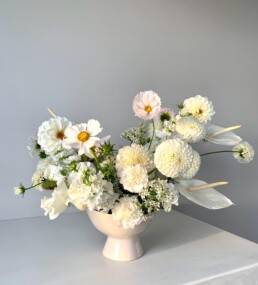
More than just Daisies - Vidette's Little Flower Shop
Did you know that we have a real life, actual floral boutique hiding in the nether streets of Cape St Francis? Having heard about the Little Flower Shop from its satisfied customers and been blown away (‘scuse the pun) by its stunning creations we decided to track down the owner, Vidette Jorge. She was only too happy to share her thoughts on blooms, business savvy and beautiful bouquets with Dune Daisies.
DD: Hi Vidette, it’s so lovely to have you with us, sitting in the Dune Daisies HQ today. How did the Little Flower Shop start, what was your motivation?
VIDETTE: Well, the Little Flower Shop launched a couple of years ago, on Spring Day (1st September 2021). It is a bespoke florist located in Cape St Francis that specialises in whimsical, sustainable creations for a range of events, weddings, celebrations, as well as private clients. The seed of the Little Flower Shop was planted whilst I was living in Ballito. There was this empty, dead space in our local mall which I thought would be the perfect place for a small flower shop. It would brighten up the area and offer beautiful, ecologically sustainable flowers to its customers.
However, real life took over this idea and the mall space remained empty. Then post Covid, I was chatting with a friend on how to do something more for myself and to explore hobbies that could become a profitable business. It had to be something creative. And my friend mentioned flowers, which reminded me of my ‘flower shop dream’ – and the flower idea took shape. The fully developed business as it is today took a lot of hard work, late nights and determination.

DD: Where do you get your flowers from?
VIDETTE: My flowers used to be sourced from the W Cape, but now, with a firm eye on carbon footprint and sustainability, I prefer to keep it local and seasonal. I do get the odd request for an event display that requires overseas sourcing, but local is definitely preferable. The Little Flower Shop offers unstructured styles of seasonal, local flowers – with the final bouquets mimicking the movement and diversity of wildflower groves. Dyed, artificial flowers are not that welcome in my shop.
DD: Who buys your creations?
VIDETTE: Lots of my clients are from overseas. They contact me to buy for local St Francis Bayers – for baby showers, work events, birthday and anniversary celebrations and of course weddings. My local client base is also growing every day.
DD: How can your clients make the most of your flowers?
VIDETTE: Flowers have different life expectancies depending on where they are grown, what their growing conditions were, how they were harvested and how well they are looked after. So I would say the life expectancy is anywhere from 4 days to 3 weeks. Dahlias last only 4-7 days.
I would keep your flowers in a cool, not too bright area, change their water every 2nd day to stop bacteria growing, have no leaves in the water and every time you change the water, cut off the bottom stems in an angle.
DD: What makes you want to spring out of bed in the morning and start flower arranging?
VIDETTE: My absolute best-thing is the deliveries! Watching people’s reactions is just amazing. It is the whole feeling that goes with someone receiving a bouquet of flowers – even if it is for a sad occasion. It is really such a boost for me. Some people hug me, some cry – it is the best part and totally makes my day.
DD: When do you have to breathe deeply and dig even deeply-er?
VIDETTE: The hardest part for me is people not being educated on flowers, and on how much they actually cost. People don’t realise the time and effort in creating the final product. It’s not mass produced; the growing, cutting, it is all hand done. Some bulbs planted into the ground now will only be ready in a year’s time! And when dealing with local suppliers, they put in such a lot of effort and it is really hard to decide what value to put on that. And of course the final cost is also dependent on what type of flower my clients choose. I offer luxurious and premium blooms, that are fragile and not hardy.

DD: What is the most important thing you have learnt since starting your business?
VIDETTE: One of the biggest take home messages I can share with you is the need to be flexible. The flower business is one beset by many environmental challenges, from rot to flooding, to drought and pests. Many hoops need to be jumped through before the flowers arrive at my workshop – I often have to work from plan ‘A’ right through to ‘F’! I have learnt not to promise too many specific flowers to my customers, to avoid disappointment.
These flowers don’t just grow, harvest, transport, wrap and deliver themselves.
DD: Any tips for those wishing to start their own small business?
VIDETTE: This journey has been a HUGE learning curve for me. I have had to learn more about business and self-development than the actual flowers. Mind-set is the key. You have to work on your mindset, believe in that you are doing, don’t worry about what everyone else is doing, don’t compete and really, just believe in yourself. That, and business skills. Network and take courses to learn as much as you can. I have also learnt such a lot from the wider, international, floral community and have met such cool people online, from places as far away as Australia and the USA.
It is important to remember that you are supplying not only product, but you are also providing a service to the community.

DD: Can you share your flower of the month?
VIDETTE: It is difficult as the seasons are changing and we are now moving into autumn. I would choose Scabiosa or cosmos – but they are also coming to the end of their season.
DD: If you could name your favourite flower and colour, what would they be?
VIDETTE: I have no favourite flower or colour! I definitely like more ‘airy’ flowers, peonies or speciality garden roses. If I had to choose a bouquet for myself, it would look like a wild field. Some flowers blowing in the wind, heavier ones down below – just how nature intended. I would love my perfect bouquet to showcase the whole life cycle of the flower – from it being in bud, to full bloom, and then also including the browner, drier elements. Bouquets should include flowers not only in their full bloom.
I love all the seasons of a flower.
DD: What should our readers consider when choosing a florist?

Find your Daisy:
- Cell: +27 (82) 695-4421
- Insta: the.little.flower.shop.za
- Email: hello@thelittleflowershop.co.za
- https://www.thelittleflowershop.co.za
“Happiness is to hold flowers in both hands”
Japanese proverb
Dig Deeper
- Tulips were once more valuable than gold! In 17th century Holland, a single bulb could cost $2000 – “Tulip Mania”
- Floriography is the use of flowers to communicate. This language of flowers dates thousands of year across diverse culture.
- Flowers have been part of wedding ceremonies dating back to Greek and Roman civilizations, but the bouquet toss originates from England in the 1800.
- The Rhizanthella orchid that grows in Australia blooms underground. It is pollinated not by bees, but by beetles.
- The white lotus is the only plant to fruit and flower simultaneously.
See Lucy’s Flowers & Sow Small Garden to dig even deeper


Know your Daisy
- Born in Joburg
- Moved to St Francis in 2015
- Has two children
- Owns a Basset Hound and a Green Cheek Conure
- Favourite places are the Cape St Francis beach and the Wildside
“To me, flowers are happiness.”
Stephano Gabbana
VIDETTE: Find someone you trust, who’s product you love. Remember that you are dealing with a creator; make sure you have seen their previous work. The vision you have in mind for your final product must align with that creation. So choose wisely.
DD: Lastly, what do you love about living and working in this area?
VIDETTE: It is a truly amazing community. I love that people stick together and help each other. Everyone is there for each other. You don’t get that in cities and bigger villages.


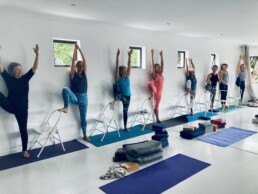
Blissful Daisies - Sharon and Iyengar Yoga
Not too long ago, I was looking for an original birthday present for a friend. Inspired by the impressive number of yoga teachers in our community and the whole peaceful, earthy vibe in St Francis, I bought a bunch of yoga classes for us to do together. Explaining that we were both beginners, I was directed towards Sharon van Niekerk’s classes as she describes the poses in detail and uses props to help coax your body into position. This sounded perfect as I doubted that I could even touch my toes at that point. I am not sure when it went from being painful to something I couldn’t do without, but Sharon’s class has been life-changing for me.
DD: Have you got any advice to anybody that would like to start yoga?
SHARON: Be consistent. If you’ve never done it before and you are not naturally a flexible person, it’s not going to be easy. It’s not a quick fix. The discipline is what comes.
Discipline your body, discipline your mind, and you will have the results that you are looking for.
My yoga teacher, David, used to joke and say that when new people want to come to class, he asks them to get down on the floor, and then get up. If you can’t get up off the floor, you should find a class that does chair yoga.
DD: Do you think your class would be suitable for a beginner?
SHARON: Yes, but only if you’re in good shape. Obviously, if you are somebody who has been sedentary for a long time, an older person, or are not naturally flexible, you will struggle.
DD: What motivates people to start doing yoga?
SHARON: Usually because they feel old age starting to creep up on them. Maybe they feel stiff and parts of their body are in pain; it is very rarely for spiritual reasons. However, people also want to start yoga because their mental state is a little bit out of whack, and they want to feel calm.

Iyengar Yoga with Sharon
Monday: 8.15-9.45 (186 St Francis Drive)
Wednesday: 8.15-9.45 (186 St Francis Drive)
Thursday: 8-9.30 (The Pound)
Saturday: 8.15-9.45 (The Dance Studio – Village)

DD: Why Iyengar Yoga and how is it different to other styles of yoga?
SHARON: When I started yoga in the 90’s in Cape Town, it wasn’t as big as it is now, but everybody raved about this guy, David Jacobs, and he was an Iyengar teacher. When I started with him, I realised that it was quite scientific and that appealed to me.
There has to be a reason and a benefit in doing something.
For example, why must I stand on my head? Because it is putting pressure on the crown of the head which creates activation of the pituitary and pineal gland, two important hormonal glands. Pineal is also connected to the third eye – there’s a lot of info one can go into. Generally, beginners aren’t really interested in all of that, but the more advanced you become, the more you understand.
From a physical perspective, why do you do head balance? Because turning upside down flushes fresh blood into all the organs, it works your shoulders, it works the spinal extension and gives you a good stretch. There are also spiritual and mental benefits. So, that’s what appeals to me about Iyengar.
DD: I read that he was very close to Yehudi Menuhin who said that Iyengar was his best violin teacher.
SHARON: Yes, he did yoga with Iyengar for many years and their association probably helped make Iyengar Yoga so popular in the West. Sivananda and Pattabhi Jois (Ashtanga) Yoga also had many followers. I like to call these yogis the Classicists.
Classical Yoga appeals to me because they have thousands of years of knowledge, they’ve got the text. Iyengar translated many books, wrote books himself and taught around the world. He was a seriously intelligent man. I watched a lot of his videos and there was something about him that really clicked with me. If you have the option, you should find a teacher that you click with because that will make you more consistent.
DD: And what about the props? Was that his idea too?
SHARON: Yes, that’s one of the things that makes Iyengar Yoga different. He was a very sickly child from a very poor background. He had tuberculosis and was a skinny little guy. On one of his school holidays he was sent to his sister who was married to Krishnamacharya who was the godfather of their lineage. He said, if you want to do yoga, just do it. So, he wasn’t given much instruction and just started. He soon realised how good it made him feel and as he improved, he was asked to demonstrate his skills. This was often before royalty or other dignitaries as a form of entertainment or spectacle to show what the incredible things his body could do. Eventually he started helping others get the poses. This made him think that there are others who might be weak or sick and suggested they use a wall or a block to make the posture easier.
Having said this, if you have a look at his book, Light on Yoga, you will see he didn’t use any props. I don’t force anyone who doesn’t need a prop to use one. Of course, everything is always changing and is not static. Over the years they found that if you do shoulder balance flat on the floor all the time, depending on the shape of your neck, you can hurt your neck. That’s why I insist on using props for this pose. Using props also involves humility, realising your own limitations and what your body is able to do and isn’t.

Facts about Sharon
Lives in Cape St Francis
Has two dogs
Owns a landscaping business
Studied Fine Art and Horticulture
Completed 3 years of Iyengar Teacher Training

DD: Do you have a favorite pose?
SHARON: Shoulder balance. It didn’t come easily to me when I started, but now it’s so valuable. When I had my cataract surgery and couldn’t do inversions for two weeks, I really felt the difference. It’s actually called Sarvangasana, meaning ‘all limbs’. When you are upside down your muscles are working against gravity, your organs are getting a rest, especially the heart. When you finish the inversion the organs get fresh blood. Also, the pressure of the chin into the thyroid gland stabilises your metabolism – these are some of the physiological benefits. From a mental point of view, it quietens your mind. It is given for respiratory problems, because when you are upside down the diaphragm has to push up against the gut and the intestines, so it tones the diaphragm and makes it strong. It also reaches different parts of your lungs when you are upside down. That’s why consistency is so important. At first it is hard and then with time it becomes easier. Then you start to see the other benefits.
DD: I like how you correct us in the classes. You are constantly manipulating our bodies to nudge them into the right position.
SHARON: That is called adjusting and another trait of Iyengar Yoga. There is always someone in the class doing this, not necessarily the teacher. One of the reasons I think Mr. Iyengar was such a guru was because when he adjusted someone in his class, you could see the whole body just fall into place. Almost like an electric shock. That was his gift – the ability to use the finest touch to put you in position and be sensitive.
DD: If you couldn’t do yoga, what else would you do?
SHARON: I would like to swim beautifully and do capoeira or parkour.


