
Everything we wish we had known before...hiking a multi-day trail
A common utterance over cups of morning coffee at Dune Daisies Headquarters is “we wish we’d known (…) before we (…).” Which is then followed either by inspired Google searches or cringeworthy laments. Surely, we can’t be the only ones who have wished for such things? When we started to note them down, the list was substantial, and we would love to share them with you.
This month, we’d like to start with unpacking (‘scuse the pun) “everything we wished we had known to pack before we went on our multi-day hike.”
Hiking as a form of exercise and adventure has become vastly popular. There are trails over mountain ranges, through forests and hugging rugged coastlines. In our neck of the woods, there are a variety of established trails, ranging from one hour to five days, 2kms to 90. However, your enjoyment of these hikes can be marred by your degree of preparedness.
It’s one thing to forget your water bottle when you take the dog for a half an hour amble down the road and quite another when you have 5 hours to get to your next pit stop with not a drop to drink. It could actually become a safety concern. Luckily, there are no excuses to be properly kitted out as the marketplace is literally flooded with every piece of equipment you could ever dream of taking with you (including things you didn’t!).
Congratulations, you have taken the plunge and booked your first ever multi-day hike! Once the payments, dates and hiking party have been finalised, your organisers will provide you with all sorts of information on your upcoming adventure; distance & average duration of each day’s walk, accommodation options, points of interest, transport details and … what to pack. This last item will depend on how long your trail is, but we (together with some of our trusty hiking buddies) have narrowed down a few must-haves to include. So that you don’t have to declare “I wish I’d known to pack that before I went on my hike”. Interested? Come and let’s pack your bag….
Hiking day pack
Depending on whether or not you are slackpacking or carrying all your gear, your requirements for a day pack will vary. If slackpacking (we love this option!), it’s important to have a good quality day pack that can fit the following: space for 3ls liquid; sarong (for drying off after swims & lying on when you take a much needed rest); buff (you can wet your buff beforehand and keep it in a ziplock bag for that extra coolness if hiking in hot weather); lunch pack and long sleeve top or lightweight jacket (for a range of weather). The day pack should have good back support and ideally have zips on the waist belt to pack your phone (for pics), sunscreen and easily accessible snacks.
Overnight bag/pack
Again, this depends on the requirements of your particular hike, but stick to the ‘less is more’ adage and you won’t go wrong. A small pillow and good quality sleeping bag (that’s not your auntie’s ‘70’s double duvet version) will reduce your packing size. And if you happen to be sharing a bunk room/tent, don’t forget the eye patches and ear plugs to ensure a good night’s rest!


Dig deeper: Hiking Routes
- Seal Point/Wild Side trails (www.kougatourism.com/walk-on-the-wild-side) / (https://foster.org.za/seal-point-2/)
- Chokka Trail (https://chokkatrail.co.za)
- Baviaans Camino (http://www.baviaanscamino.com)
- Leopard Trail (https://gobaviaans.co.za/project/leopard-trail-general-information/)
- Otter Trail (www.sanparks.org)
“ You’ll need special shoes for hiking – and a bit of a special soul as well.”
Terri Guillemets

Grab a bag
- Hiking shops: www.capeunionmart.co.za, www.takealot.com, www.naturehike.co.za
- Second hand gear: www.gumtree.co.za or visit your local seconds shop
- Borrow from a friend


Water bladder
These are very nifty water packs that you fill up, put in your day pack and allow you to suck water/liquid from an attachment that snakes over your shoulder. They come in different sizes from 500mls to 2ls. Benefits: you don’t have to hold up your walking crew while you stop, lug out your water bottle, drink, put it back in, ho-hum (you get the idea); when empty, the bladder becomes literally weightless; you can add ice if walking in hot temps or an isotonic drink if you need extra hydration. Drawbacks: they can leak! Ensure that your water bladder is intact and sealable before your hike, otherwise you’ll end up with a soggy bottom (trust me, we have been there!).
Micropore / Vaseline / Zambuck / Vicks
You will thank us when you include these to carry in your day pack. Tape micropore over any ‘hot spot’ that you may feel will erupt into a blister and sabotage your walking enjoyment for the day. Those who wish to err on the side of caution can tape each toe in the morning before the day’s hike (just make sure there is no dirt to cause friction). To eliminate any potential abrasion, you can always liberally apply Vaseline or Zambuck in between your toes and all over your feet – the theory is that any small particles of sand/dirt will be unable to find purchase on your skin and cause blisters. Zambuck is a fabulous all-rounder for stings, blisters & moisturising lip balm, plus the packaging is iconic. An evening rub with Vicks can help soothe even the sorest of feet. While we are on the topic of feet, a great tip we received is to take your shoes and socks off when you stop to rest – let those hard-working feet take a breather while you do.
Tyre & transport savvy
There’s a good chance the start of your trail is found at the end of a long dirt road. And so remember to pack your common sense and reduce your car’s tyre pressure. Softer tyres are less likely to puncture. Make sure you have directions to your destination on hand. Cell reception is patchy in the wilderness and GPS is not helpful, so clear, concise directions are a must-have.
Energy
We’re talking battery power here, not muscle power; for cameras, rechargeable headlight batteries, cell phones, etc. A power bank is super useful even if your accommodation claims to have solar. Infrastructure can fail in the wild, and it’s good to be self-sufficient where energy is concerned.
Hiking sticks
Hold on, hiking sticks? Believe us. Beg, borrow or buy a pair, and you will not be sorry. Your hiking sticks will become your favourite accessory. They will help you scramble up that rocky incline, stop you from wobbling off that ledge and give you a much needed support to lean on when your breath leaves you. Another plus is that even though they come in pairs, you can use just the one and lend its pair to your walking buddy.

Snacks & lunches on the go
Everyone loves a snack and as your body exerts itself up those mountains, it will thank you for the added nutrition and energy. There are many online sites to browse for self-prepared trail mix inspiration (www.thepioneerwoman.com) and delicious salad options (or you can try out our cabbage salad recipe).
Earth friendly toiletries
Remember to pack biodegradable nappy bags for when you need to ‘go’ en route. Even if you dig a hole, do NOT leave dirty loo paper lying around. It’s a big no-no. Shampoo bars and environmentally friendly soaps are also a must-have to pack. Many rest camps have showers that drain straight into the earth. There’s no room for chemicals in the wilderness.
Dry Bag
These are worthwhile accessories ranging in size from 5-50l. Perfect for the times when it’s poring with rain or you are fording ice cold rivers and have items that need to stay dry. Bring a dry bag to your hike and know you’ll be helping out your hiking partners.
Ice
It’s one thing to have tepid water to drink while you are hiking and quite another to have warm beers waiting for you at your destination. Plan ahead (as far as possible) and make sure someone has thought about your post-hike beverages.
Meditative moments
Sociable animals that we are, it’s natural that we have heaps to share and discuss with our hiking buddies. But make it a ‘thing’ that you start each morning’s hike with a 1/2hr-1hr silent spell. No talking, no chit chat. Just silence. The effect on the group dynamic will be profound and you will all benefit from the inner reflection whilst immersing yourself in the wilds.
And finally, a Dune Daisies must-have: don’t forget to pack your sense of humour …
Let us know what else you think us daisies should pack next time we hit the hills!
Cabbage salad
1/4 cabbage or biggish baby cabbage
1 each of the following – red onion, beetroot, large carrot, tart green apple
a root of ginger
a handful of raisins
a handful of mixed seeds, eg pumpkin, sunflower, chia seeds, cashews
a block of mature cheddar (chopped into small squares) or 1 tuna sachet (can omit for vegetarians).
Olive oil & salt to taste.
Chop finely, mix and divide amongst your hiking pals.



Words of wisdom from my favourite daisy - my mother
Have you ever said something very earnestly to your child and then suddenly been struck by how much you sound like your mother? I have. More and more, it seems. Just as well I don’t mind sounding like my mom, in fact it’s something I aspire to do.
My mom has always had sage advice that never fails to calm and soothe. Over the years, I have heard the same few lines countless times and can almost predict when they will surface, yet they are still as effective and impactful as ever. This Mother’s Day, I would like to pay tribute to my beautiful mom and share with you some of the things she has always told me. These lines are not anything new and she recently told me that they are also things her mother used to tell her. Nevertheless, they are meaningful to me and have given me strength and perspective over the years – perhaps they will be helpful to you too.

The first strangely comforting line has echoed in my head throughout my life, particularly in my younger years. I was at the stage where I was throwing myself into life, somewhat recklessly, and learning some hard lessons along the way. When things weren’t going well, my first instinct was to call my mom (in those days from a call box on the side of the road). Often, just hearing her voice on the other end of the phone was enough to open the water gates and all that I had so carefully tried to put a lid on came streaming out in a nonsensical rush of emotion. Mom knew that nothing much could change the situation. She couldn’t take away my fears or disappointment, no matter how much she would like to. She would listen supportively, letting me dump all my woes on her through the phone line. Then she would say with a big sigh,
“Don’t worry, my love, as Moses said – this too shall pass.”
Admittedly, back then I found this mildly annoying. Surely she must have some other ideas to guide me through my trauma? Quoting Moses seemed a bit like a cop out. But, as the years passed, I discovered that maybe Moses did have some wisdom to impart. Time does have a way of healing and realising that nothing is forever can be oddly reassuring.
(Disclaimer: I have since found out that that isn’t really what Moses said and it is often used out of context. Nevertheless, the message is good, and I have become quite attached to Moses through it all.)

The next one is a classic. Particularly useful when talking to an emotional and often overly dramatic person, having moments of serious doubt.
“Ma, I am sure it won’t work out, maybe I should just quit now” or “there’s no way I’m going to make it.”
I had the silly habit of trying to talk myself out of situations, preparing myself for the worst. Some might even call it self-sabotage. My sweet mother would listen attentively and then gently say,
“Remember, don’t fall until you are pushed.”
Although I had heard this phrase often enough, the gentle reminder never failed to give me that little bit of extra courage.
Spoil your Daisy
- Plant tulips or bulbs for her to enjoy later.
- Write your mom a poem.
- Make her a card telling her much she means to you.
- Plant her favourite herbs in a pot.
- Take her to the beach for supper (pick up her favourite take aways first).
- Make a photo book of all your favourite memories with her.
- Take her for a coffee and be sure to tell her how much she means to you.
- Buy her a voucher for a spa treatment – there are so many spas in town (good one for moms and sons to do)
- Treat her to some yoga classes – go with her!
- Pack tea and biscuits and take her for a picnic in a beautiful garden (the Community Garden is beautiful)

The tween years can be particularly hard when it comes to friendships. One moment you are best buddies and the next, you have found that your supposed bestie has been whispering spiteful things behind your back which a well-meaning friend has decided to share with you. Of course, this is all very upsetting, but when you are a twelve-year-old girl, this feels like the end of the world. You feel physically sick, you cry and literally take to your bed. My mom, a life-long advocate of taking the upper hand and holding your head up high, even when times are tough, used to say,
“Let it be like water off a duck’s back – their words cannot hurt you, only if you let them.”
It’s actually quite sound advice, even though it wasn’t often that well-received. Finding the inner fortitude to hold your head up high and pretend something doesn’t bother you, when all you want to do is cry and gouge someone’s eyes out, is really quite a challenge. Nevertheless, my mom continued to challenge me to embrace my inner duckiness.
For most of my adult life, I lived in foreign countries. I left South Africa at the age of 21 and only returned a few years ago. In every place I lived there were many wonderful things to enjoy and there was always a solid reason for me to live in that particular place – studies, work or family. Yet, I think deep down I always missed my country and had this constant unsettled feeling.

I was searching for the perfect place to live, obviously still not accepting that all I really wanted was to be around the people I love most. I must have said, ‘I like it here but…’at least a thousand times. After listening to this for many years, my mom (probably in exasperation) told me:


This often segued into her next favourite saying,
“Just be happy. It’s a choice.”
I never fully grasped this one until later in life. My mom and stepdad really live this one out in their daily lives. I have often found them sitting next to each other on the couch just having a chuckle at themselves. They make the best of everything. They even try and see the upside of loadshedding – an excuse to make hot chocolate on the gas burner! My mom loves nothing better than to sit in a sunny spot and watch the birds dart in and out of her garden. She giggles as she regals stories of how there is one little bird who must be a little ‘slow’ because the other birds come and take care of him. She watches with amazement as the other birds flutter around and bring him titbits to eat every now and then. Her eyes sparkle with delight and I realise that this is what happiness is – this is the big prize. To be deeply content sitting in a ray of sunshine observing all the small miracles.
Mom’s last tidbit is a more recent one. After a difficult period of my life, I was not feeling strong emotionally. My general feeling was of numbness. Every day had its challenges and the sadness of the years before had taken its toll on my spirit. Desperate to find joy again, I looked for it everywhere else except within myself. I threw myself into situations without too much thought, thoroughly convinced that this must be what I needed. I was so happy to be distracted from my grief and be able to fill the hole with something else. I went all in! Of course, the joy was short-lived and when the situation imploded, I was distraught and probably in a worse position than when I started. One afternoon, in the sunny spot on mom’s porch, she said this,
“Make sure that you are singing your song, not someone else’s.”
She had read a story about an African tribe that had a beautiful tradition. A pregnant mother will gather with some close friends and go into the wilderness to pray and meditate until they hear the baby’s unique song. They practice the song and go back to the village and teach it to the rest of the community. When the baby is born, the song gets sung to the child as they gather to celebrate the birth. Throughout their life, the song is sung at pivotal points. It is sung at their initiation when they pass from childhood to adulthood, at their marriage and then finally to say goodbye when they are close to dying. The only other time the villagers sing the song during a person’s life is if they commit a crime or socially deviant act. Then the villagers circle around the person and sing their song to them, reminding them of the music within them and their true nature. My mom said that there are times in our lives when someone may want you to sing their song rather than yours. By doing this you become resentful and lose your own voice. Harmonize and support someone else, but not at the expense of your own happiness.

I feel constant gratitude for all my mother has taught me in life. She is unfailingly kind, gentle and thoughtful. She can be ditzy and witty all at the same time and is smart and strong. She raised four young children on her own after my father passed away and never complained. My mom exemplifies aging gracefully and with humour. People say that girls often end up like their mothers. If I can be anything like my mother, I would consider my life a success.
PS In many homes there is only one parent, one parent fulfilling the role of both mother and father. One parent doing their best, but always wondering if they are doing enough to compensate for the missing parent. I always panic before special days like Father’s Day, knowing that instead of being a celebration, it can actually be quite a difficult and sad day, a glaring reminder of empty shoes. Knowing that Mother’s Day is probably like this for many other families, I considered axing the idea of Mother’s Day. Then, my brother reminded me of what an amazing mother we have and that she was worth celebrating.
Dune Daisy Shortbread
My mom makes the best shortbread ever. Make some for someone you love. Wrap it in a beautiful piece of fabric, grab a flask of tea and find a sunny spot to watch the birds!

Whoops-a-daisies - The ugly side of our other 'national flower'

At Dune Daisies, we like nothing better than to walk our dogs on the beach, make the most of the beautiful surroundings and meet our daily fitness goals. We check out the marine life, fill our lungs with ozone and let the sand tickle in-between our toes. It’s all very wonderful – until the soft sand underfoot is replaced by discarded sweet wrappers, cigarette butts, washed up soft drink cans and dumped refuse.
Our ‘whoops-a-daisies’ for this month (and not such a funny one at that) is marine litter.
Millions of tons of plastic and marine waste wash up on the world’s beaches every year (SST). We have all watched appalled at clips of people around the globe wading through literal ‘seas’ of waste. The ocean, beaches, intertidal zones, rivers, estuaries and all that live and depend on them are literally choking on a never-ending deluge of plastic and rubbish. And unfortunately, it is now happening on our doorsteps.
“The greatest threat to our planet is that someone else will save it”
Robert Swan

Here at home, it is estimated that up to a ¼ million tons of rubbish enters South Africa’s oceans as marine litter every year. We are ranked as one of the top marine polluters in the world (UNEP)! Not something to be proud of.Here’s some sobering facts:
- South Africans generate up to 1000 tons of plastic waste each day (SST)
- 80% of marine litter originates on land (UNEP)
- Over half of plastic marine litter is from ‘on-the-go’ food packaging (eg food wrappers) (Ocean Pledge)
- The amount of plastic waste entering the world’s oceans are exponentially growing each year (with an estimated 250 million tons by 2025) (Ocean Pledge)
What can we do in the face of this depressingly enormous problem? First of all – don’t panic! There are LOTS of ways that you, as the individual Dune Daisy reader can make a difference.
Lobby at a provincial/country/global scale
- Take a look at UNEP’s Regional Seas Programme www.unep.org for info on SA’s Sustainable Development Goals and Sea Shepherd www.seashepherd.org, WESSA www.wessa.org.za WWW South Africa www.wwf.org.za and the Sustainable Seas Trust www.sst.org.za for multiple ways to become involved.


Organise a beach clean-up in your area
- There are lots of organised coastal clean-ups, check facebook & Instagram for one near you. The Kromme Trust here in St Francis Bay organises clean-ups www.stfranciskrommetrust.co.za as do the local surf clubs (Slipway Surf Club and Seal Point Boardriders Club). Or else, grab some friends and family members, a few bags and tongs and go pick up.
Sign your own ocean pledge
- Check out www.oceanpledge.org for some life changing, inspiring ways to make a difference.

“The trash and litter of nature disappears into the ground with the passing of each year, but man’s litter has more permanence”
John Steinbeck

Download the Marine Debris Checker
- Part of the Beach Co-op www.thebeachcoop.org, this nifty app allows you to record your beach clean-up activities and contribute towards larger scale research – pretty cool, hey?
Take the Zero to Ocean Hero Challenge
- WWW South Africa has a 5 week challenge you can sign up for – we have, do you have what it takes? www.explore.panda.org
Make July Plastic Free
- Become part of a global movement to reduce plastic use and take the ‘Plastic Free July’ challenge. This website is jam packed full of info and will show you many ways to reduce your plastic usage. www.plasticfreejuly.org

Walking amongst the Daisies - The healing power of nature
Have you ever returned home after a walk on the beach feeling revitalised and bursting full of good cheer? And have you ever watched your kids (or fur babies) sleep ever so soundly after a good run in the park? Yes?
Well, did you realise that you were not simply taking the dog out for a walk or getting fit? You were also visiting mother nature’s medicine chest. One that offers a cornucopia of treatments for not only physical ailments, but anxiety, depression, learning disorders, fatigue … the list goes on.
We are all too aware of the widespread soul ‘sore-ness’ of ourselves, our friends and our communities. Often, a visit to the doctor is the first port of call. Medication, together with (hopefully) some kind of therapy is prescribed. Sometimes this works, most often not.
But how cool is this – doctors around the world have woken up to the fact that pharmaceutically based medication may not always be the answer (or the only one). Those in the know are actually prescribing time in nature as the medicine. Instead of taking the latest antidepressant, a daily walk into the forest or hiking on a nature trail is written on the doctor’s note. Patients in Canada, New Zealand, the UK and Japan have all enjoyed such ‘green prescriptions’. And the benefits of spending more time in nature are astounding, especially for kids.
It’s something that we have always intuitively known, but lost as society has further dissociated from nature. Well, Mother Nature is calling us back – and it’s time to heed her call.


The next time you are feeling tired and a bit cranky (and let’s face it, it happens to the best of us), grab your child, your dog, your bestie or even just your water bottle, and head outside. To the water’s edge, the sandy dune, the fynbos trail or even just to go stand under that gorgeous milk wood tree over there.
And take a moment. And another. And just breathe. And just listen. And just be.
I can guarantee that when you walk back inside your front door that you’ll feel better equipped to deal with what was next on your to-do list.
We really should update ‘mother knows best’ (personally I’m a fake it ‘till I make it kind of mum) to ‘Mother Nature knows best’. Because she really does.


“Nature itself is the best physician”
Hippocrates
Dune Reading

Hardman, Isabel (2020), The Natural Health Service, Atlantic Books, London, UK ISBN978-1786495907
Dig Deeper
Wild Green Sally (Nature writer and conservationist)
“You should sit in nature for 20 minutes a day … unless you’re busy, then you should sit for an hour.”
Zen saying
Animal assisted: petting farms / building relationships with dogs and horses
Arts & crafts: creativity outdoors (in a park/forest) for inspiration or using natural materials such as clay, grass in an outdoor setting
Conservation: pairing of protecting spaces in nature with physical exercise
Dark nature: stargazing at night
Green exercise: running/bike riding in nature
Therapeutic horticulture: growing food in community gardens
Wilderness therapy: group hiking, making shelters

Lighting the Daisies - The Seal Point Lighthouse
Surrounded by gentle trails, idyllic rock pools and vibrant reefs, the Seal Point Lighthouse is irrefutably the most elegant and gracious lady in our community (and believe me, the competition is stiff). She maintains her perfect posture even with waves crashing at her feet and wind whipping her form. With her generous warm glow, it’s hard to imagine that at one point she was said to be loneliest lighthouse in South Africa.
Her story began in 1875. After nearly two centuries of shipwrecks, it was time to cast a little light on the situation. Cape St Francis is situated on the most south-eastern point of the South African coastline. It is the point where skippers need to alter their course if navigating around the country. Many ships take a shortcut and come close to land. Sadly, many come a little too close and came a cropper.
The designer of the Bird Island Lighthouse, Mr. J. Flack, and the lighthouse builder, Mr. B. Godfrey, were appointed to build a lighthouse at Seal Point and made the arduous trip by ox-wagon from Port Elizabeth taking a week to get here. Construction began on the structure using local rock and sand (some say you can still see where they removed blocks from the surrounding outcrops). They laboured at it for a couple of years until it was finally complete in 1878. Sadly, Mr. Flack died of typhus a year into the project and never got to see his lady all aglow.

At first there was nothing else in the area, only the lighthouse. The lighthouse keepers were supplied with provisions by local farmers, but lived a relatively solitary existence. Gradually, people began to explore the area and a few even decided to build holiday homes. Who would have thought it would become the thriving community it is now?
The Seal Point Lighthouse has now become a hub of activity thanks to a group of local entrepreneurs. The bottom floor of the lighthouse consists of two wings, each housing elegant and luxurious accommodation. The central portion of the lighthouse displays pictures of the old lighthouse keepers and the far end is used as a pop-up shop during the season.
Buy a ticket at the amazing Nevermind kiosk next door to climb up to the top of the lighthouse. Unless the weather is shoddy, it’s open daily from 10am to 3.30pm. As the stairs are rather narrow, only a limited number of people can go up at the same time, so be sure to check out how many people are before you. I went up with my 8 year old daughter and, although she really enjoyed the experience, was a little scared going up and down the last few flights of stairs which are very narrow and steep. Of course, the thrill of being at the top and the magnificent view wiped out her fear.
There is a small, old building next the lighthouse that is under conservation protection, but am sure will be renovated into something fabulous soon. We’ll keep you posted!

PS There are three buildings next to the lighthouse. Formerly a penguin rehabilitation centre run by SANCCOB, the closest one to the lighthouse is the fabulous Nevermind restaurant. Nevermind never disappoints and appeals to all – from the tiny tots to the connoisseurs. The furtherest building from the lighthouse is called Salt. Salt has a yoga studio used by local instructors and smaller private therapy rooms. Doing yoga with a view of the the Cape St Francis Beach is indeed a special experience.
Dig Deeper
- It took 839 days to build.
- At 27.75m, our lighthouse is one of the highest stone masonry structures in South Africa.
- She was illuminated for the first time on 4 July 1878.
- The strength of the illumination is measured in candlepower – initially it burnt 15 000 candles visible for 28 nautical miles. By 1931, the candlepower had increased to 2750 000 (still only visible for 28 nautical miles)
- Currently, the light is automated and monitored in Port Elizabeth.
- The fog horn tends to sound after load-shedding.
- All it’s 154 steps are encased in the lighthouse, only the last couple of flights are more like step ladders.

Whoops a Daisies
Sadly, this stretch of coast has seen many shipwrecks. Apparently, if you factor in all the shipwrecks known and divide it by the length of the coastline, there would be a wreck every kilometre. We pay tribute to the lives lost at sea, by naming the streets of Cape St Francis after various shipwrecks. If you would like to see a few pictures of the ships that came a cropper, visit Jill’s Groovy Scoops, grab a scoop of deliciousness and check out the mini-museum in the shop.

Dune Reading
The Seal Point Lighthouse Official Website : Find all the details about accommodation, Nevermind, tower tours and much more here.
The Heritage Portal: A more comprehensive history of the lighthouse.
The Lighthouse’s Facebook page: News about all the happenings at the lighthouse and in it’s surrounding cottages.
The St Francis Kromme Trust: Shipwrecks: This website has an amazing amount of information about the local area, including some fascinating stories about some of the shipwrecks.
Surfline: The real story of Cape St Francis: Craig Jarvis writes a wonderful story about the how things evolved in Cape St Francis.
Simpson, RN, The Monument Around Us, 2006: NL Hulett: An essential read about the story of the Hulett family and St Francis.
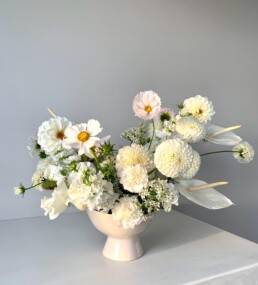
More than just Daisies - Vidette's Little Flower Shop
Did you know that we have a real life, actual floral boutique hiding in the nether streets of Cape St Francis? Having heard about the Little Flower Shop from its satisfied customers and been blown away (‘scuse the pun) by its stunning creations we decided to track down the owner, Vidette Jorge. She was only too happy to share her thoughts on blooms, business savvy and beautiful bouquets with Dune Daisies.
DD: Hi Vidette, it’s so lovely to have you with us, sitting in the Dune Daisies HQ today. How did the Little Flower Shop start, what was your motivation?
VIDETTE: Well, the Little Flower Shop launched a couple of years ago, on Spring Day (1st September 2021). It is a bespoke florist located in Cape St Francis that specialises in whimsical, sustainable creations for a range of events, weddings, celebrations, as well as private clients. The seed of the Little Flower Shop was planted whilst I was living in Ballito. There was this empty, dead space in our local mall which I thought would be the perfect place for a small flower shop. It would brighten up the area and offer beautiful, ecologically sustainable flowers to its customers.
However, real life took over this idea and the mall space remained empty. Then post Covid, I was chatting with a friend on how to do something more for myself and to explore hobbies that could become a profitable business. It had to be something creative. And my friend mentioned flowers, which reminded me of my ‘flower shop dream’ – and the flower idea took shape. The fully developed business as it is today took a lot of hard work, late nights and determination.

DD: Where do you get your flowers from?
VIDETTE: My flowers used to be sourced from the W Cape, but now, with a firm eye on carbon footprint and sustainability, I prefer to keep it local and seasonal. I do get the odd request for an event display that requires overseas sourcing, but local is definitely preferable. The Little Flower Shop offers unstructured styles of seasonal, local flowers – with the final bouquets mimicking the movement and diversity of wildflower groves. Dyed, artificial flowers are not that welcome in my shop.
DD: Who buys your creations?
VIDETTE: Lots of my clients are from overseas. They contact me to buy for local St Francis Bayers – for baby showers, work events, birthday and anniversary celebrations and of course weddings. My local client base is also growing every day.
DD: How can your clients make the most of your flowers?
VIDETTE: Flowers have different life expectancies depending on where they are grown, what their growing conditions were, how they were harvested and how well they are looked after. So I would say the life expectancy is anywhere from 4 days to 3 weeks. Dahlias last only 4-7 days.
I would keep your flowers in a cool, not too bright area, change their water every 2nd day to stop bacteria growing, have no leaves in the water and every time you change the water, cut off the bottom stems in an angle.
DD: What makes you want to spring out of bed in the morning and start flower arranging?
VIDETTE: My absolute best-thing is the deliveries! Watching people’s reactions is just amazing. It is the whole feeling that goes with someone receiving a bouquet of flowers – even if it is for a sad occasion. It is really such a boost for me. Some people hug me, some cry – it is the best part and totally makes my day.
DD: When do you have to breathe deeply and dig even deeply-er?
VIDETTE: The hardest part for me is people not being educated on flowers, and on how much they actually cost. People don’t realise the time and effort in creating the final product. It’s not mass produced; the growing, cutting, it is all hand done. Some bulbs planted into the ground now will only be ready in a year’s time! And when dealing with local suppliers, they put in such a lot of effort and it is really hard to decide what value to put on that. And of course the final cost is also dependent on what type of flower my clients choose. I offer luxurious and premium blooms, that are fragile and not hardy.

DD: What is the most important thing you have learnt since starting your business?
VIDETTE: One of the biggest take home messages I can share with you is the need to be flexible. The flower business is one beset by many environmental challenges, from rot to flooding, to drought and pests. Many hoops need to be jumped through before the flowers arrive at my workshop – I often have to work from plan ‘A’ right through to ‘F’! I have learnt not to promise too many specific flowers to my customers, to avoid disappointment.
These flowers don’t just grow, harvest, transport, wrap and deliver themselves.
DD: Any tips for those wishing to start their own small business?
VIDETTE: This journey has been a HUGE learning curve for me. I have had to learn more about business and self-development than the actual flowers. Mind-set is the key. You have to work on your mindset, believe in that you are doing, don’t worry about what everyone else is doing, don’t compete and really, just believe in yourself. That, and business skills. Network and take courses to learn as much as you can. I have also learnt such a lot from the wider, international, floral community and have met such cool people online, from places as far away as Australia and the USA.
It is important to remember that you are supplying not only product, but you are also providing a service to the community.

DD: Can you share your flower of the month?
VIDETTE: It is difficult as the seasons are changing and we are now moving into autumn. I would choose Scabiosa or cosmos – but they are also coming to the end of their season.
DD: If you could name your favourite flower and colour, what would they be?
VIDETTE: I have no favourite flower or colour! I definitely like more ‘airy’ flowers, peonies or speciality garden roses. If I had to choose a bouquet for myself, it would look like a wild field. Some flowers blowing in the wind, heavier ones down below – just how nature intended. I would love my perfect bouquet to showcase the whole life cycle of the flower – from it being in bud, to full bloom, and then also including the browner, drier elements. Bouquets should include flowers not only in their full bloom.
I love all the seasons of a flower.
DD: What should our readers consider when choosing a florist?

Find your Daisy:
- Cell: +27 (82) 695-4421
- Insta: the.little.flower.shop.za
- Email: hello@thelittleflowershop.co.za
- https://www.thelittleflowershop.co.za
“Happiness is to hold flowers in both hands”
Japanese proverb
Dig Deeper
- Tulips were once more valuable than gold! In 17th century Holland, a single bulb could cost $2000 – “Tulip Mania”
- Floriography is the use of flowers to communicate. This language of flowers dates thousands of year across diverse culture.
- Flowers have been part of wedding ceremonies dating back to Greek and Roman civilizations, but the bouquet toss originates from England in the 1800.
- The Rhizanthella orchid that grows in Australia blooms underground. It is pollinated not by bees, but by beetles.
- The white lotus is the only plant to fruit and flower simultaneously.
See Lucy’s Flowers & Sow Small Garden to dig even deeper


Know your Daisy
- Born in Joburg
- Moved to St Francis in 2015
- Has two children
- Owns a Basset Hound and a Green Cheek Conure
- Favourite places are the Cape St Francis beach and the Wildside
“To me, flowers are happiness.”
Stephano Gabbana
VIDETTE: Find someone you trust, who’s product you love. Remember that you are dealing with a creator; make sure you have seen their previous work. The vision you have in mind for your final product must align with that creation. So choose wisely.
DD: Lastly, what do you love about living and working in this area?
VIDETTE: It is a truly amazing community. I love that people stick together and help each other. Everyone is there for each other. You don’t get that in cities and bigger villages.


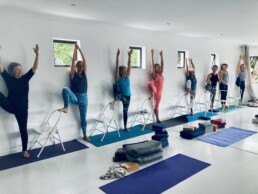
Blissful Daisies - Sharon and Iyengar Yoga
Not too long ago, I was looking for an original birthday present for a friend. Inspired by the impressive number of yoga teachers in our community and the whole peaceful, earthy vibe in St Francis, I bought a bunch of yoga classes for us to do together. Explaining that we were both beginners, I was directed towards Sharon van Niekerk’s classes as she describes the poses in detail and uses props to help coax your body into position. This sounded perfect as I doubted that I could even touch my toes at that point. I am not sure when it went from being painful to something I couldn’t do without, but Sharon’s class has been life-changing for me.
DD: Have you got any advice to anybody that would like to start yoga?
SHARON: Be consistent. If you’ve never done it before and you are not naturally a flexible person, it’s not going to be easy. It’s not a quick fix. The discipline is what comes.
Discipline your body, discipline your mind, and you will have the results that you are looking for.
My yoga teacher, David, used to joke and say that when new people want to come to class, he asks them to get down on the floor, and then get up. If you can’t get up off the floor, you should find a class that does chair yoga.
DD: Do you think your class would be suitable for a beginner?
SHARON: Yes, but only if you’re in good shape. Obviously, if you are somebody who has been sedentary for a long time, an older person, or are not naturally flexible, you will struggle.
DD: What motivates people to start doing yoga?
SHARON: Usually because they feel old age starting to creep up on them. Maybe they feel stiff and parts of their body are in pain; it is very rarely for spiritual reasons. However, people also want to start yoga because their mental state is a little bit out of whack, and they want to feel calm.

Iyengar Yoga with Sharon
Monday: 8.15-9.45 (186 St Francis Drive)
Wednesday: 8.15-9.45 (186 St Francis Drive)
Thursday: 8-9.30 (The Pound)
Saturday: 8.15-9.45 (The Dance Studio – Village)

DD: Why Iyengar Yoga and how is it different to other styles of yoga?
SHARON: When I started yoga in the 90’s in Cape Town, it wasn’t as big as it is now, but everybody raved about this guy, David Jacobs, and he was an Iyengar teacher. When I started with him, I realised that it was quite scientific and that appealed to me.
There has to be a reason and a benefit in doing something.
For example, why must I stand on my head? Because it is putting pressure on the crown of the head which creates activation of the pituitary and pineal gland, two important hormonal glands. Pineal is also connected to the third eye – there’s a lot of info one can go into. Generally, beginners aren’t really interested in all of that, but the more advanced you become, the more you understand.
From a physical perspective, why do you do head balance? Because turning upside down flushes fresh blood into all the organs, it works your shoulders, it works the spinal extension and gives you a good stretch. There are also spiritual and mental benefits. So, that’s what appeals to me about Iyengar.
DD: I read that he was very close to Yehudi Menuhin who said that Iyengar was his best violin teacher.
SHARON: Yes, he did yoga with Iyengar for many years and their association probably helped make Iyengar Yoga so popular in the West. Sivananda and Pattabhi Jois (Ashtanga) Yoga also had many followers. I like to call these yogis the Classicists.
Classical Yoga appeals to me because they have thousands of years of knowledge, they’ve got the text. Iyengar translated many books, wrote books himself and taught around the world. He was a seriously intelligent man. I watched a lot of his videos and there was something about him that really clicked with me. If you have the option, you should find a teacher that you click with because that will make you more consistent.
DD: And what about the props? Was that his idea too?
SHARON: Yes, that’s one of the things that makes Iyengar Yoga different. He was a very sickly child from a very poor background. He had tuberculosis and was a skinny little guy. On one of his school holidays he was sent to his sister who was married to Krishnamacharya who was the godfather of their lineage. He said, if you want to do yoga, just do it. So, he wasn’t given much instruction and just started. He soon realised how good it made him feel and as he improved, he was asked to demonstrate his skills. This was often before royalty or other dignitaries as a form of entertainment or spectacle to show what the incredible things his body could do. Eventually he started helping others get the poses. This made him think that there are others who might be weak or sick and suggested they use a wall or a block to make the posture easier.
Having said this, if you have a look at his book, Light on Yoga, you will see he didn’t use any props. I don’t force anyone who doesn’t need a prop to use one. Of course, everything is always changing and is not static. Over the years they found that if you do shoulder balance flat on the floor all the time, depending on the shape of your neck, you can hurt your neck. That’s why I insist on using props for this pose. Using props also involves humility, realising your own limitations and what your body is able to do and isn’t.

Facts about Sharon
Lives in Cape St Francis
Has two dogs
Owns a landscaping business
Studied Fine Art and Horticulture
Completed 3 years of Iyengar Teacher Training

DD: Do you have a favorite pose?
SHARON: Shoulder balance. It didn’t come easily to me when I started, but now it’s so valuable. When I had my cataract surgery and couldn’t do inversions for two weeks, I really felt the difference. It’s actually called Sarvangasana, meaning ‘all limbs’. When you are upside down your muscles are working against gravity, your organs are getting a rest, especially the heart. When you finish the inversion the organs get fresh blood. Also, the pressure of the chin into the thyroid gland stabilises your metabolism – these are some of the physiological benefits. From a mental point of view, it quietens your mind. It is given for respiratory problems, because when you are upside down the diaphragm has to push up against the gut and the intestines, so it tones the diaphragm and makes it strong. It also reaches different parts of your lungs when you are upside down. That’s why consistency is so important. At first it is hard and then with time it becomes easier. Then you start to see the other benefits.
DD: I like how you correct us in the classes. You are constantly manipulating our bodies to nudge them into the right position.
SHARON: That is called adjusting and another trait of Iyengar Yoga. There is always someone in the class doing this, not necessarily the teacher. One of the reasons I think Mr. Iyengar was such a guru was because when he adjusted someone in his class, you could see the whole body just fall into place. Almost like an electric shock. That was his gift – the ability to use the finest touch to put you in position and be sensitive.
DD: If you couldn’t do yoga, what else would you do?
SHARON: I would like to swim beautifully and do capoeira or parkour.


